
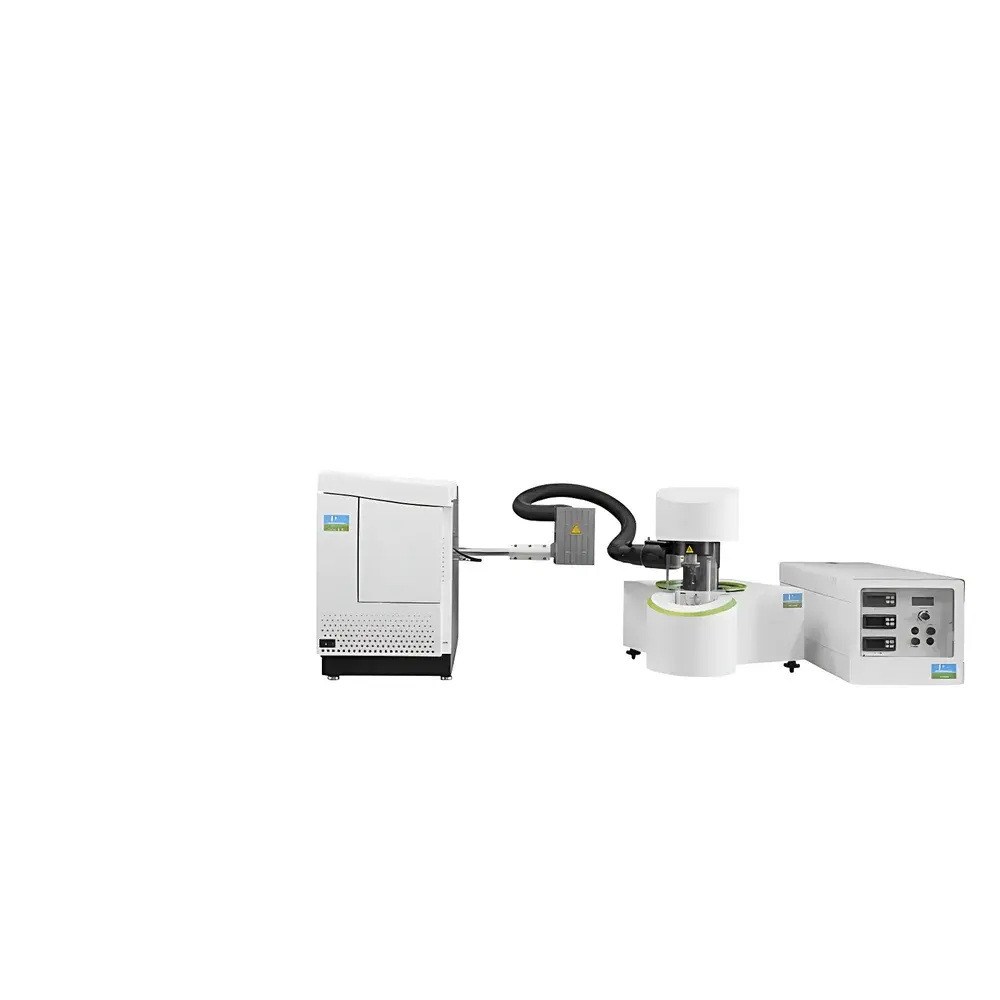
PerkinElmer Pyris 1 TG-MS Coupled Thermal Analysis System
| Brand | PerkinElmer |
|---|---|
| Origin | USA |
| Manufacturer Type | Original Equipment Manufacturer (OEM) |
| Import Status | Imported |
| Model | TG-MS |
| Pricing | Upon Request |
Overview
The PerkinElmer Pyris 1 TG-MS Coupled Thermal Analysis System integrates a high-performance thermogravimetric analyzer (TGA) with a Clarus-series quadrupole mass spectrometer (MS) via a heated capillary transfer line. This hyphenated technique enables real-time, evolved gas analysis (EGA) during thermal decomposition, oxidation, desorption, or pyrolysis processes. Based on the fundamental principle of simultaneous mass loss measurement (via microbalance) and molecular weight–specific detection of gaseous effluents (via electron ionization or chemical ionization), the system delivers unambiguous identification and semi-quantitative tracking of volatile species—down to sub-ppm levels—evolved as a function of temperature or time. Unlike standalone TGA or MS instruments, the TG-MS configuration preserves temporal correlation between mass change events and corresponding gas-phase signatures, making it indispensable for mechanistic thermal degradation studies, polymer stability assessment, pharmaceutical excipient compatibility screening, and regulatory-compliant impurity profiling.
Key Features
- Pyris 1 TGA platform with optimized mass sensitivity (<0.1 µg resolution) and precise temperature control (±0.1 °C accuracy up to 1150 °C)
- TL2000 heated transfer line operating continuously up to 210 °C, minimizing condensation and ensuring quantitative gas transport
- Interchangeable fused-silica capillaries (ID: 0.15 mm, 0.25 mm, 0.53 mm) for flow-rate and residence-time optimization across sample types
- Clarus MS engine featuring a robust rhodium filament emitter, extended mass range (up to 1200 Da), and dual ionization modes: tunable electron impact (EI, 10–70 eV) and optional chemical ionization (CI) for reduced fragmentation
- Automated synchronization: TGA start command triggers MS acquisition, ensuring zero-time alignment between thermogram and mass chromatogram
- Helium carrier-compatible design supporting inert, oxidative, or reactive atmospheres (with optional gas switching module)
Sample Compatibility & Compliance
The system accommodates solid, powder, and thin-film samples (typically 0.1–20 mg) across diverse material classes—including polymers, pharmaceuticals, catalysts, batteries, composites, and inorganic hydrates. Sample pans are compatible with standard alumina, platinum, and gold crucibles. Data acquisition and reporting support audit-trail-enabled workflows compliant with 21 CFR Part 11 requirements when used with PerkinElmer’s certified software packages. The platform meets key international standards for thermal analysis, including ASTM E1131 (standard test method for compositional analysis by TGA), ISO 11358 (polymer thermogravimetry), and USP (residual solvents in pharmaceuticals). Routine calibration follows GLP/GMP-aligned protocols using certified reference materials (e.g., calcium oxalate monohydrate, copper sulfate pentahydrate).
Software & Data Management
Data acquisition and processing are performed using PerkinElmer’s proprietary Pyris and TurboMass software suites. Pyris controls TGA parameters (ramp rate, hold time, atmosphere flow), while TurboMass manages MS tuning, spectral library search (NIST/EPA/NIH), and time-resolved ion chromatogram generation. Synchronized data export supports .csv, .txt, and .xml formats for third-party chemometric analysis (e.g., PCA, MCR-ALS). All raw and processed datasets include embedded metadata (instrument ID, operator, date/time stamp, calibration status), enabling full traceability. Optional instrument qualification packages (IQ/OQ/PQ) and electronic signature modules are available for regulated laboratories.
Applications
- Identification of decomposition intermediates and residual solvents in active pharmaceutical ingredients (APIs)
- Quantification of plasticizer loss, filler volatilization, and flame-retardant degradation kinetics in polymer composites
- Monitoring CO₂, H₂O, NOₓ, and SOₓ evolution during coal/catalyst combustion or calcination
- Distinguishing physical desorption from chemical bond cleavage in MOFs and battery electrode materials
- Verification of coating integrity and moisture content in medical device packaging films
- Supporting root-cause analysis in failure investigations per ICH Q5C and ISO 10993-12 guidelines
FAQ
What is the maximum operating temperature of the TL2000 transfer line?
The TL2000 heated transfer line maintains stable operation up to 210 °C, preventing condensation of mid-to-high boiling point analytes.
Can the system perform quantitative evolved gas analysis?
Yes—when calibrated with certified gas standards and coupled with internal reference compounds, relative quantitation of evolved species is achievable within ±15% RSD.
Is chemical ionization (CI) included as standard or optional?
CI source is an optional add-on; base configuration includes tunable EI only.
How is synchronization between TGA and MS ensured?
Hardware-level TTL triggering ensures sub-second latency between TGA start signal and MS acquisition initiation.
Does the system support multi-step temperature programs with MS-triggered event logging?
Yes—user-defined temperature holds, ramps, and isothermal segments can be paired with automated MS scan parameter adjustments at specified thermal events.



