
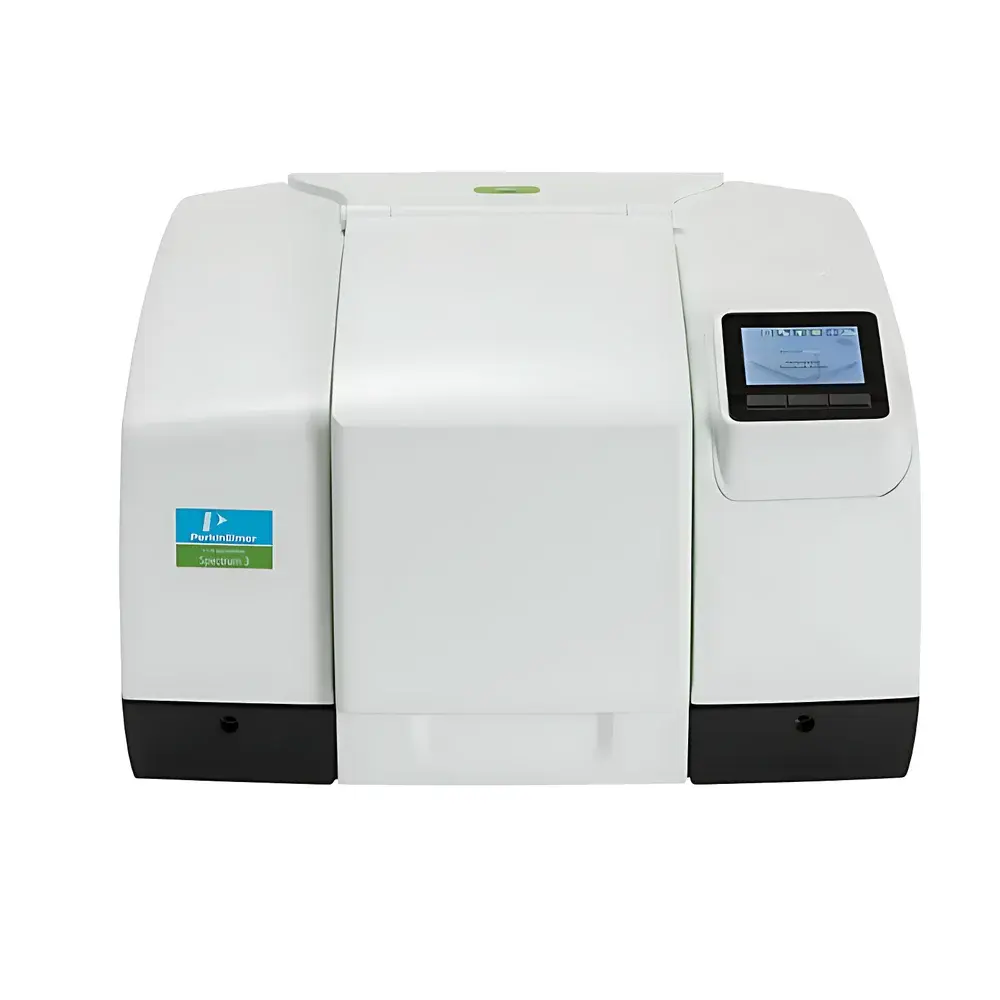
PerkinElmer Spectrum 3™ Fourier Transform Infrared (FT-IR) Spectrometer
| Brand | PerkinElmer |
|---|---|
| Origin | USA |
| Manufacturer Type | Original Equipment Manufacturer (OEM) |
| Import Status | Imported |
| Model | Spectrum 3 |
| Instrument Type | Laboratory FT-IR Spectrometer |
| Instrument Category | Fourier Transform Type |
| Wavenumber Range | Not Specified |
| Resolution | Not Specified |
| Scan Speed | Up to 100 scans/sec |
| Signal-to-Noise Ratio | Not Specified |
Overview
The PerkinElmer Spectrum 3™ Fourier Transform Infrared (FT-IR) Spectrometer is a modular, research-grade benchtop instrument engineered for high-fidelity molecular fingerprinting across the near-, mid-, and far-infrared spectral regions. Built upon PerkinElmer’s proven Michelson interferometer architecture with dynamically aligned optics and thermally stabilized reference laser control, the system delivers intrinsic measurement stability essential for long-term spectral reproducibility. Its optical design incorporates high-efficiency KBr and CsI beam splitters, dual-detector capability (DTGS and MCT), and an automated aperture control system that dynamically optimizes throughput versus resolution trade-offs. Unlike dispersive IR systems, the Spectrum 3™ leverages Fellgett’s (multiplex) and Jacquinot’s (throughput) advantages inherent to FT-based detection—enabling simultaneous acquisition of all wavenumbers with consistent photometric accuracy. This architecture supports both routine QC workflows and advanced time-resolved or hyphenated applications without hardware reconfiguration.
Key Features
- Modular platform architecture with field-upgradable components including detectors, sources, and beam splitters
- Automated alignment and real-time optical path optimization via internal He–Ne reference laser feedback loop
- Scan speed up to 100 spectra per second—enabling kinetic studies, rapid screening, and real-time process monitoring
- Thermally isolated optical bench with active vibration damping for enhanced signal stability in non-dedicated lab environments
- Integrated purge management system compatible with dry air or nitrogen purging to minimize atmospheric CO₂ and H₂O interference
- Direct coupling interface for hyphenated techniques including thermogravimetric analysis–infrared spectroscopy (TG-IR), reaction monitoring cells, and electrochemical flow cells
Sample Compatibility & Compliance
The Spectrum 3™ accommodates a broad range of sample forms—including solids (KBr pellets, ATR crystals, transmission films), liquids (sealed cells, liquid cells with CaF₂ or BaF₂ windows), and gases (gas cells with variable pathlengths)—via interchangeable sampling modules. All accessories are mechanically registered and software-recognized to ensure traceable method execution. The instrument complies with key regulatory frameworks for analytical instrumentation: it supports audit trail generation, electronic signature enforcement, and user-access-level controls required under FDA 21 CFR Part 11 and EU Annex 11. Data integrity protocols align with ALCOA+ principles (Attributable, Legible, Contemporaneous, Original, Accurate, Complete, Consistent, Enduring, Available), and method validation workflows conform to ICH Q2(R2) and USP . Routine performance qualification follows ASTM E1421 and ISO 17025–compliant procedures.
Software & Data Management
Spectrum Touch™ software provides an intuitive, role-based interface for acquisition, processing, and reporting—designed for both novice users and expert spectroscopists. It includes embedded chemometric tools (PCA, PLS, hierarchical clustering), spectral library search engines (Sadtler, Polymer, Pharma), and customizable report templates compliant with GLP/GMP documentation standards. Raw interferogram and spectrum files are stored in open-format .spc and .csv exports, ensuring interoperability with third-party data analysis platforms such as MATLAB, Python (SciPy), and R. The software supports networked deployment with centralized license management and integrates seamlessly with LIMS and ELN systems via RESTful API. All data handling operations—including baseline correction, atmospheric compensation, peak integration, and quantitative calibration—maintain full traceability through immutable metadata tagging.
Applications
- Raw material identity verification and batch release testing in pharmaceutical manufacturing (per USP and EP 2.2.24)
- In-process monitoring of polymerization reactions and catalytic processes using time-resolved FT-IR
- Characterization of thin-film coatings, semiconductor dopants, and 2D materials via reflection-absorption and grazing-angle measurements
- Quantitative moisture analysis in food matrices using partial least squares regression calibrated against Karl Fischer titration
- Forensic identification of unknown substances in law enforcement laboratories (ISO/IEC 17025 accredited workflows)
- Stability-indicating assays for drug degradation products under ICH Q1A–Q1E stress conditions
- Electrochemical IR studies of electrode–electrolyte interfaces during battery cycling
FAQ
Is the Spectrum 3™ compatible with attenuated total reflectance (ATR) sampling?
Yes—it supports multiple ATR accessories including diamond, ZnSe, and Ge crystal heads with automatic pressure-sensing and angle calibration.
Can the instrument be validated for GMP-regulated environments?
Yes—full IQ/OQ/PQ documentation packages, 21 CFR Part 11 compliance kits, and vendor-supported validation services are available.
Does the system support external triggering for synchronized measurements?
Yes—TTL-compatible trigger inputs enable precise synchronization with external events such as pump strokes, furnace ramps, or potentiostat pulses.
What detector options are available for extended spectral range coverage?
Standard configurations include DTGS for mid-IR and liquid-nitrogen-cooled MCT for high-sensitivity far-IR; optional InSb and bolometer detectors extend coverage into the near-IR and THz domains.
How is spectral calibration maintained over time?
The system performs daily self-calibration using its internal He–Ne laser reference and polystyrene film standard; NIST-traceable calibration certificates are provided with each instrument shipment.




