
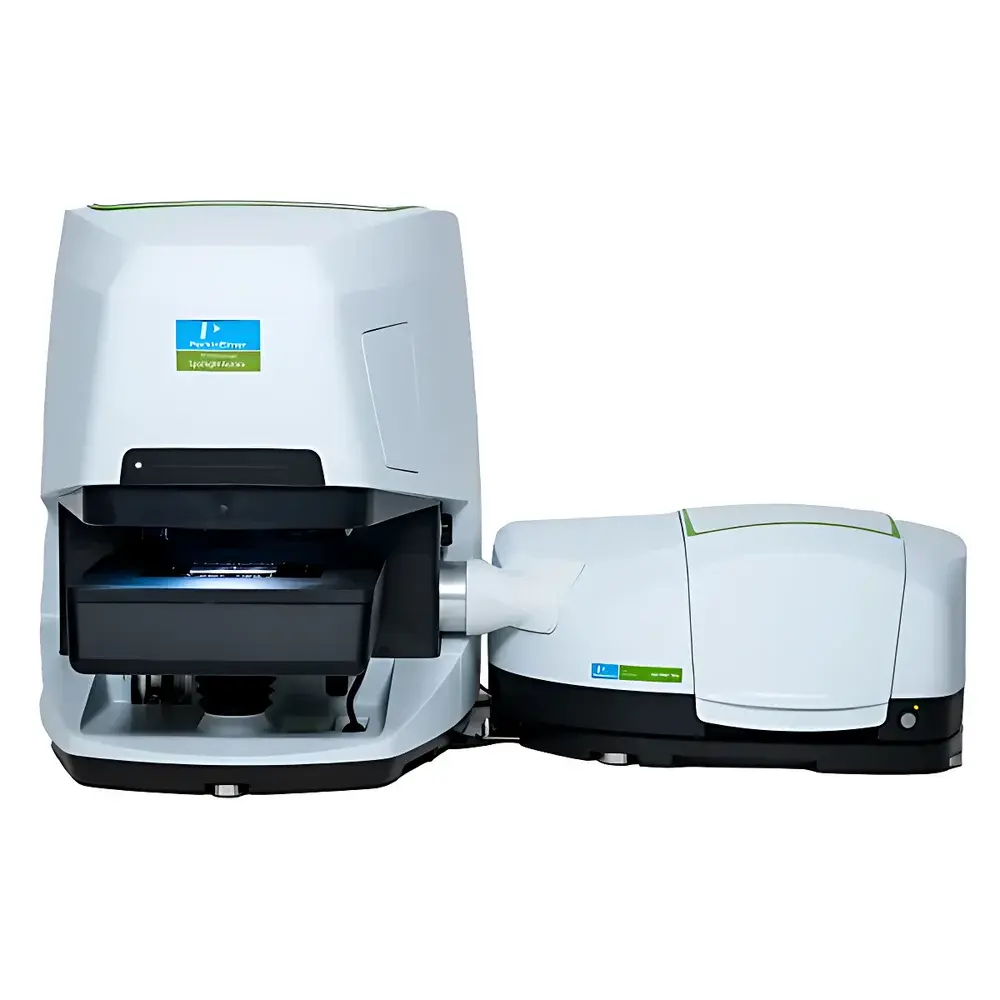
PerkinElmer Spotlight™ Aurora Fourier Transform Infrared (FT-IR) Microscope
| Brand | PerkinElmer |
|---|---|
| Origin | United Kingdom |
| Manufacturer Type | Original Equipment Manufacturer (OEM) |
| Product Origin | Imported |
| Model | Spotlight™ Aurora |
| Pricing | Available Upon Request |
Overview
The PerkinElmer Spotlight™ Aurora Fourier Transform Infrared (FT-IR) Microscope is a high-performance benchtop analytical instrument engineered for spatially resolved chemical identification and mapping of microscopic samples. Leveraging Michelson interferometry and a liquid-nitrogen-cooled MCT (Mercury Cadmium Telluride) detector, the system delivers high signal-to-noise ratio (SNR), spectral fidelity across the mid-IR range (typically 4000–600 cm⁻¹), and diffraction-limited spatial resolution down to ~5.5 µm (dependent on wavelength and objective). Unlike conventional dispersive IR microscopes, the Spotlight Aurora acquires full interferograms at each pixel in imaging mode—enabling true hyperspectral data cubes (x, y, ν) for multivariate analysis, cluster mapping, and spectral library correlation. Its core application domain spans failure analysis, pharmaceutical polymorph screening, microplastic identification, forensic trace evidence characterization, and semiconductor contaminant forensics—where molecular specificity at micron-scale spatial resolution is non-negotiable.
Key Features
- Automated spectral matching engine with real-time library search against >15,000 reference spectra (including polymer, pharmaceutical, and contaminant libraries); results annotated with match quality metrics (e.g., Hit Quality Index, HQI)
- Integrated ATR (Attenuated Total Reflection) module with diamond or germanium crystal options, enabling rapid, solvent-free surface analysis of solids and viscous liquids without sample preparation
- Motorized XYZ stage with sub-micron repeatability and auto-focus capability, supporting large-area mosaic mapping (up to 100 × 100 mm) with seamless stitching
- Guided workflow software interface (Spectrum Touch™) designed for operator independence—minimizes training time and reduces procedural variability across users
- Modular optical architecture allowing field-upgradable components: dual-detector support (MCT + DTGS), optional visible-light camera co-registration, and polarization modulation accessories
- Rugged mechanical design compliant with ISO 17025 laboratory environmental requirements; vibration-isolated optical bench and thermally stabilized interferometer ensure long-term measurement stability
Sample Compatibility & Compliance
The Spotlight Aurora accommodates diverse sample formats—including powders, thin films, cross-sectioned polymer laminates, biological tissue sections (FFPE or cryo-mounted), metallographic mounts, and microelectronic wafers—without requiring conductive coating or vacuum. Its ATR mode eliminates scattering artifacts common in transmission measurements of heterogeneous or opaque specimens. From a regulatory standpoint, the system supports audit-ready data integrity: all spectral acquisitions, processing steps, and metadata (instrument parameters, user ID, timestamp, calibration status) are logged automatically in encrypted .spc files. Software complies with FDA 21 CFR Part 11 requirements via electronic signature enforcement, role-based access control, and immutable audit trails—making it suitable for GLP, GMP, and ISO/IEC 17025-accredited laboratories.
Software & Data Management
Controlled by Spectrum Touch™ software, the Spotlight Aurora provides an intuitive, task-oriented interface that abstracts complex FT-IR theory while retaining full analytical transparency. Users define acquisition protocols (e.g., number of scans, aperture size, step resolution) through guided wizards; processed spectra are exported in ASTM E131-compliant formats (.spa, .csv) and can be imported directly into third-party chemometric platforms (e.g., Pirouette®, Unscrambler®). The software includes built-in tools for baseline correction, atmospheric compensation (H₂O/CO₂ subtraction), peak integration, and false-color chemical mapping. All raw interferograms and processed data are stored with embedded calibration certificates and hardware configuration snapshots—ensuring full traceability per ISO/IEC 17025 clause 7.5.2.
Applications
- Contaminant identification in automotive paint defects, medical device packaging, or pharmaceutical blister packs
- Layer-by-layer chemical stratigraphy of multilayer films and coated substrates
- Polymorph distribution analysis in tablet formulations using spectral deconvolution and hierarchical clustering
- Microplastic particle classification (e.g., PE vs. PET vs. PP) in environmental filter extracts
- Corrosion product speciation on alloy surfaces following accelerated aging tests
- Forensic fiber comparison with statistical confidence scoring based on spectral similarity metrics
FAQ
What spectral resolution is achievable with the Spotlight Aurora?
Standard operation offers 4 cm⁻¹ resolution; optional configurations support 2 cm⁻¹ or 1 cm⁻¹ for enhanced peak discrimination in narrow-band systems.
Can the system perform quantitative analysis?
Yes—when coupled with validated calibration models (e.g., partial least squares regression), it supports quantification of blend ratios, additive concentrations, and degradation markers, subject to matrix-matched standards and linearity verification per ASTM E1655.
Is external purge gas required for optimal performance?
While not mandatory, continuous dry air or nitrogen purge is recommended to minimize atmospheric water vapor interference, particularly below 1500 cm⁻¹—consistent with best practices outlined in ISO 18389.
How does the system handle heterogeneous or irregularly shaped samples?
The motorized stage and auto-focus algorithm dynamically adjust focal plane across height-varied surfaces; combined with variable aperture sizing (down to 10 × 10 µm), it maintains consistent spectral quality across topographically complex specimens.
Does PerkinElmer provide method validation support?
Yes—application scientists offer protocol development assistance, including ICH Q2(R2)-aligned validation documentation templates for specificity, accuracy, precision, and robustness assessment.




