
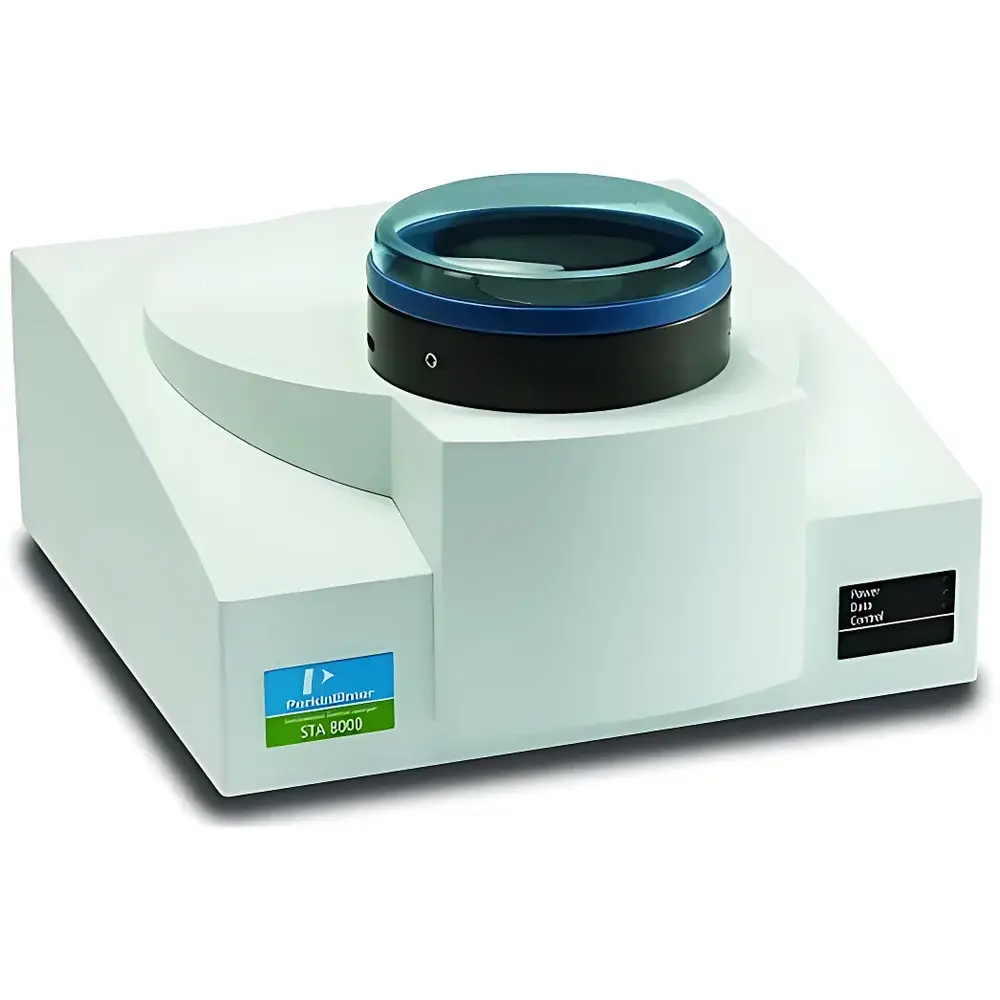
PerkinElmer STA6000 Simultaneous Thermal Analyzer
| Brand | PerkinElmer |
|---|---|
| Origin | USA |
| Manufacturer Type | Original Equipment Manufacturer (OEM) |
| Product Category | Imported Instrument |
| Model | STA6000 |
| Pricing | Upon Request |
| Heating Rate (°C/min) | Up to 100 |
| Temperature Range (°C) | −150 to 1500 |
| Temperature Stability | ±0.01 °C |
| Maximum Sample Weight (g) | 2000 |
| Atmosphere Control | Dual-gas MFC with Auto-Switching (Inert, Oxidizing, Reducing) |
Overview
The PerkinElmer STA6000 Simultaneous Thermal Analyzer is an integrated thermogravimetric analyzer (TGA) and differential thermal analyzer (DTA), engineered for high-precision, real-time measurement of mass change (TG), heat flow differences (DTA), and calorimetric response (DSC-mode output in mW) under controlled temperature programs and atmospheric conditions. Based on the principle of simultaneous dual-signal detection—where sample and reference crucibles are mounted on a single, monolithic SaTurn® sensor platform—the instrument eliminates mechanical and thermal lag between channels, enabling true synchrony in data acquisition. Its vertical furnace architecture, combined with optimized thermal mass distribution and active cooling, supports rapid heating rates up to 100 °C/min and controlled cooling down to −150 °C, making it suitable for both routine quality control and advanced materials research including polymer degradation kinetics, catalyst stability assessment, pharmaceutical polymorph screening, and inorganic phase transition analysis.
Key Features
- Patented SaTurn® sensor technology: Integrates sample pan support and platinum reference ring into a single inert, high-conductivity platform—ensuring identical thermal pathways for sample and reference, resulting in ultra-flat DTA baselines and enhanced signal-to-noise ratio.
- Vertical sample loading design: Enables ergonomic, tool-free sample insertion and rapid exchange—critical for high-throughput labs and multi-user environments.
- Integrated dual-mass-flow controller (MFC) system: Supports automatic, programmable switching between up to two gases (e.g., N2, air, O2, Ar, H2/Ar) with precise flow regulation (0–200 mL/min), meeting ASTM E1131 and ISO 11358 requirements for atmosphere-dependent decomposition studies.
- High-stability temperature control: Achieves ±0.01 °C isothermal stability over extended durations, validated per ASTM E1970 for baseline reproducibility in quantitative DSC-mode interpretation.
- Modular automation compatibility: Optional 45-position autosampler enables unattended operation with full thermal history logging, supporting GLP-compliant workflows and 21 CFR Part 11–ready audit trails when used with PyrisTM software.
- Compact footprint (W × D × H: 45 × 60 × 70 cm): Designed for space-constrained laboratories without compromising thermal shielding integrity or electromagnetic interference (EMI) isolation.
Sample Compatibility & Compliance
The STA6000 accommodates standard platinum, alumina, and graphite crucibles (up to 2000 mg gross weight), supporting solids, powders, gels, and thin films across diverse material classes—including battery cathode materials, biopolymers, metal-organic frameworks (MOFs), and pharmaceutical excipients. All thermal protocols adhere to internationally recognized standards: ASTM E1131 (TGA/DTA), ASTM E1970 (DSC calibration), ISO 11358 (polymer thermal degradation), and USP (thermal analysis of drug substances). The system’s hardware architecture and firmware meet IEC 61000-4 electromagnetic compatibility requirements, and its gas-handling subsystem complies with ISO 8573-1 Class 4 purity specifications for analytical-grade carrier gases.
Software & Data Management
Controlled exclusively via PyrisTM software (v12.5+), the STA6000 provides fully integrated method development, real-time data visualization, and post-run kinetic analysis (e.g., Ozawa-Flynn-Wall, Kissinger, Friedman models). Pyris supports secure user authentication, electronic signatures, and configurable audit trails compliant with FDA 21 CFR Part 11 and EU Annex 11. Raw data files (.pdt) are stored in vendor-neutral ASCII format, enabling direct import into MATLAB, OriginLab, or Thermo-Calc for advanced modeling. Batch processing, report templating (PDF/Excel), and LIMS integration via ASTM E1461-compliant API are available as licensed modules.
Applications
- Quantitative residue analysis in catalysts and ash content determination per ASTM D3174.
- Decomposition onset temperature mapping for flame-retardant polymers under nitrogen/oxygen atmospheres.
- Hydration/dehydration behavior of hydrates and solvates in active pharmaceutical ingredients (APIs).
- Thermal stability profiling of solid-state electrolytes in next-generation Li-ion and Na-ion batteries.
- Multi-step reaction enthalpy deconvolution in ceramic precursor pyrolysis (e.g., sol-gel AlOOH → Al2O3).
- Validation of thermal cycling durability in shape-memory alloys and phase-change materials (PCMs).
FAQ
What is the minimum detectable mass change resolution?
The STA6000 achieves ≤0.1 µg mass resolution under standard operating conditions (25 °C, static N2), verified using certified NIST SRM 1976a (calcium oxalate monohydrate) calibration.
Can the instrument perform dynamic vacuum measurements?
No—gas control is limited to positive-pressure MFC-regulated atmospheres; vacuum operation requires external pumping systems not supported by factory configuration.
Is calibration traceable to national standards?
Yes—temperature calibration uses NIST-traceable indium, tin, zinc, and aluminum standards; mass calibration employs certified weights per ISO/IEC 17025-accredited procedures.
Does the SaTurn® sensor require periodic replacement?
No—platinum-based construction ensures indefinite service life under normal use; sensor integrity is monitored continuously via diagnostic self-tests embedded in Pyris firmware.
What safety certifications does the STA6000 hold?
CE-marked per EN 61010-1:2010 (Safety Requirements for Electrical Equipment), UL 61010-1 certified, and RoHS 2011/65/EU compliant.



