
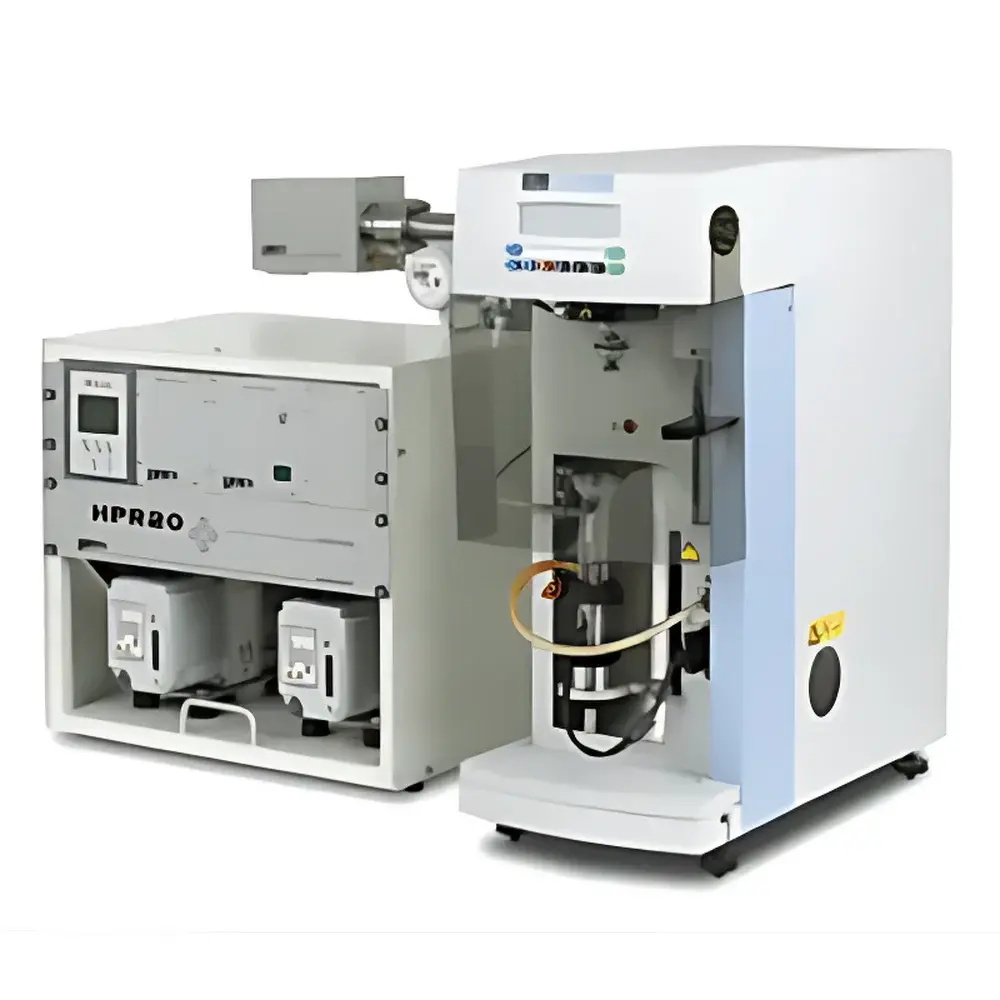
PerkinElmer TG-hiden MS Thermal Gravimetric Analysis–Mass Spectrometry Coupled System
| Brand | PerkinElmer |
|---|---|
| Manufacturer Origin | USA |
| Manufacturer Type | Original Equipment Manufacturer (OEM) |
| Instrument Category | Imported |
| Model | TG-hiden MS |
| Pricing | Available Upon Request |
Overview
The PerkinElmer TG-hiden MS is a fully integrated thermal gravimetric analysis–mass spectrometry (TGA-MS) coupled system engineered for real-time, molecular-level identification of evolved gases during thermal decomposition, desorption, oxidation, or pyrolysis processes. Based on the principle of simultaneous mass loss measurement (via high-resolution microbalance TGA) and gas-phase speciation (via quadrupole mass spectrometry), this platform enables unambiguous correlation between weight change events and corresponding volatile species evolution—down to sub-ppb detection limits for selected analytes. Unlike standalone TGA or offline GC-MS approaches, the TG-hiden MS provides time-resolved, stoichiometrically anchored gas evolution profiles, making it indispensable for mechanistic thermal degradation studies, polymer stability assessment, pharmaceutical excipient compatibility screening, battery cathode decomposition analysis, and catalytic reaction monitoring under controlled atmosphere.
Key Features
- Fully synchronized operation: TGA furnace initiation automatically triggers MS acquisition via hardware-level TTL signal handshake, ensuring zero time-lag between mass loss onset and ion detection.
- Hiden HPR-60 quadrupole mass spectrometer with selectable mass range options (200, 300, or 500 amu), field-upgradable without instrument disassembly.
- Helium carrier-compatible operation with variable electron ionization energy (10–70 eV) and soft ionization mode (e.g., 10 eV EI) to minimize fragmentation and enhance molecular ion signal integrity.
- Heated capillary transfer line (up to 300 °C) with integrated sintered metal filter to prevent condensable deposition and maintain stable transmission efficiency across temperature ramps.
- Modular coupling architecture: Compatible with multiple PerkinElmer TGA platforms—including TGA 4000 (robust routine analysis), STA 6000 (simultaneous TGA/DTA up to 1000 °C), and Pyris 1 TGA (ultra-low drift, <0.1 µg baseline stability)—enabling application-specific configuration.
- Real-time spectral acquisition at 100 Hz scan rate, supporting high-fidelity deconvolution of overlapping gas evolution peaks during rapid thermal events.
Sample Compatibility & Compliance
The system accommodates solid, powder, thin-film, and fiber samples (typically 1–20 mg) in standard alumina, platinum, or quartz crucibles. It supports inert (N₂, Ar, He), oxidative (air, O₂), and reducing (H₂/N₂ mixtures) atmospheres with precise flow control (0–200 mL/min). All hardware and software components comply with ISO/IEC 17025 requirements for testing laboratories and support GLP/GMP workflows through audit-trail-enabled method storage, user access control, and electronic signature capability per FDA 21 CFR Part 11. Data output conforms to ASTM E2550 (Standard Test Method for Thermal Stability by Thermogravimetry) and ISO 11358 (Plastics — Thermogravimetry of polymers).
Software & Data Management
Operation is managed via PerkinElmer’s proprietary Pyris™ software suite, extended with Hiden’s QGA (Quantitative Gas Analysis) module. The interface provides synchronized dual-channel visualization: TGA derivative (DTG) overlaid with real-time total ion current (TIC) and selected ion monitoring (SIM) traces. Peak deconvolution, library matching (NIST MS Search), and quantitative calibration (using certified gas standards) are supported. Raw data is saved in vendor-neutral ASCII format (.txt) and .csv, enabling third-party integration with MATLAB, Python-based chemometrics tools, or LIMS systems. All acquisition parameters, calibration logs, and operator metadata are embedded in each data file for full traceability.
Applications
- Identification of residual solvents and monomer impurities in polymer synthesis intermediates.
- Thermal stability mapping of lithium-ion battery cathode materials (e.g., NMC, LFP) under air vs. argon.
- Decomposition pathway elucidation of pharmaceutical active ingredients (APIs) and co-formulated excipients per ICH Q1E guidelines.
- Monitoring of catalyst deactivation mechanisms via CO₂, SOₓ, NOₓ, and hydrocarbon evolution profiling.
- Characterization of carbon black oxidation kinetics and char formation behavior in composite resins.
- Validation of thermal cleaning efficacy in semiconductor packaging substrates.
FAQ
Can the mass spectrometer be upgraded from 200 amu to 500 amu after installation?
Yes—the Hiden HPR-60 system supports field-upgradable mass range expansion without requiring vacuum chamber disassembly or recalibration of detector electronics.
Is helium the only compatible carrier gas for the MS interface?
Helium is the primary carrier due to its optimal ion transmission characteristics and compatibility with Hiden’s electron multiplier detectors; however, nitrogen and argon may be used for specific applications with adjusted tuning parameters.
Does the system support quantitative analysis of evolved gases?
Yes—quantitative capability is achieved via external calibration using certified gas mixtures and internal reference compounds, with detection limits ranging from low-ppb to ppm depending on compound ionization efficiency and dwell time.
How is synchronization maintained between TGA temperature ramp and MS acquisition timing?
Hardware-level TTL triggering ensures sub-millisecond temporal alignment; additionally, all spectra are timestamped against the TGA thermocouple reading with 0.1 s resolution.
Are there regulatory validation packages available for pharmaceutical use?
PerkinElmer provides IQ/OQ documentation templates compliant with ASTM E2550 and USP , along with optional GxP-compliant installation and operational qualification services conducted by certified field engineers.



