
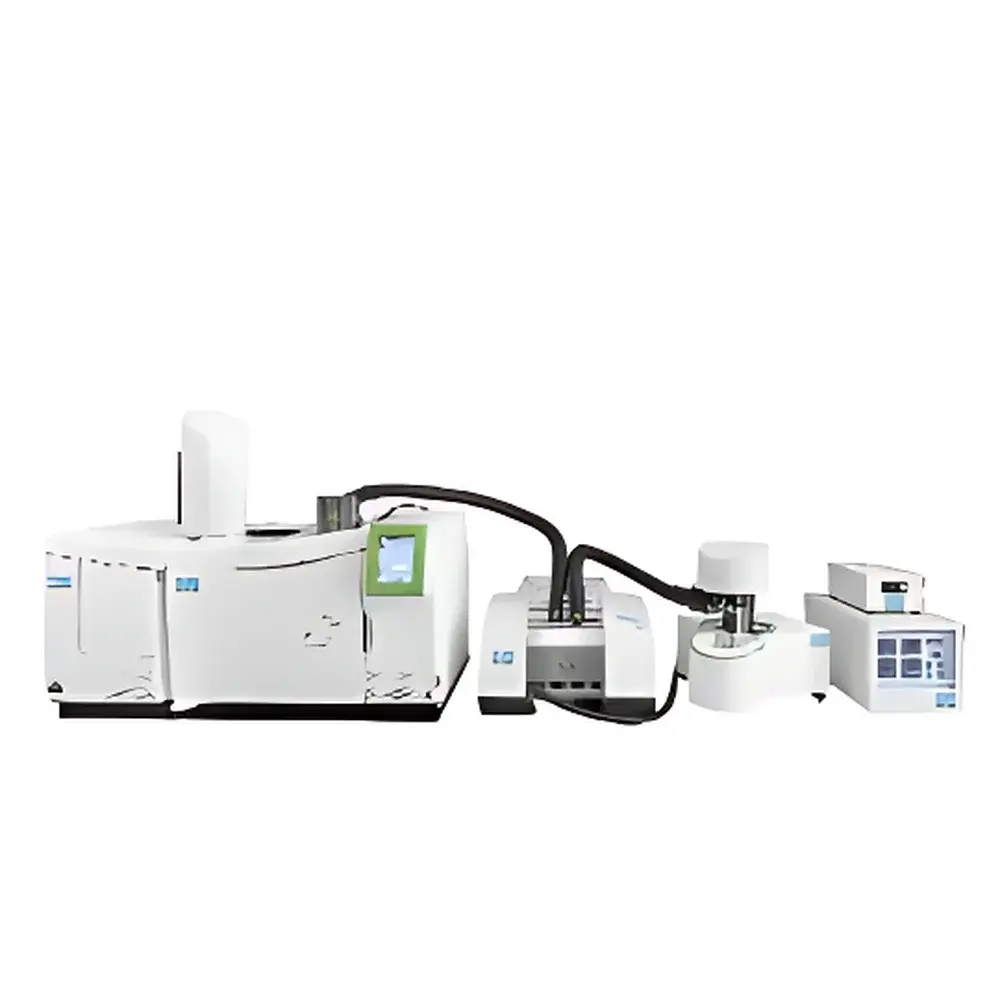
PerkinElmer TG-IR-GC/MS Coupled Thermal Analysis System
| Brand | PerkinElmer |
|---|---|
| Origin | USA |
| Manufacturer Type | Original Equipment Manufacturer (OEM) |
| Product Category | Imported Instrument |
| Model | PerkinElmer TG-IR-GC/MS |
| Pricing | Upon Request |
Overview
The PerkinElmer TG-IR-GC/MS is a fully integrated hyphenated analytical platform that synchronously couples thermogravimetric analysis (TGA), Fourier-transform infrared spectroscopy (FTIR), and gas chromatography/mass spectrometry (GC/MS) into a single, coherently controlled workflow. Engineered for precision in evolved gas analysis (EGA), this system enables real-time, multi-modal characterization of thermal decomposition pathways, volatile organic compound (VOC) evolution profiles, and molecular structural identification of gaseous effluents. Unlike ad-hoc instrument interfacing solutions, the PerkinElmer system features proprietary hardware synchronization—thermally insulated transfer lines with precise temperature control (up to 300 °C), pressure-regulated gas flow management, and time-resolved data alignment across all three detectors—ensuring stoichiometric fidelity between mass loss events, IR absorbance bands, and GC/MS chromatographic peaks. The architecture supports both static and dynamic EGA modes, accommodating controlled heating rates (0.1–100 °C/min), programmable isothermal holds, and reactive atmosphere purging (N₂, Ar, O₂, synthetic air) per ASTM E1131 and ISO 11358 standards.
Key Features
- Seamless OEM-level integration: Single software interface (Pyris™ and TurboMass™ with TG-IR-GC/MS add-on module) for synchronized method setup, real-time monitoring, and correlated data export.
- Dedicated heated transfer line: Maintains effluent integrity from TGA furnace to FTIR cell and GC injector, minimizing condensation and adsorption artifacts.
- High-sensitivity FTIR gas cell: 10-cm pathlength, KBr beam splitter, DTGS detector optimized for transient gas-phase spectra; spectral resolution down to 4 cm⁻¹ with 16-scan coaddition per second.
- Triple-stage GC/MS configuration: Split/splitless injector, low-bleed 30-m fused silica column (e.g., DB-5ms), quadrupole mass analyzer with unit-mass resolution (m/z 10–650), electron ionization (70 eV).
- Comprehensive calibration traceability: NIST-traceable reference gases (CO₂, CH₄, H₂O, NH₃) for IR quantification; certified VOC standards (EPA TO-14/TO-15 mixtures) for GC/MS response validation.
- Robust architecture for GLP/GMP environments: Audit trail logging, electronic signatures (21 CFR Part 11 compliant), and method version control embedded in acquisition software.
Sample Compatibility & Compliance
The system accommodates solid, powder, and thin-film samples (0.1–50 mg typical mass range) across polymers, pharmaceuticals, catalysts, battery materials, and environmental matrices. Sample pans are compatible with standard alumina, platinum, or gold-plated crucibles. Regulatory alignment includes full support for USP <467>, ICH Q3C(R8), ASTM E2550 (TGA), ASTM E1640 (FTIR of evolved gases), and ISO 9001-certified manufacturing processes. All firmware and software updates undergo formal change control per ISO/IEC 17025 requirements for testing laboratories.
Software & Data Management
Data correlation is performed via Pyris™ Thermal Analysis Software (v12.5+) and TurboMass™ (v6.3+), linked through PerkinElmer’s Hyphenated Data Fusion Engine. This engine aligns TGA derivative (DTG) peaks, FTIR spectral snapshots (at user-defined temperature thresholds or mass-loss intervals), and GC/MS total ion chromatograms (TIC) on a common time-temperature axis. Export formats include ASCII, CSV, JCAMP-DX, and mzML for third-party chemometric tools (e.g., MATLAB, Python SciPy). Raw datasets are stored in encrypted project files with SHA-256 checksums; backup policies enforce daily offsite replication per ISO 27001 Annex A.8.3.
Applications
- Pharmaceutical stability studies: Identification of degradants formed during accelerated aging (e.g., lactide ring-opening in PLGA, solvent residue profiling in lyophilized formulations).
- Polymer additive migration: Quantification of plasticizers (e.g., DEHP, DINP) and flame retardants (e.g., TBBPA) released under thermal stress.
- Catalyst deactivation mechanism analysis: Correlating coke formation (TGA mass loss), surface-bound carbonyls (FTIR), and aromatic condensation products (GC/MS).
- Battery electrode off-gas characterization: Detection of HF, COF₂, and electrolyte decomposition fragments (e.g., EMC, DMC) during thermal runaway simulation.
- Environmental forensics: Speciation of halogenated dioxins/furans and PCB congeners evolved from contaminated soils during controlled pyrolysis.
FAQ
What interfaces are required to connect the TGA, FTIR, and GC/MS modules?
No third-party adapters or custom plumbing are needed—the system ships with factory-aligned, vacuum-tight stainless-steel transfer lines, pressure-regulated flow controllers, and TTL-triggered synchronization cables pre-validated for signal latency <100 ms.
Can the system operate in standalone mode for individual techniques?
Yes. Each subsystem retains full autonomous functionality with native software; hyphenation is enabled only when the coupling module license is activated.
Is method transfer possible between different PerkinElmer TG-IR-GC/MS installations?
Absolutely. Method files include embedded instrument configuration metadata, enabling reproducible deployment across labs—verified via inter-laboratory round-robin studies per ISO 5725-2.
How is background subtraction handled for FTIR gas-phase spectra?
Real-time background acquisition occurs during inert gas purge prior to heating; dynamic correction applies linear baseline interpolation between user-defined spectral windows, eliminating water vapor and CO₂ interference.
What maintenance protocols ensure long-term data comparability?
PerkinElmer provides quarterly performance qualification (PQ) kits—including certified reference materials for TGA buoyancy correction, FTIR gas cell transmission verification, and GC/MS tuning standards—documented in accordance with ISO/IEC 17025 clause 7.7.



