
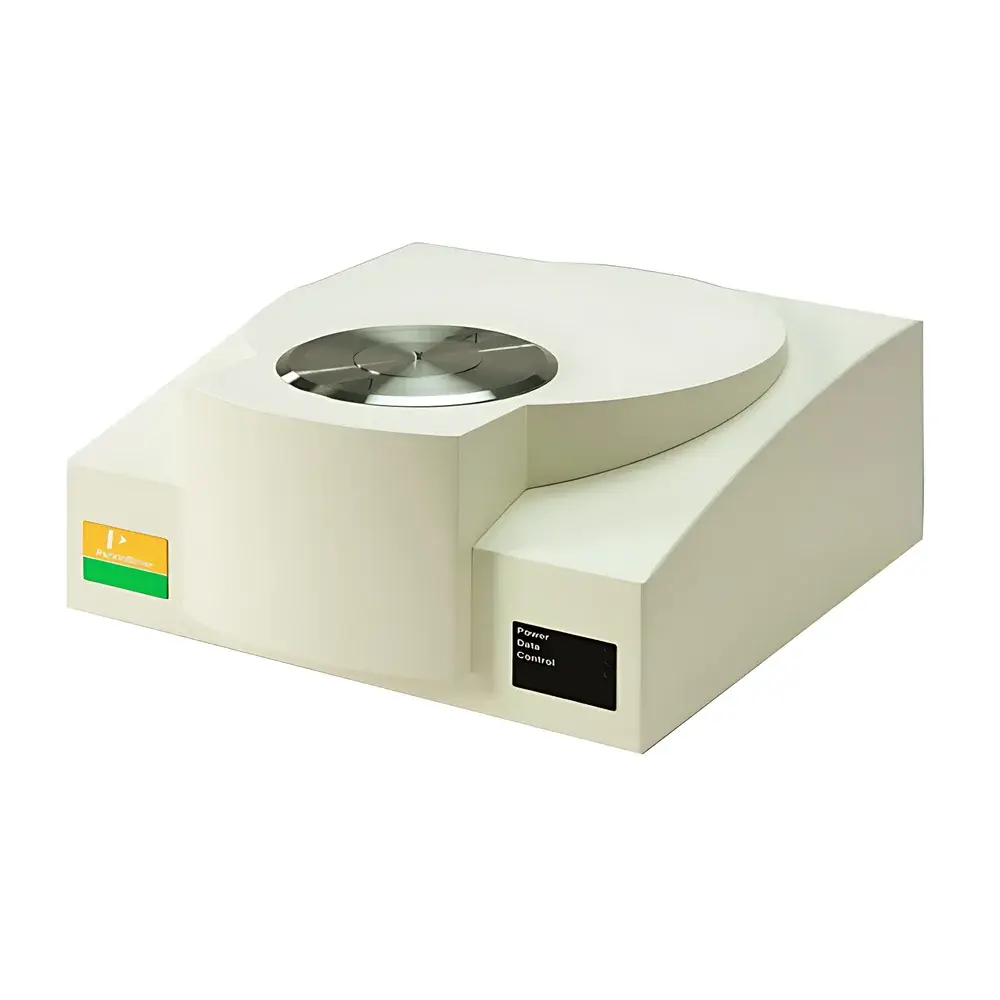
PerkinElmer TGA 4000 Thermogravimetric Analyzer
| Brand | PerkinElmer |
|---|---|
| Origin | USA |
| Manufacturer Type | Original Equipment Manufacturer (OEM) |
| Product Category | Imported Instrument |
| Model | TGA 4000 |
| Temperature Range | Ambient to 1000 °C |
| Balance Capacity | 1500 mg |
| Balance Resolution | 0.2 µg |
| Balance Accuracy/Precision | ±0.02% / ±0.01% |
| Heating Rate | 0.1–200 °C/min |
| Temperature Accuracy/Precision | ±1 °C / ±0.8 °C |
| Sample Pan Volume | 180 µL |
| Atmosphere Options | Static or dynamic, including N₂, Ar, He, CO₂, air, O₂, and other inert or reactive gases |
| Integrated Mass Flow Controller | Standard |
| Optional Autosampler | 45-position |
Overview
The PerkinElmer TGA 4000 is a high-performance thermogravimetric analyzer engineered for precision, reproducibility, and operational robustness in both research and quality control environments. It operates on the fundamental principle of measuring mass change as a function of temperature or time under controlled atmospheric conditions—enabling quantitative analysis of thermal decomposition, oxidation, dehydration, volatilization, and compositional stability. Designed with an integrated ceramic furnace architecture, the TGA 4000 delivers exceptional thermal uniformity across its extended isothermal zone, ensuring accurate alignment between programmed and actual sample temperature throughout the full operating range (ambient to 1000 °C). Its top-loading configuration, combined with a vibration-isolated, thick-walled stainless-steel balance enclosure, minimizes mechanical interference and thermal drift—critical for achieving sub-microgram resolution (0.2 µg) and long-term baseline stability.
Key Features
- Ceramic furnace with optimized thermal mass and geometry for rapid heating/cooling cycles and enhanced chemical resistance—compatible with aggressive atmospheres including oxygen, chlorine, and corrosive vapors.
- Forced-air or liquid-cooling options reduce cooldown time by up to 60% compared to conventional systems, increasing throughput without compromising thermal fidelity.
- Integrated dual-channel mass flow controller (MFC) enables precise, software-driven regulation of purge and reactant gas flows (N₂, Ar, O₂, CO₂, air, He), including programmable gas-switching sequences during a single run.
- Top-access design with ergonomic sample loading; robust ceramic sample pans (up to 180 µL volume or 1500 mg mass capacity) ensure compatibility with powders, films, fibers, and viscous materials.
- Patented shape-memory alloy (SMA) robotic arm in the optional 45-position autosampler provides reliable, temperature-synchronized sample exchange—loading occurs only after furnace stabilization, eliminating thermal shock artifacts.
- Dual-path sample handling mechanism allows concurrent preparation and measurement, minimizing instrument idle time and supporting unattended overnight operation.
Sample Compatibility & Compliance
The TGA 4000 accommodates diverse sample forms—including polymers, pharmaceuticals, catalysts, composites, ceramics, and battery materials—without requiring pre-conditioning or dilution. Its wide dynamic atmosphere capability supports ASTM E1131, ISO 11358, USP , and ICH Q5C testing protocols. The system’s hardware and Pyris™ software architecture are designed to meet GLP/GMP documentation requirements, including full audit trail logging, user access controls, and electronic signature support per FDA 21 CFR Part 11 when configured with appropriate IT infrastructure.
Software & Data Management
Pyris™ software provides intuitive method development, real-time data visualization, and automated reporting templates compliant with laboratory information management systems (LIMS). It supports multi-step gas switching routines, derivative thermogravimetry (DTG) calculation, peak deconvolution, and kinetic modeling (e.g., Kissinger, Ozawa-Flynn-Wall). All raw data files are stored in vendor-neutral formats (.csv, .txt) alongside metadata-rich .pma archives. Data integrity safeguards include checksum validation, automatic backup scheduling, and version-controlled method libraries with timestamped revision history.
Applications
- Quantitative determination of moisture, solvent residue, filler content, and polymer degradation onset in pharmaceutical formulations per ICH guidelines.
- Thermal stability assessment of lithium-ion battery cathode/anode materials under inert and oxidizing atmospheres.
- Char yield and ash content analysis in coal, biomass, and waste-derived fuels per ASTM D7582 and ISO 1171.
- Decomposition kinetics of nanocomposites and flame-retardant additives using isoconversional methods.
- Residue quantification in catalytic reactions and supported metal oxide systems under controlled reactive gas environments.
- Hydration/dehydration behavior of metal–organic frameworks (MOFs) and zeolites via stepwise temperature ramping with gas modulation.
FAQ
What is the maximum recommended sample mass for high-accuracy TGA measurements?
For optimal signal-to-noise ratio and thermal lag minimization, PerkinElmer recommends 1–10 mg for most solid samples; however, the TGA 4000 maintains linearity and repeatability up to 1500 mg for bulk material screening applications.
Can the TGA 4000 be interfaced with FT-IR or MS for evolved gas analysis (EGA)?
Yes—the instrument features a dedicated heated transfer line port (maintained at up to 300 °C) and pressure-regulated outlet compatible with PerkinElmer Frontier™ FT-IR, TurboMatrix™ GC/MS, and Clarus® SQ mass spectrometers using factory-validated coupling kits.
Is the 45-position autosampler compatible with reactive gas environments?
Yes—each sample position is sealed under inert gas prior to insertion, and the autosampler chamber is continuously purged during operation to prevent cross-contamination and oxidation of sensitive samples.
Does the system support custom gas mixtures beyond standard single-gas configurations?
The integrated MFC supports two independent gas channels; third-party gas mixing modules (e.g., Brooks Instrument SLA series) can be added externally and fully controlled via Pyris™ through analog/digital I/O interfaces.
How is temperature calibration verified on the TGA 4000?
Calibration is performed using certified reference materials (e.g., Ni, Cu, Al, KCl) traceable to NIST standards; Pyris™ includes built-in calibration wizards that guide users through multi-point verification and correction of both sensor offset and heating rate nonlinearity.



