
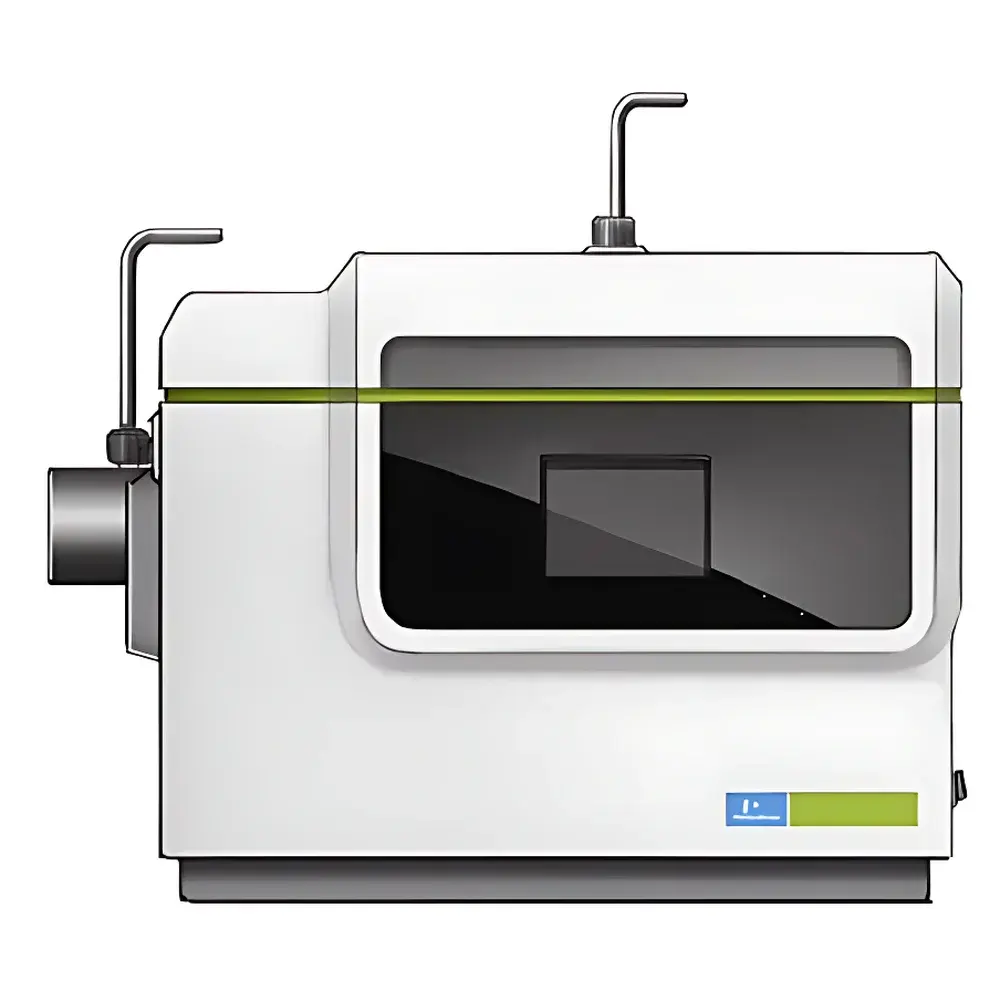
PerkinElmer Titan MPS Microwave Digestion System
| Brand | PerkinElmer |
|---|---|
| Origin | USA |
| Manufacturer Type | Original Equipment Manufacturer (OEM) |
| Origin Category | Imported |
| Model | Titan MPS |
| Cavity Class | Industrial-Grade |
| Sample Capacity | 16 × 75 mL vessels or 8 × 100 mL vessels |
| Max Temperature | 260 °C |
| Max Pressure | 100 bar |
| Pressure & Temperature Monitoring | Direct Optical Pressure Control™ (DPC) and Direct Optical Temperature Control™ (DTC) per vessel |
| Vessel Material | TFM™ fluoropolymer |
| Cavity Lining | PFA-coated cylindrical stainless steel |
| Gas Management | Integrated acid-resistant fume capture and continuous cavity venting |
| Software Platform | Linux-based embedded GUI with network-enabled remote access (no client software required) |
| Compliance Support | Designed for GLP/GMP environments |
Overview
The PerkinElmer Titan MPS Microwave Digestion System is an industrial-grade, top-loading microwave-assisted sample preparation platform engineered for high-throughput, reproducible, and chemically robust acid digestion of challenging matrices—including soils, polymers (e.g., PVC), botanicals (e.g., tea leaves), biological tissues, and environmental solids. It operates on the principle of controlled microwave energy absorption within sealed, pressurized reaction vessels, enabling rapid and complete decomposition of organic and inorganic components under precisely regulated thermal and mechanical conditions. Unlike conventional batch-style systems with indirect sensing, the Titan MPS implements proprietary Direct Optical Pressure Control™ (DPC) and Direct Optical Temperature Control™ (DTC) technology—measuring pressure and temperature *in situ*, at the vessel level, without physical probes or thermocouples. This eliminates cross-contamination risk, sensor drift, and calibration dependency while delivering real-time, vessel-specific feedback for dynamic microwave power modulation. The system’s cylindrical, PFA-coated stainless steel cavity ensures uniform field distribution and long-term resistance to aggressive reagents (e.g., HNO₃/HF/HClO₄ mixtures), supporting routine operation at up to 260 °C and 100 bar.
Key Features
- Top-loading architecture with interlocked safety lid—enables rapid, ergonomic vessel insertion and removal without tilting or rotating heavy rotors.
- Optical DPC/DTC monitoring: Non-contact, per-vessel measurement with sub-second sampling frequency; no thermal lag or mechanical wear.
- Modular turntable design: Interchangeable rotor configurations support both 16-position (75 mL) and 8-position (100 mL) vessel arrays—adapting to throughput or volume requirements without hardware modification.
- TFM™ fluoropolymer vessels: Chemically inert, pressure-rated, reusable, and serialized for full traceability; backed by a 12-month limited warranty.
- Integrated fume management: Acid-resistant gas scrubbing system captures volatile byproducts (e.g., NO₂, Cl₂, HF vapors); continuous cavity exhaust prevents condensate buildup and protects external housing.
- Embedded Linux-based controller: 7-inch color touchscreen interface powered by PowerPC™ CPU; supports method creation, execution, real-time graphing, and timestamped event logging.
Sample Compatibility & Compliance
The Titan MPS accommodates diverse solid and semi-solid samples requiring EPA Method 3051A/3052, ASTM D5511, ISO 11466, and USP compliant digestion protocols. Its 100 bar pressure rating enables complete mineralization of refractory materials—including silicates, metal alloys, and halogen-rich polymers—without pre-dilution or multi-step procedures. Vessels comply with CE, UL, and IEC 61000-4 electromagnetic compatibility standards. Data integrity features include electronic signatures, user-level access control, and immutable audit trails aligned with FDA 21 CFR Part 11 requirements for regulated laboratories. All digestion methods—including those developed in-house—are stored with version history, operator ID, and instrument firmware metadata.
Software & Data Management
The Titan MPS runs a deterministic, open-source Linux OS with a purpose-built GUI optimized for analytical workflows. Preloaded with over 200 validated digestion methods spanning environmental, clinical, food, and geochemical applications, the system allows users to clone, edit, and validate custom protocols with parameter locking (e.g., ramp time, hold temperature, max pressure). All run data—including raw optical sensor outputs, power profiles, and alarm events—are saved in CSV and XML formats with ISO 8601 timestamps. Remote monitoring is enabled via standard HTTP/HTTPS: any network-connected PC or tablet can access live status, historical runs, and method libraries through a browser—no proprietary client installation or license keys required. Exported datasets integrate natively with LIMS platforms and statistical analysis tools (e.g., JMP, Minitab) via structured metadata tags.
Applications
- Environmental testing: Total metal recovery from soil, sediment, sludge, and airborne particulates (PM₁₀/PM₂.₅ filters).
- Materials science: Digestion of catalysts, battery cathode materials (e.g., NMC, LFP), and composite resins prior to ICP-MS/OES quantification.
- Pharmaceutical QA/QC: Residual catalyst screening in active pharmaceutical ingredients (APIs) per ICH Q2(R2) guidelines.
- Food safety: Determination of toxic elements (As, Cd, Pb, Hg) in infant formula, spices, and seafood per EU Commission Regulation (EU) No 2023/915.
- Clinical research: Trace element profiling in hair, nails, and biopsy tissues using high-sensitivity mass spectrometry.
FAQ
Does the Titan MPS require consumable sensors or disposable temperature probes?
No. The optical DTC and DPC systems are fully non-invasive and maintenance-free—no thermocouples, RTDs, or fiber-optic cables are used or replaced.
Can I validate my own digestion methods on this system?
Yes. The software supports full method lifecycle management—including development, verification (per ICH Q2), and version-controlled archiving—with built-in uncertainty estimation tools for critical parameters.
Is the system compatible with third-party vessel brands?
PerkinElmer recommends exclusive use of factory-certified TFM™ vessels to ensure pressure integrity, optical signal fidelity, and warranty coverage.
How is data security enforced during remote access?
All network communications use TLS 1.2+ encryption; authentication requires LDAP/Active Directory integration or local role-based credentials with session timeout and lockout policies.
What maintenance intervals are recommended for routine operation?
Annual calibration verification of optical sensors and pressure transducers is advised; cavity cleaning and gasket inspection should occur after every 200 runs or per internal SOP—no scheduled downtime required.



