
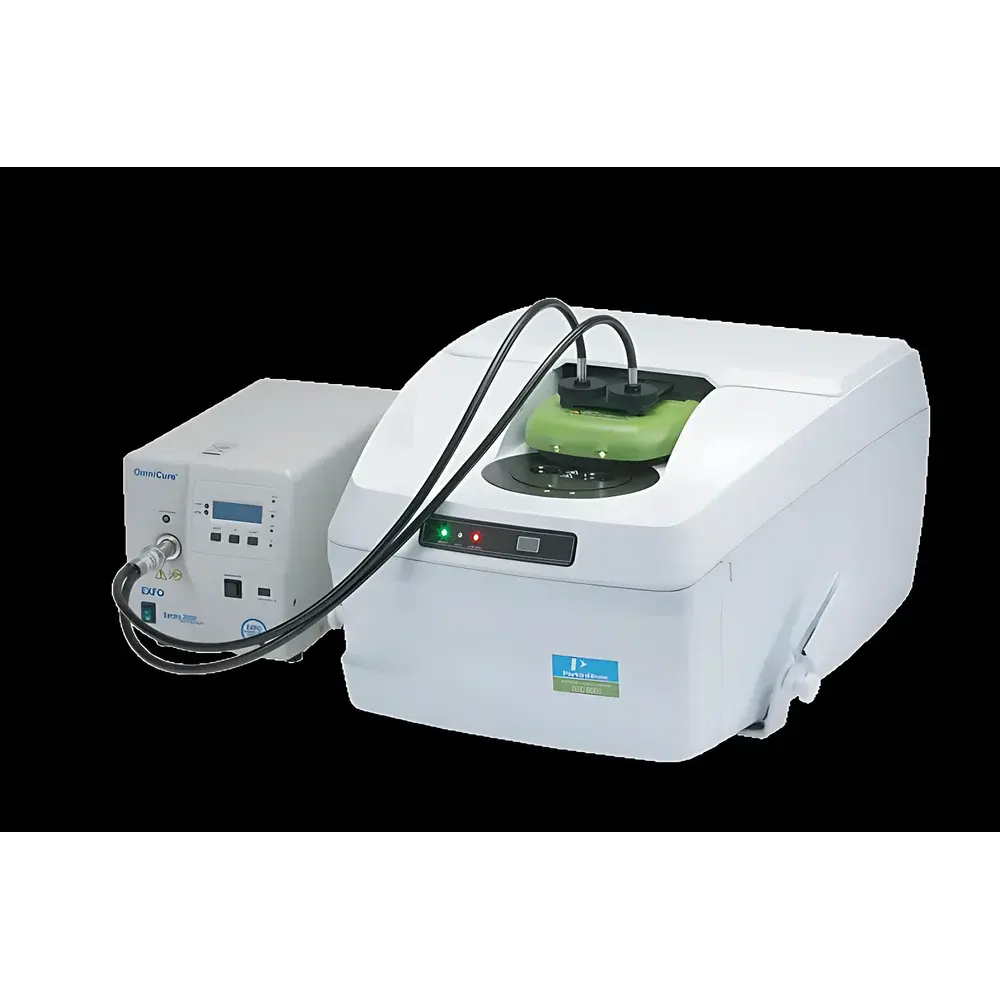
PerkinElmer UV-DSC Coupling System: DSC 8500 with EXFO® UV Curing Module
| Brand | PerkinElmer |
|---|---|
| Origin | USA |
| Manufacturer Type | Original Equipment Manufacturer (OEM) |
| Import Status | Imported |
| Model | PerkinElmer DSC 8500 coupled with EXFO® UV Curing System |
| Pricing | Available upon request |
Overview
The PerkinElmer UV-DSC Coupling System integrates a high-performance power-compensated differential scanning calorimeter—specifically the DSC 8500—with a fully synchronized, fiber-coupled ultraviolet (UV) irradiation module based on EXFO® technology. This hybrid platform enables real-time, in situ thermal analysis of photochemical and photothermal processes under controlled UV exposure. Unlike conventional DSC systems, which operate in darkness or ambient light, this configuration maintains precise thermal isolation while delivering calibrated, spatially defined UV flux directly to the sample pan within the furnace chamber. The measurement principle relies on dual-oven heat-flux compensation architecture, where independent temperature control of sample and reference furnaces ensures baseline stability even during rapid photoinduced exotherms or endotherms. With heating and cooling rates up to 750 °C/min and sub-millikelvin temperature resolution, the system supports both kinetic modeling of UV-triggered reactions (e.g., free-radical polymerization, photolysis, or crosslinking) and quantitative enthalpy determination under non-isothermal or isothermal irradiation protocols.
Key Features
- Power-compensated DSC architecture with dual independent furnace zones for enhanced baseline reproducibility during UV irradiation
- EXFO®-based UV source integrated via bifurcated quartz fiber optic delivery, enabling independent positioning of illumination paths toward sample, reference, or sensor surfaces
- Adjustable UV intensity control via motorized iris diaphragm and spectral filtering options (e.g., 254 nm, 365 nm, or broadband UV-A/UV-B)
- Real-time synchronization between DSC thermogram acquisition (100 Hz data rate) and UV exposure timing (programmable on/off, pulse width modulation)
- Thermal shielding and optical baffling to minimize stray radiation effects on furnace electronics and thermocouple junctions
- Compliance-ready firmware supporting audit trails, user access levels, and electronic signatures per FDA 21 CFR Part 11 requirements
Sample Compatibility & Compliance
The system accommodates standard hermetic aluminum DSC pans (50–100 µL capacity), sealed or vented, as well as custom quartz or sapphire crucibles for UV-transparent applications. It is validated for use with photocurable resins, dental composites, ink formulations, photoresists, pharmaceutical co-crystals, and polymer blends exhibiting UV-sensitive phase transitions. All hardware and software comply with ISO/IEC 17025:2017 general requirements for testing laboratories, and thermal calibration procedures follow ASTM E1269 and E1356 standards. Optional GLP/GMP-compliant documentation packages include instrument qualification reports (IQ/OQ/PQ), traceable NIST-calibrated reference materials (indium, zinc, sapphire), and full validation protocols for photothermal method transfer.
Software & Data Management
Pyris™ Thermal Analysis Software v12.5 provides dedicated UV-DSC experiment templates—including isothermal photopolymerization, modulated UV-DSC, and light-ramp kinetics workflows. Raw data files (.pdt) are stored in vendor-neutral HDF5 format with embedded metadata (wavelength, irradiance, shutter status, furnace PID logs). Kinetic analysis modules support Ozawa-Flynn-Wall, Kissinger, and advanced model-fitting algorithms (e.g., nth-order, autocatalytic, diffusion-controlled) using nonlinear regression with confidence interval estimation. Export options include CSV, ASCII, and XML for integration into LIMS or statistical platforms such as JMP or MATLAB. All data handling adheres to ALCOA+ principles (Attributable, Legible, Contemporaneous, Original, Accurate, Complete, Consistent, Enduring, Available).
Applications
- Quantification of photoinitiation efficiency and conversion kinetics in acrylate- and epoxy-based UV-curable coatings
- Thermal stability assessment of photoactive pharmaceutical ingredients (PAPIs) under simulated sunlight exposure
- Development of low-VOC dental restorative materials with optimized curing depth and shrinkage stress profiles
- Reaction enthalpy mapping of photoinduced Diels–Alder cycloadditions in smart polymer synthesis
- Quality control of LED-curable adhesives across production batches using standardized UV-DSC fingerprinting
- Investigation of photothermal degradation pathways in organic photovoltaic (OPV) active layers
FAQ
What UV wavelength ranges are supported by the EXFO® module?
The base configuration includes 365 nm (UV-A) and 254 nm (UV-C) LED or mercury-xenon lamp options; broadband UV-A/UV-B sources (280–400 nm) are available upon request.
Can the system perform simultaneous UV irradiation and modulated DSC (MDSC)?
Yes—Pyris software supports superimposed sinusoidal temperature modulation during continuous or pulsed UV exposure, enabling separation of reversing and non-reversing heat flow components under photoactive conditions.
Is the UV source intensity calibrated and traceable?
Each system ships with factory-calibrated radiometric certification (NIST-traceable UV irradiance meter), and in-situ monitoring is possible via optional integrated photodiode feedback loop.
How is thermal drift minimized during prolonged UV exposure?
The dual-furnace design actively compensates for radiant heating from the UV source; additionally, thermally isolated fiber feedthroughs and reflective furnace liners reduce parasitic energy absorption.
Does PerkinElmer provide application-specific method development support?
Yes—application scientists offer remote and on-site method optimization, including photokinetic modeling, UV dose calibration, and regulatory documentation support for ICH Q5C, Q1B, and ISO 10993-12 studies.




