
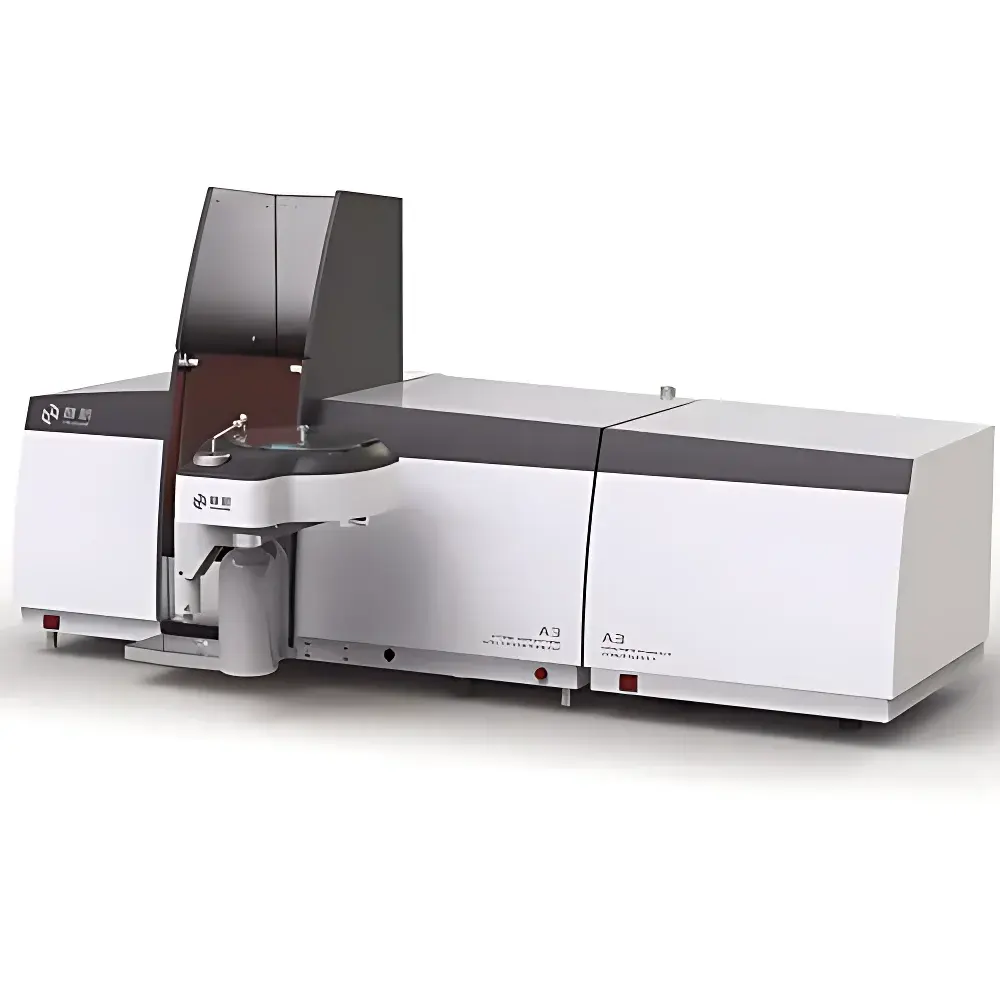
Persee A3 Series Flame and Graphite Furnace Atomic Absorption Spectrometer
| Brand | Persee |
|---|---|
| Origin | Beijing, China |
| Manufacturer Type | Direct Manufacturer |
| Instrument Type | Flame and Graphite Furnace AAS |
| Monochromator | Concave Grating |
| Optical System | Double-Beam |
| Detector | Photomultiplier Tube (PMT) |
| Background Correction | Deuterium Lamp + Self-Reversal |
| Wavelength Accuracy | ±0.15 nm |
| Baseline Stability | ±0.002 A/30 min (static) |
| RSD (Repeatability) | ≤0.6% for Cu (air-acetylene), ≤1.0% for Cu (LPG-air) and Ba (N₂O-acetylene), ≤2.0% for Cu and Cd (graphite furnace) |
| Characteristic Concentration | Cu < 0.02 µg/mL/1% (air-acetylene & LPG-air), Ba < 0.15 µg/mL/1% (N₂O-acetylene) |
| Detection Limit | Cu < 0.004 µg/mL (flame), Cd < 0.4 pg (graphite furnace) |
Overview
The Persee A3 Series Flame and Graphite Furnace Atomic Absorption Spectrometer is a third-generation benchtop atomic absorption instrument engineered for high-precision elemental quantification across diverse sample matrices. Based on the fundamental principle of atomic absorption spectroscopy—where ground-state free atoms in the gaseous phase absorb light at element-specific wavelengths—the A3 employs a double-beam optical architecture with a concave holographic grating monochromator to ensure spectral resolution and photometric accuracy. Its integrated dual-atomization platform supports four distinct atomization modes: air-acetylene flame, nitrous oxide-acetylene flame, liquefied petroleum gas (LPG)-air flame, and electrothermal graphite furnace—enabling method flexibility without hardware reconfiguration. Designed for compliance-driven laboratories, the system meets CE marking requirements and incorporates engineering safeguards for operational safety, including automatic gas pressure monitoring and combustion head recognition.
Key Features
- Integrated dual-atomization platform: Simultaneous flame and graphite furnace capability with quick-switching, rotary-insertion autosampler—eliminating manual module replacement.
- Intelligent gas management: Automatic identification of three flame burner heads (air-acetylene, N₂O-acetylene, LPG-air) coupled with real-time gas pressure surveillance and interlock logic to prevent unsafe ignition conditions.
- Robust optical design: Double-beam compensation minimizes drift from lamp intensity fluctuations and environmental thermal effects; concave grating delivers high throughput and low stray light (<0.05% at 220 nm).
- Multi-mode background correction: Dual-wavelength deuterium lamp correction for broad-band absorption overlaid with self-reversal (SR) correction for narrow-line interference—critical for high-salt or complex-matrix samples.
- Stable baseline performance: ±0.002 A/30 min static baseline stability enables extended integration times and low-concentration measurements with high signal-to-noise ratio.
- Regulatory-ready architecture: Firmware supports audit trail logging, user access levels, and electronic signature capability—aligned with GLP and FDA 21 CFR Part 11 expectations for data integrity.
Sample Compatibility & Compliance
The A3 accommodates aqueous solutions, digested environmental and biological samples, acid-diluted geological extracts, and organic solvents (with appropriate nebulizer and flame optimization). Its flame modes support routine ppm-level analysis (e.g., Ca, Mg, Fe in water, food, and pharmaceutical excipients), while the graphite furnace configuration achieves sub-pg detection limits for trace elements such as Cd, Pb, As, and Se in clinical serum or semiconductor-grade chemicals. The instrument conforms to ISO 11171 (spectral bandwidth verification), ASTM D1555–22 (petroleum product metals), and USP (elemental impurities in pharmaceuticals). All calibration and QC procedures are traceable to NIST SRM reference materials, and factory validation reports include wavelength accuracy, photometric linearity, and detection limit verification per IUPAC guidelines.
Software & Data Management
Persee AAS Control Software v4.x provides intuitive workflow-driven operation—from method setup and calibration curve generation (linear, quadratic, or weighted least-squares) to real-time peak integration and multi-point standard addition. Raw spectral data, instrument parameters, and operator metadata are stored in encrypted .aasx binary files compliant with ISO/IEC 17025 documentation requirements. Export options include CSV, PDF analytical reports with embedded chromatograms, and XML-based LIMS integration via ODBC. Audit trails record all parameter changes, calibration events, and user logins with timestamps and IP addresses—fully configurable for GMP environments requiring full traceability and electronic record retention.
Applications
- Environmental testing labs: Quantification of heavy metals (Pb, Cd, Cr, Ni) in wastewater, soil leachates, and airborne particulates per EPA Method 7000B and ISO 11885.
- Clinical and forensic toxicology: Trace-level Cd and Pb analysis in whole blood and urine using graphite furnace with Zeeman background correction.
- Pharmaceutical quality control: Elemental impurity screening (ICH Q3D) for catalyst residues (Pd, Pt, Rh) in active pharmaceutical ingredients (APIs).
- Food safety monitoring: Determination of essential (Zn, Cu, Fe) and toxic (As, Hg) elements in infant formula, dairy, and fortified cereals per AOAC 984.27 and ISO 17294-2.
- Materials science: Alloy composition verification (Al, Mn, Si in aluminum alloys) and rare-earth dopant profiling in phosphors and ceramics.
FAQ
What atomization modes does the A3 support, and how are they selected?
The A3 offers four atomization configurations: air-acetylene flame, nitrous oxide-acetylene flame, LPG-air flame, and graphite furnace. Selection is performed via software-driven hardware positioning—no manual disassembly required. The autosampler automatically adjusts height, gas flow, and power settings based on the chosen mode.
Is the A3 compliant with FDA 21 CFR Part 11 requirements?
Yes—the instrument firmware includes role-based user authentication, electronic signatures, and immutable audit trails for all analytical and system events, supporting Part 11 readiness when deployed with validated IT infrastructure.
Can the A3 perform standard addition calibrations?
Yes. The software supports automated standard addition sequences for both flame and graphite furnace modes, including matrix-matched spiking and iterative concentration calculation.
What is the typical detection limit for cadmium using graphite furnace mode?
The certified detection limit for Cd is <0.4 pg (absolute), corresponding to ~0.002 µg/L in a 20 µL injection volume—verified per IUPAC definitions using 3σ of blank replicates.
Does the system support external LIMS connectivity?
Yes—via ODBC-compliant database export and structured XML output, enabling bidirectional data exchange with major laboratory information management systems including LabWare, STARLIMS, and Thermo Fisher SampleManager.





