
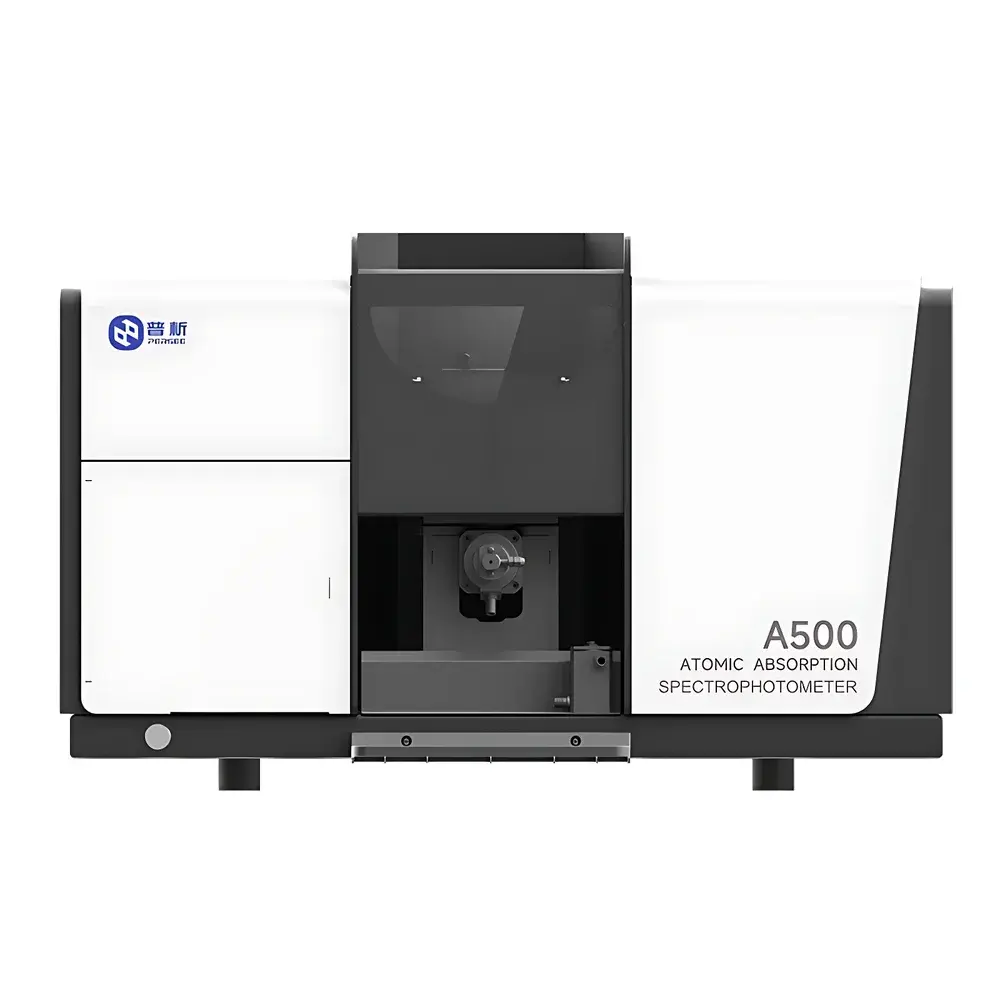
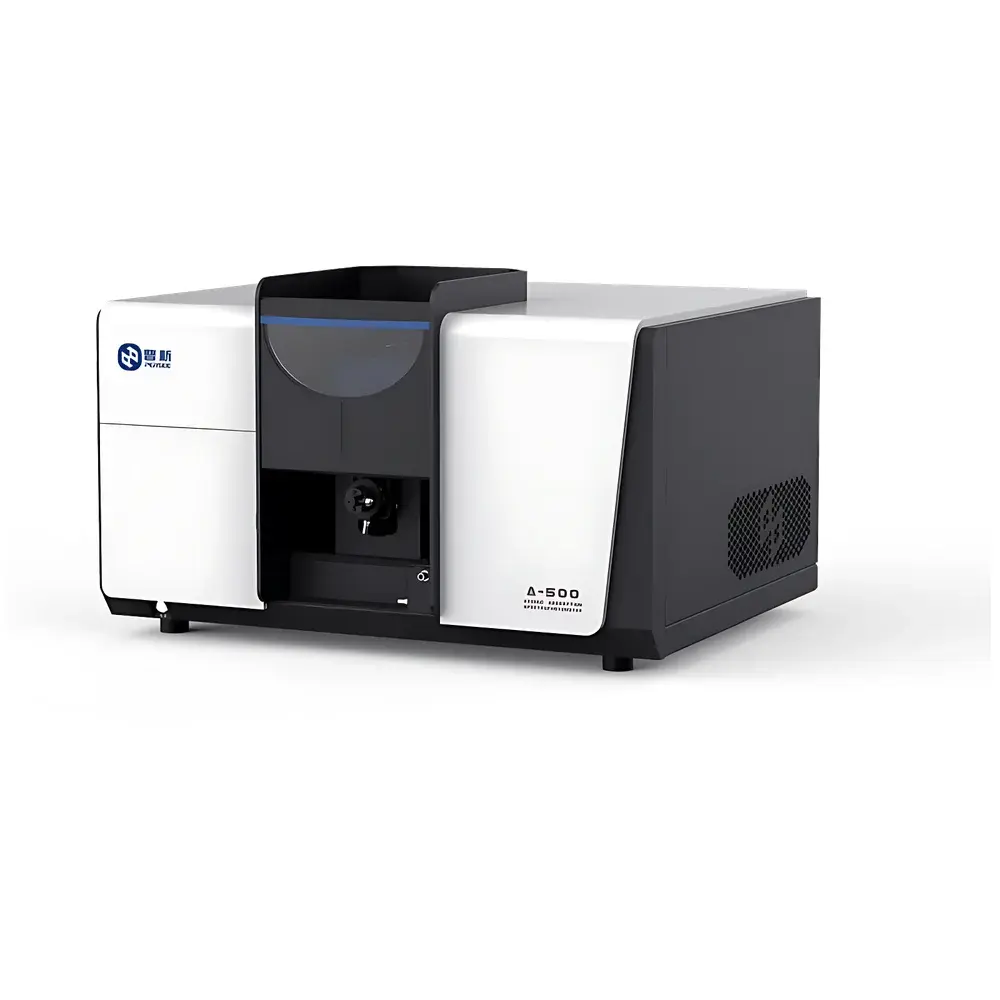
Persee A500 Flame and Graphite Furnace Atomic Absorption Spectrometer
| Brand | Persee |
|---|---|
| Origin | Beijing, China |
| Manufacturer Type | Direct Manufacturer |
| Instrument Type | Flame and Graphite Furnace AAS |
| Monochromator | Plane Grating |
| Optical System | Double-Beam |
| Detector | Photomultiplier Tube (PMT) |
| Background Correction | Zeeman Effect |
| Cu Sensitivity | >0.3 A at 5 ppm |
| Precision (RSD) | <0.4% |
| Cu Detection Limit | <0.004 µg/mL |
| Baseline Drift | <0.0008 A/30 min |
| Peak-to-Peak Baseline Noise | <0.0008 A/30 min |
Overview
The Persee A500 Flame and Graphite Furnace Atomic Absorption Spectrometer is a dual-mode analytical instrument engineered for high-precision quantitative elemental analysis across environmental, pharmaceutical, clinical, food safety, and metallurgical laboratories. It operates on the fundamental principle of atomic absorption spectroscopy—measuring the attenuation of characteristic hollow cathode lamp radiation as ground-state atoms in a flame or graphite furnace absorb light at element-specific wavelengths. The A500 integrates flame atomization for routine, higher-concentration analyses (e.g., Ca, Mg, Na in water or serum) with electrothermal graphite furnace atomization for ultra-trace detection (sub-ppt levels), enabling comprehensive coverage from µg/L to mg/L concentration ranges. Its double-beam optical architecture actively compensates for source intensity fluctuations and lamp aging, ensuring long-term photometric stability without manual recalibration.
Key Features
- Advanced all-reflective, aspheric, achromatic optical system with proprietary UV-enhanced high-reflectivity dielectric coatings—optimized for uniform beam profile and maximum photon throughput, directly improving signal-to-noise ratio (SNR) and detection sensitivity.
- Monolithic optical platform design: All critical optical components—including monochromator, beam splitter, and detector assembly—are mounted on a single thermally stable baseplate. This architecture minimizes micro-displacements due to thermal expansion or mechanical vibration, delivering exceptional optical alignment retention over extended operation cycles.
- Full-wavelength Zeeman background correction in both flame and graphite furnace modes: Utilizes polarization modulation of the magnetic field to separate atomic absorption from broadband and structured molecular absorption. Achieves background correction factors exceeding 150× at 1 A and 100× at 2 A—critical for complex matrices such as digested soil extracts or biological tissues.
- Dual-channel PMT detection system: Two independent photomultiplier tubes simultaneously monitor orthogonally polarized beams (parallel and perpendicular to the magnetic field). Enables real-time, ratio-based background subtraction without time-sharing or signal interruption—preserving analytical throughput and measurement integrity.
- Optimized plane grating monochromator with high groove density and low stray light performance: Ensures spectral resolution ≤0.2 nm at 200 nm, supporting accurate line isolation for adjacent emission lines (e.g., Fe 248.3 nm vs. Cr 248.4 nm).
Sample Compatibility & Compliance
The A500 supports aqueous liquid samples, acid-digested solids (EPA Method 3050B/3052), and slurries compatible with graphite furnace introduction. Flame mode accommodates sample uptake rates of 3–6 mL/min; graphite furnace mode enables programmable temperature ramping (drying, ashing, atomization, cleaning) with integrated argon purge control. The system complies with ISO/IEC 17025 requirements for calibration traceability and meets key regulatory method criteria including ASTM D1688 (copper in water), USP (heavy metals), and EPA 7000B (flame AAS) and 7010 (GFAAS). All instrument parameters, method files, and raw absorbance data are timestamped and logged—supporting GLP/GMP audit readiness and 21 CFR Part 11-compliant electronic record management when paired with validated laboratory information management systems (LIMS).
Software & Data Management
The A500 is operated via Persee’s AAS Control Suite—a Windows-based application supporting method development, sequence programming, calibration curve generation (linear, quadratic, weighted least-squares), QC check standards (spike recovery, continuing calibration verification), and automated report export (PDF, CSV, XML). Audit trail functionality logs all user actions, parameter changes, and instrument status events with immutable timestamps. Data files adhere to ASTM E1382-compliant metadata structure, facilitating interoperability with third-party statistical analysis tools (e.g., JMP, Minitab) and enterprise LIMS platforms via ODBC or HL7 interfaces.
Applications
- Environmental monitoring: Quantification of Pb, Cd, As, Ni, and Cr in drinking water, wastewater, and leachates per ISO 11885 and EPA 200.7.
- Pharmaceutical quality control: Heavy metal testing in active pharmaceutical ingredients (APIs) and excipients per ICH Q3D and USP /.
- Clinical toxicology: Trace-level blood lead (Pb-B) and urinary cadmium (Cd-U) analysis using graphite furnace protocols.
- Food and agriculture: Determination of essential (Fe, Zn, Cu) and toxic (Hg, Se) elements in fortified cereals, infant formula, and plant tissue digests.
- Geochemical analysis: Multi-element screening of rock, sediment, and ore samples following lithium metaborate fusion or aqua regia digestion.
FAQ
What atomization techniques does the A500 support?
The A500 integrates both air-acetylene flame atomization and electrothermal graphite furnace atomization within a single platform, allowing users to switch between modes without hardware reconfiguration.
Is Zeeman background correction available for all elements and wavelengths?
Yes—the system implements full-wavelength Zeeman correction using a permanent magnet and synchronized polarization modulator, effective across the entire 190–900 nm spectral range without wavelength-dependent limitations.
How is baseline stability verified during routine operation?
Baseline drift and noise are monitored automatically during warm-up and calibration sequences using internal dark-current measurements; results are logged and can be exported for trending analysis per ISO/IEC 17025 Clause 5.9.
Can the A500 be integrated into a regulated laboratory environment?
Yes—when deployed with validated software configuration, access-controlled user roles, and enabled audit trail logging, the A500 supports compliance with FDA 21 CFR Part 11, EU Annex 11, and GLP requirements for electronic records and signatures.
Related Products




