
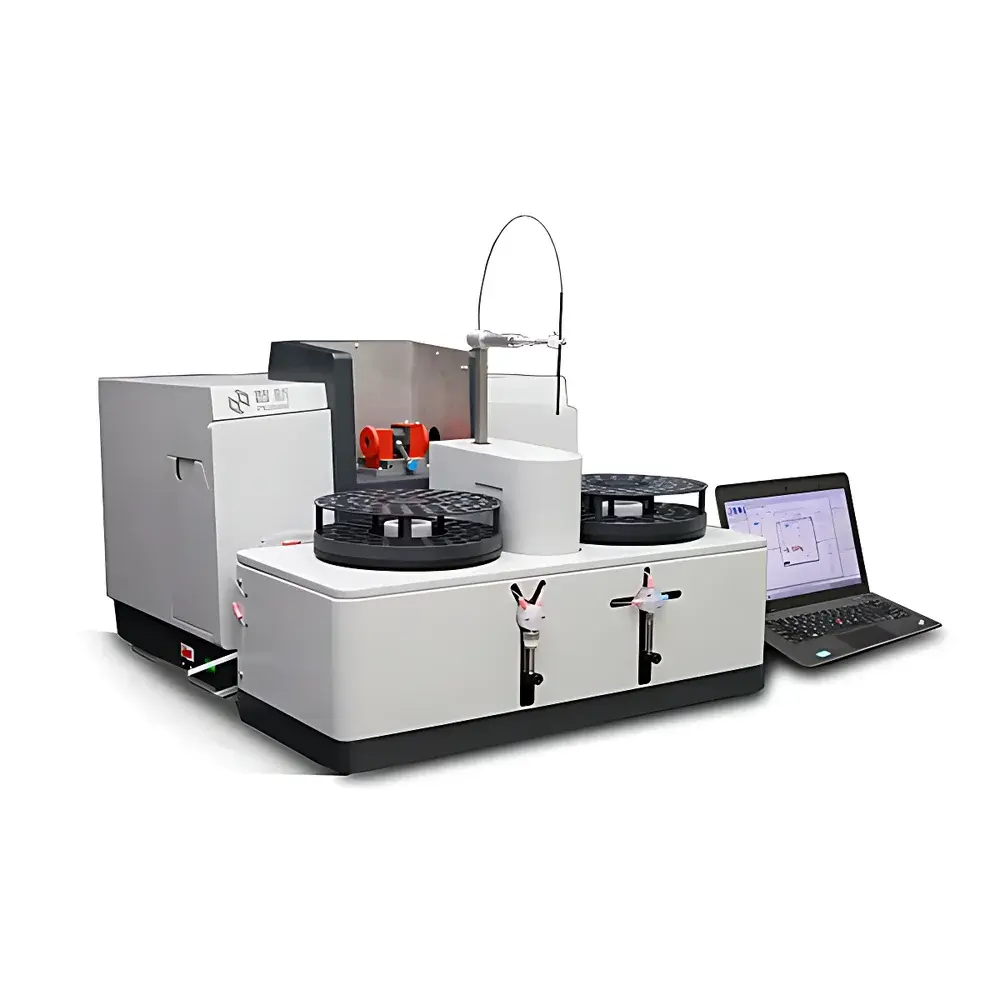
Persee CPG2/CPG2S Automated Lead and Cadmium Analyzer for Grain Analysis
| Brand | Persee |
|---|---|
| Origin | Beijing, China |
| Manufacturer Type | Direct Manufacturer |
| Region of Origin | Domestic (China) |
| Model | CPG2/CPG2S |
| Instrument Type | Graphite Furnace Atomic Absorption Spectrometer (GFAAS) |
| Monochromator | Plane Grating |
| Optical System | Double-Beam |
| Detector | Solid-State Detector |
| Background Correction | Automatic Deuterium/Hollow Cathode Lamp Dual-Beam Background Correction |
| Detection Limits | Pb: 0.02 mg/kg, Cd: 0.002 mg/kg |
Overview
The Persee CPG2/CPG2S Automated Lead and Cadmium Analyzer is a dedicated graphite furnace atomic absorption spectrometer engineered for high-throughput, regulatory-compliant quantification of lead (Pb) and cadmium (Cd) in cereal grains, rice, wheat, corn, and other staple food matrices. It operates on the fundamental principle of graphite furnace atomic absorption spectroscopy (GFAAS), wherein solid or liquid samples are atomized within a temperature-controlled graphite tube under inert atmosphere, and element-specific absorption of hollow cathode lamp radiation is measured at characteristic wavelengths (283.3 nm for Pb; 228.8 nm for Cd). The instrument integrates automated sample introduction, thermal program control, background correction, and spectral signal processing into a single platform optimized for food safety laboratories performing routine monitoring under national and international grain quality standards.
Key Features
- High-throughput automation: Processes up to 240 grain samples per 24-hour period, including integrated auto-digestion (microwave-assisted or hot-block assisted sample preparation modules optional), auto-dilution, and sequential dual-element measurement without manual intervention.
- Dual-element simultaneous determination: Engineered optical path and synchronized furnace temperature programming enable concurrent quantification of Pb and Cd in a single run—reducing cycle time and cross-contamination risk.
- Ultra-low detection capability: Achieves method detection limits (MDL) of 0.02 mg/kg for Pb and 0.002 mg/kg for Cd in homogenized grain flour, validated per ISO 11885 and GB 5009.12–2023 protocols.
- Double-beam optical architecture with plane grating monochromator: Ensures baseline stability and minimizes drift during extended analytical sequences; solid-state detector provides linear dynamic range exceeding 3 orders of magnitude.
- Intelligent background correction: Combines deuterium arc and high-intensity hollow cathode lamp sources with real-time dual-beam ratioing to correct for non-specific absorption and matrix-induced spectral interferences.
- Operator-independent workflow: Pre-loaded, certified reference material (CRM)-validated methods—including those aligned with China’s GB standards and Codex Alimentarius GLs for Pb/Cd in cereals—are accessible via one-click execution; no prior AAS expertise required.
Sample Compatibility & Compliance
The CPG2/CPG2S supports direct analysis of acid-digested grain extracts (HNO₃–H₂O₂ or HNO₃–HClO₄ digestates) and accommodates slurry sampling for select low-moisture milled grains. Sample introduction is fully automated via programmable autosampler with wash-rinse cycles compliant with ISO/IEC 17025 traceability requirements. All analytical procedures adhere to key regulatory frameworks including GB 5009.12–2023 (Pb), GB 5009.15–2014 (Cd), ISO 17294-2:2016 (water and digests), and EU Commission Regulation (EU) No 2023/915 (maximum levels of Cd in cereals). Instrument validation reports include linearity (r² ≥ 0.999), spike recovery (85–115%), repeatability (RSD ≤ 5% at 3× MDL), and long-term stability (≤2% signal drift over 8 h).
Software & Data Management
The embedded Persee Analytical Suite v4.2 provides full audit trail functionality compliant with FDA 21 CFR Part 11 requirements—including electronic signatures, user role-based access control, immutable raw data logging, and versioned method storage. All spectra, furnace temperature profiles, calibration curves, QC charts (control charts per ISO 8402), and final reports are stored in encrypted SQLite databases with optional network backup. Export formats include PDF analytical reports, CSV raw data, and XML-compatible structured output for LIMS integration (ASTM E1482, HL7 ADT).
Applications
- Routine surveillance testing of rice, wheat, barley, oats, and maize for compliance with national grain safety thresholds.
- Verification of Pb/Cd removal efficiency in grain cleaning, milling, and parboiling processes.
- Support for accreditation bodies conducting proficiency testing (PT) schemes under ISO/IEC 17043.
- Research applications in soil–plant transfer studies, biofortification trials, and heavy metal uptake modeling in cereal crops.
- Contract testing laboratories serving feed mills, export inspection agencies, and food processors requiring GLP-aligned documentation.
FAQ
What sample preparation is required prior to analysis?
Grain samples must be homogenized to ≤0.15 mm particle size, then subjected to closed-vessel microwave digestion (using HNO₃ + H₂O₂) or hot-block digestion (HNO₃ + HClO₄). Final digestates are diluted to 1–5% v/v nitric acid matrix and filtered (0.45 µm) before autosampler loading.
Is the system compatible with third-party CRM materials?
Yes—certified reference materials including NIST SRM 1568b (rice flour), ERM-BB184 (wheat flour), and GBW(E) 100348 (corn flour) are pre-configured in method libraries with assigned target values and uncertainty budgets.
How is instrument performance verified daily?
A built-in QC sequence executes automatic calibration verification using mid-level standards, blank assessment, and duplicate analysis of a control sample; results trigger visual alerts if %RSD > 5% or recovery falls outside 85–115%.
Can the CPG2S variant perform hydride generation for other elements?
No—the CPG2S is optimized exclusively for Pb and Cd via electrothermal atomization. For As, Se, or Hg analysis, Persee recommends coupling with the AS-20 hydride generation module (sold separately) and compatible HG-AAS instrumentation.
What maintenance intervals are recommended for graphite tubes and cuvettes?
Graphite tubes are rated for ≥300 firings under standard Pb/Cd thermal programs; lifetime is monitored automatically and logged in the maintenance calendar. Platform cups and Zeeman correction optics require biannual inspection and cleaning per ISO 9001 preventive maintenance schedule.



