
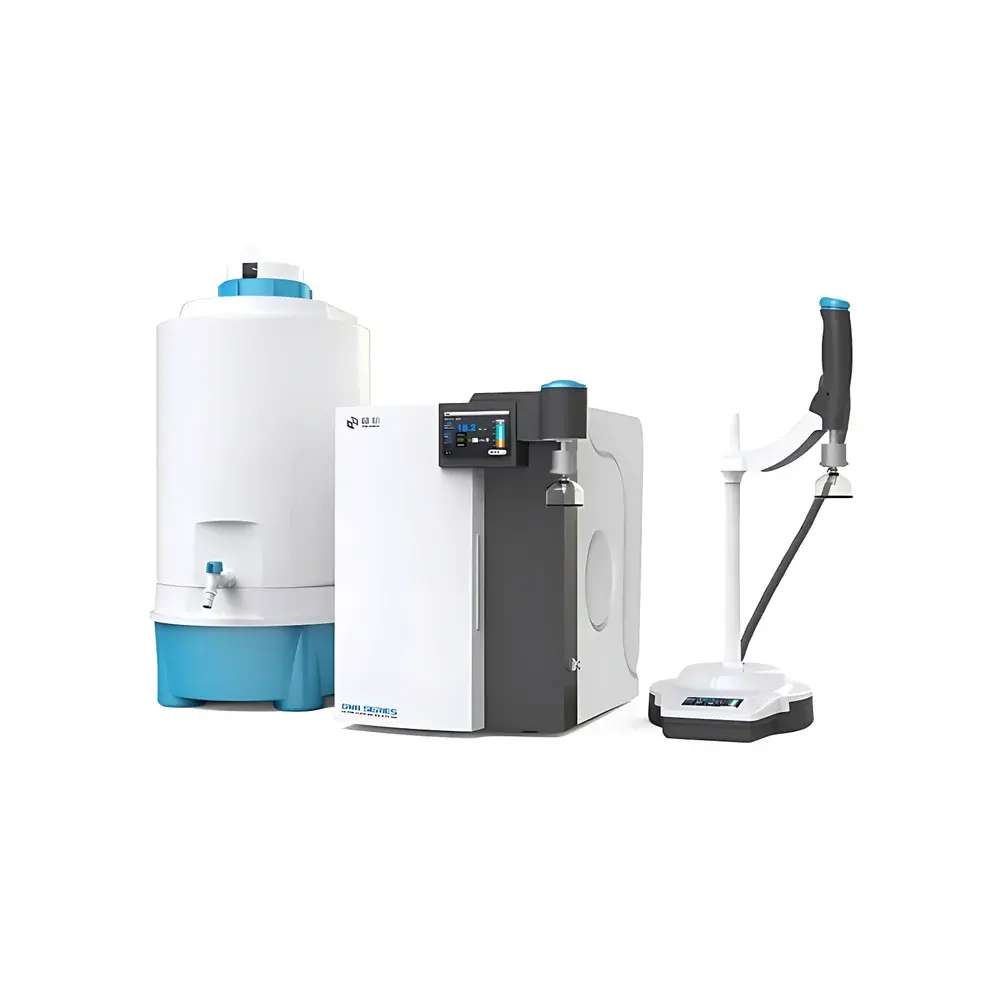
Persee GWB-1T/2T and GWB-1E/2E Ultra Pure Water Systems
| Brand | Persee |
|---|---|
| Origin | Beijing, China |
| Manufacturer Type | Original Equipment Manufacturer (OEM) |
| Product Category | Domestic |
| Model | GWB-1T/2T, GWB-1E/2E |
| Pricing Range | USD 12,500 – 21,000 (FOB Beijing) |
| Water Grade | ASTM Type I / ISO 3696 Grade 1 / CLSI EP28-A3c Class I |
| Resistivity | 18.2 MΩ·cm @ 25 °C |
| Heavy Metals & Soluble Silica | < 0.1 ppb |
| Total Organic Carbon (TOC) | ≤ 5 ppb |
| Microbial Count | < 1 CFU/1000 mL |
| Endotoxin | < 0.001 EU/mL |
| Particles (>0.1 µm) | < 1 particle/mL |
| Flow Rate (Pure Water Reservoir) | 5 L/min |
| Flow Rate (Ultra-Pure Water Dispense) | 2 L/min |
| Ion Removal Efficiency (Anions/Cations) | < 0.1 ppb residual |
Overview
The Persee GWB-1T/2T and GWB-1E/2E Ultra Pure Water Systems are engineered for continuous, on-demand production of Type I ultrapure water compliant with ASTM D1193-20, ISO 3696:1987, and CLSI EP28-A3c standards. These systems integrate a multi-stage purification architecture—comprising pre-treatment (activated carbon + dual-grade sediment filtration), reverse osmosis (RO), electrodeionization (EDI), and final polishing via dual-wavelength UV oxidation (185/254 nm) and ultra-low adsorption ion-exchange resins—to achieve reproducible resistivity ≥18.2 MΩ·cm at 25 °C, TOC ≤5 ppb, and endotoxin levels below 0.001 EU/mL. The GWB-1E/2E variants emphasize extended consumable lifetime through optimized EDI current density control and low-silica feedwater conditioning, while the GWB-1T/2T models prioritize high-volume reservoir-based distribution with integrated recirculation loop sanitization.
Key Features
- Multi-point dispensing architecture supporting up to two independent remote dispensing terminals, each configurable with five flow rates: drip mode, 0.5, 1.0, 1.5, and 2.0 L/min—enabling precise volumetric delivery for analytical instrumentation (e.g., HPLC, IC, ICP-MS) and cell culture applications.
- 4.3-inch capacitive touchscreen interface with real-time monitoring of critical parameters: resistivity, TOC, temperature, system pressure, filter saturation status, and UV lamp operational hours; all data logged with timestamped audit trail.
- GLP-compliant data management: internal storage for ≥12 months of usage history, plus SD card export capability supporting CSV format for traceable record retention per FDA 21 CFR Part 11 Annex 11 requirements.
- Modular consumable design with RFID-tagged cartridges enabling automatic recognition, remaining life calculation, and predictive replacement alerts—reducing operator dependency and minimizing downtime.
- Integrated air-gap storage tank with ultraviolet irradiation (254 nm) and periodic ozone sanitization cycles to suppress biofilm formation and maintain microbial counts <1 CFU/1000 mL over extended static periods.
Sample Compatibility & Compliance
The GWB series delivers water suitable for high-sensitivity analytical workflows requiring stringent purity specifications—including but not limited to: LC-MS mobile phase preparation, atomic absorption spectroscopy calibration, semiconductor wafer rinsing, and primary neuronal cell culture media formulation. All output meets or exceeds the maximum allowable limits defined in USP Water for Pharmaceutical Purposes, EP 2.2.43 Purified Water, and JP XVII Purified Water monographs. System validation documentation supports IQ/OQ protocols aligned with ISO/IEC 17025 laboratory accreditation frameworks.
Software & Data Management
Firmware v3.2+ supports local Ethernet connectivity for integration into centralized lab infrastructure monitoring platforms. Raw sensor outputs (resistivity, TOC, UV intensity, flow pulse counts) are sampled at 1 Hz and aggregated into 1-minute rolling averages. Audit logs include user ID (if configured with LDAP authentication), action type (e.g., “dispense start”, “cartridge replaced”), and geotagged timestamps. Data export complies with ALCOA+ principles (Attributable, Legible, Contemporaneous, Original, Accurate, Complete, Consistent, Enduring, Available) for regulatory submissions.
Applications
- HPLC and UHPLC mobile phase preparation where sub-ppb ionic contamination could compromise column longevity and peak symmetry.
- ICP-MS sample introduction systems requiring ultra-low background metals and particulates to prevent cone clogging and isobaric interferences.
- Molecular biology applications including qPCR master mix preparation and CRISPR-Cas9 reagent dilution where endotoxin-induced false positives must be eliminated.
- Calibration of reference electrodes and conductivity meters demanding stable, non-polarizing electrolyte solutions.
- Final rinse steps in cleanroom component manufacturing under ISO 14644-1 Class 5 environments.
FAQ
What is the recommended maintenance schedule for the GWB system?
Pre-filters require replacement every 6 months or after 3,000 L; RO membrane every 24 months or 20,000 L; EDI stack every 36 months; and polishing cartridge every 12 months or 5,000 L—whichever occurs first. Maintenance intervals are dynamically adjusted based on feedwater quality and usage metrics.
Can the system be validated for GMP compliance?
Yes. Full IQ/OQ documentation packages—including installation checklists, operational test scripts, calibration certificates for inline sensors, and performance qualification reports—are available upon request and align with Annex 15 and PIC/S PE 009-16 guidelines.
Is remote monitoring supported via cloud platform?
Local network monitoring is standard; cloud-based telemetry requires optional Persee LabLink Gateway (sold separately) and TLS 1.2–encrypted MQTT communication to meet HIPAA and GDPR data residency requirements.
How does the system handle feedwater variability?
Integrated feedwater quality sensors (conductivity, hardness proxy, chlorine detection) automatically adjust RO recovery ratio and EDI current setpoints to maintain consistent product water quality across inlet TDS ranges from 50–500 ppm.
Are spare parts and consumables stocked internationally?
Distributor networks in Germany, USA, Singapore, and Brazil maintain 90-day inventory coverage for all core consumables; lead time for non-stock items is 4–6 weeks ex-Beijing warehouse.



