
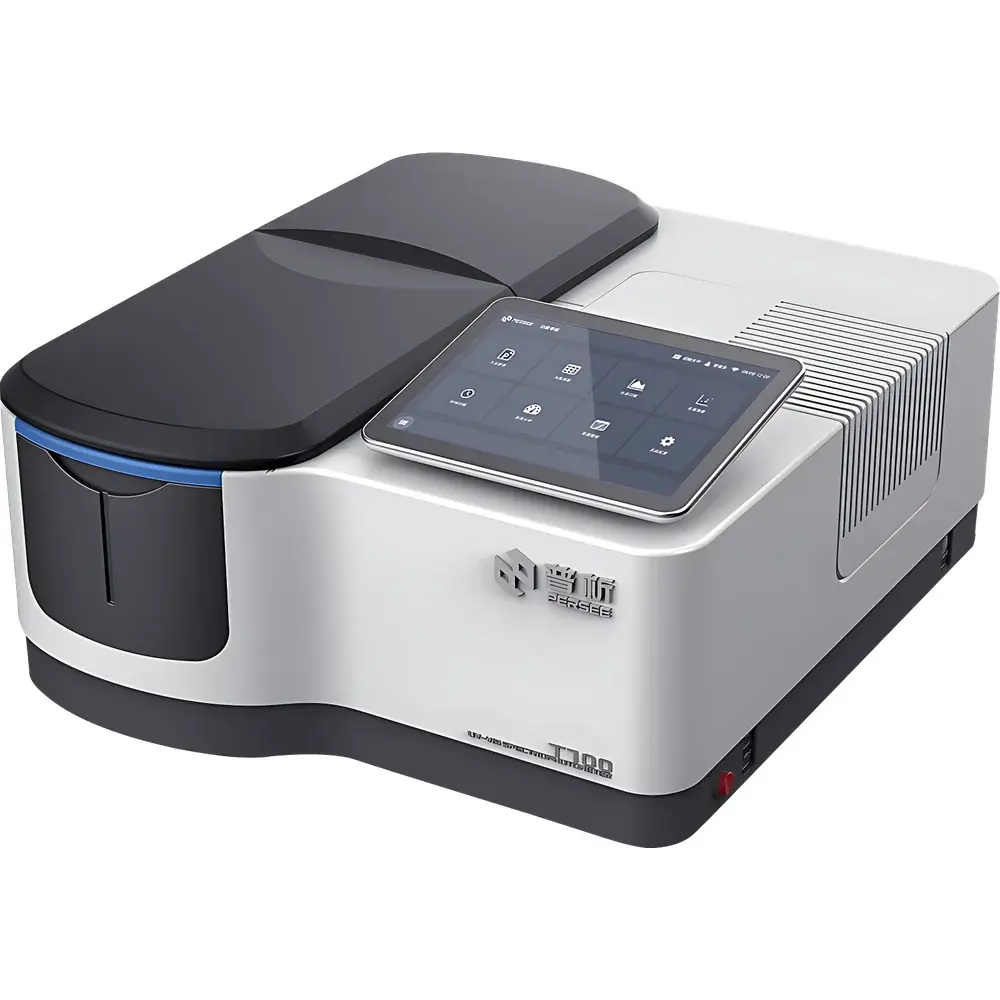
Persee T700/T600 Series Dual-Beam Ultraviolet-Visible Spectrophotometer
| Brand | Persee |
|---|---|
| Origin | Beijing, China |
| Manufacturer Type | Direct Manufacturer |
| Product Origin | Domestic (China) |
| Model | T700/T600 |
| Optical Design | Dual-Beam |
| Detector Type | Photocell |
| Wavelength Range | 190–1100 nm |
| Wavelength Accuracy | ±0.3 nm |
| Wavelength Repeatability | ≤0.1 nm |
| Spectral Bandwidth | 5 nm / 2 nm / 1 nm / 0.5 nm / 0.2 nm (selectable) |
| Stray Light | ≤0.01% T at 220 nm |
| Absorbance Range | –4 to +4 Abs |
| Scan Speed | Up to 30,000 nm/min |
| Interface | Ethernet port |
| Display | 9.7-inch capacitive touchscreen |
| Compliance | Meets JJG 178–2015 (Chinese National Verification Regulation for UV-Vis Spectrophotometers, Class I accuracy) |
Overview
The Persee T700/T600 Series Dual-Beam Ultraviolet-Visible Spectrophotometer is engineered for high-precision quantitative and qualitative analysis across academic, pharmaceutical, environmental, and industrial laboratories. Based on the dual-beam optical architecture—where sample and reference beams are measured simultaneously—the instrument inherently compensates for source intensity drift, lamp aging, and electronic fluctuations, ensuring exceptional photometric stability and long-term measurement reproducibility. Operating across a broad spectral range of 190–1100 nm, it supports routine absorbance, transmittance, reflectance, and kinetic measurements with configurable spectral bandwidths down to 0.2 nm—enabling resolution of closely spaced absorption peaks in complex matrices such as protein conjugates, dye formulations, or multi-component pharmaceutical solutions. Its optical path is optimized for minimal stray light (<0.01% T at 220 nm), critical for accurate low-transmittance measurements in highly absorbing samples (e.g., concentrated nucleic acid or colored wastewater). The system conforms to JJG 178–2015, China’s national metrological verification regulation for UV-Vis spectrophotometers, certified at Class I accuracy level—indicating compliance with stringent requirements for wavelength accuracy (±0.3 nm), repeatability (≤0.1 nm), and photometric linearity.
Key Features
- Dual-beam optical design with real-time reference compensation, eliminating baseline drift during extended scans or temperature fluctuations.
- Selectably variable spectral bandwidth (0.2–5 nm) via motorized slit control—enabling method-specific optimization for resolution versus signal-to-noise ratio.
- High-speed spectral acquisition: full 190–1100 nm scan completed in ≤2 seconds at maximum speed (30,000 nm/min), reducing throughput time without sacrificing data fidelity.
- 9.7-inch capacitive touchscreen interface with intuitive, icon-driven workflow—requiring only three taps to initiate measurement, calibration, or method recall.
- Rugged industrial enclosure featuring chemical-resistant coating (resistant to dilute acids, bases, and common organic solvents) and spill-containment sample compartment with removable, washable cuvette holder.
- Integrated Ethernet interface supporting TCP/IP communication for centralized instrument management, remote diagnostics, and secure data transfer within LIMS or ELN environments.
Sample Compatibility & Compliance
The T700/T600 accommodates standard 10-mm square quartz, glass, or plastic cuvettes (including matched pairs for ratio-based quantitation), as well as optional accessories for microvolume analysis (e.g., 2–5 µL capillary cells), solid reflectance measurement (integrating sphere), or flow-through applications (liquid chromatography detector coupling). All optical components—including grating, mirrors, and detector—are sealed against ambient dust and humidity to ensure consistent performance under routine laboratory conditions. The instrument meets JJG 178–2015 Class I verification criteria, and its firmware architecture supports audit-trail-enabling features required for GLP and GMP environments—including user-defined method locking, electronic signature prompts, and timestamped operation logs exportable via USB or network. While not pre-certified to FDA 21 CFR Part 11, the system’s access control, data integrity safeguards, and traceable calibration history provide a compliant foundation for validation protocols.
Software & Data Management
The embedded operating system delivers native support for method creation, spectral overlay, derivative spectroscopy, multi-wavelength quantitation, and kinetic time-course analysis. Methods—including wavelength programs, calibration curves, and report templates—can be saved internally or exported to USB storage in CSV, PDF, or proprietary .SPC format. Network connectivity enables synchronized method deployment across multiple instruments and integration with enterprise-level data repositories. Optional PC-based software (Persee UVWin Pro) extends functionality with advanced curve-fitting algorithms (e.g., Gaussian deconvolution), spectral library matching, and automated compliance reporting aligned with ISO/IEC 17025 documentation standards. All data files include embedded metadata: instrument ID, operator login, calibration date, and environmental sensor readings (if equipped).
Applications
- Pharmaceutical QC: Active pharmaceutical ingredient (API) assay per USP , excipient identification, dissolution testing, and stability-indicating assays.
- Environmental monitoring: Nitrate/nitrite, phosphate, COD, and heavy metal speciation (e.g., Cr(VI) via diphenylcarbazide method) in drinking water and wastewater per EPA and ISO methods.
- Life sciences: Nucleic acid quantification (A260/A280 ratios), protein concentration (BCA/Lowry), enzyme kinetics (NADH/NADPH monitoring at 340 nm), and cell culture density (OD600).
- Materials science: Thin-film thickness estimation via interference fringe analysis, pigment dispersion characterization, and semiconductor bandgap determination.
- Academic research & teaching: Spectral library development, Beer–Lambert law validation, and comparative photostability studies under controlled irradiation.
FAQ
What is the difference between the T700 and T600 models?
The T700 series includes enhanced hardware features including automatic slit width selection, expanded method memory, and optional Ethernet-enabled remote control; the T600 series offers fixed or manually selectable slits and streamlined operation optimized for routine QA/QC labs.
Is the instrument compatible with third-party cuvettes and accessories?
Yes—standard 10-mm pathlength cuvettes (quartz, glass, PMMA) from major suppliers (e.g., Hellma, Starna, Sarstedt) are fully supported. Optional accessories—including fiber-optic probes, temperature-controlled cells, and integrating spheres—are available through Persee’s certified partner network.
How is wavelength calibration verified and maintained?
Wavelength accuracy is factory-verified using holmium oxide and didymium oxide reference filters traceable to NIM (National Institute of Metrology, China). Users may perform periodic verification using these standards; no user-serviceable optical alignment is required.
Can measurement data be integrated into a LIMS or ELN system?
Yes—via Ethernet interface using standard HTTP POST or FTP protocols. Raw spectral data, metadata, and processed results can be automatically routed to designated servers with configurable naming conventions and folder structures.
Does the system support regulatory compliance for pharmaceutical manufacturing?
The T700/T600 provides foundational capabilities for 21 CFR Part 11 and EU Annex 11 compliance—including user authentication, audit trails, and electronic signatures—when deployed with validated software configuration and documented change control procedures.






