
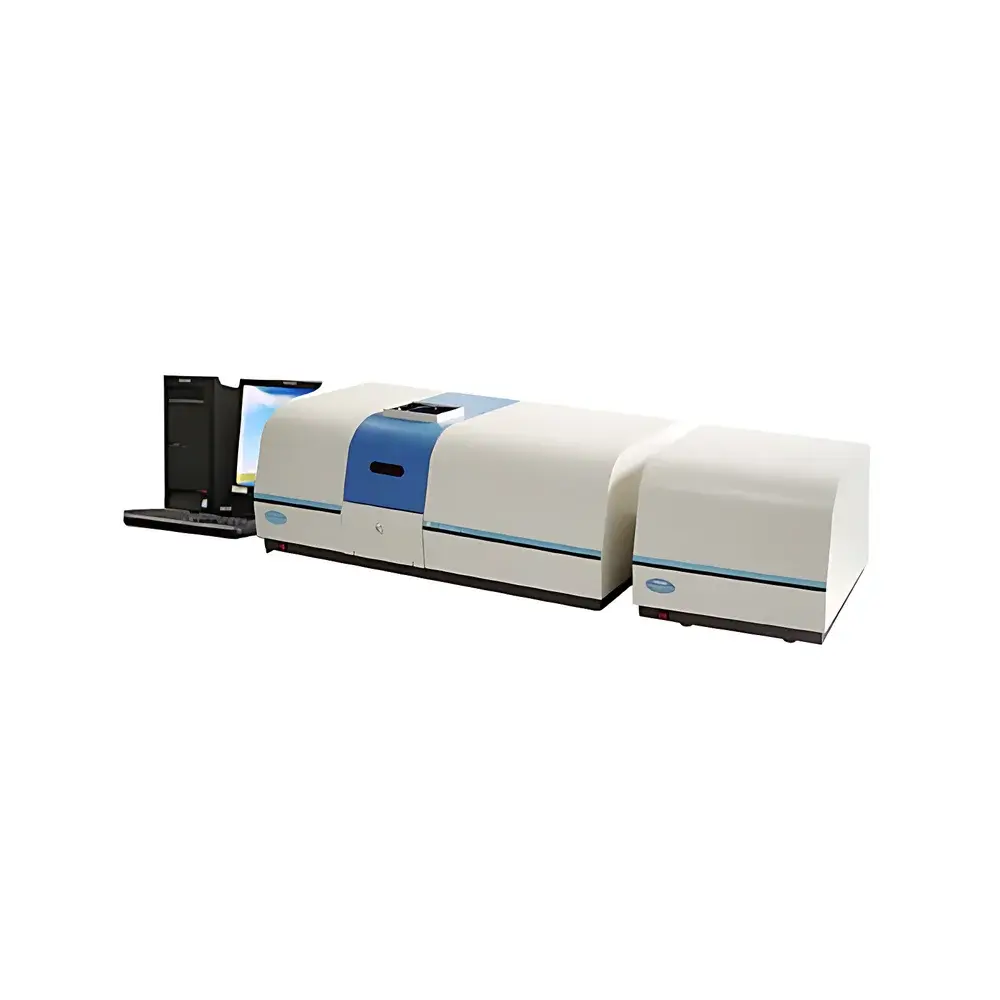
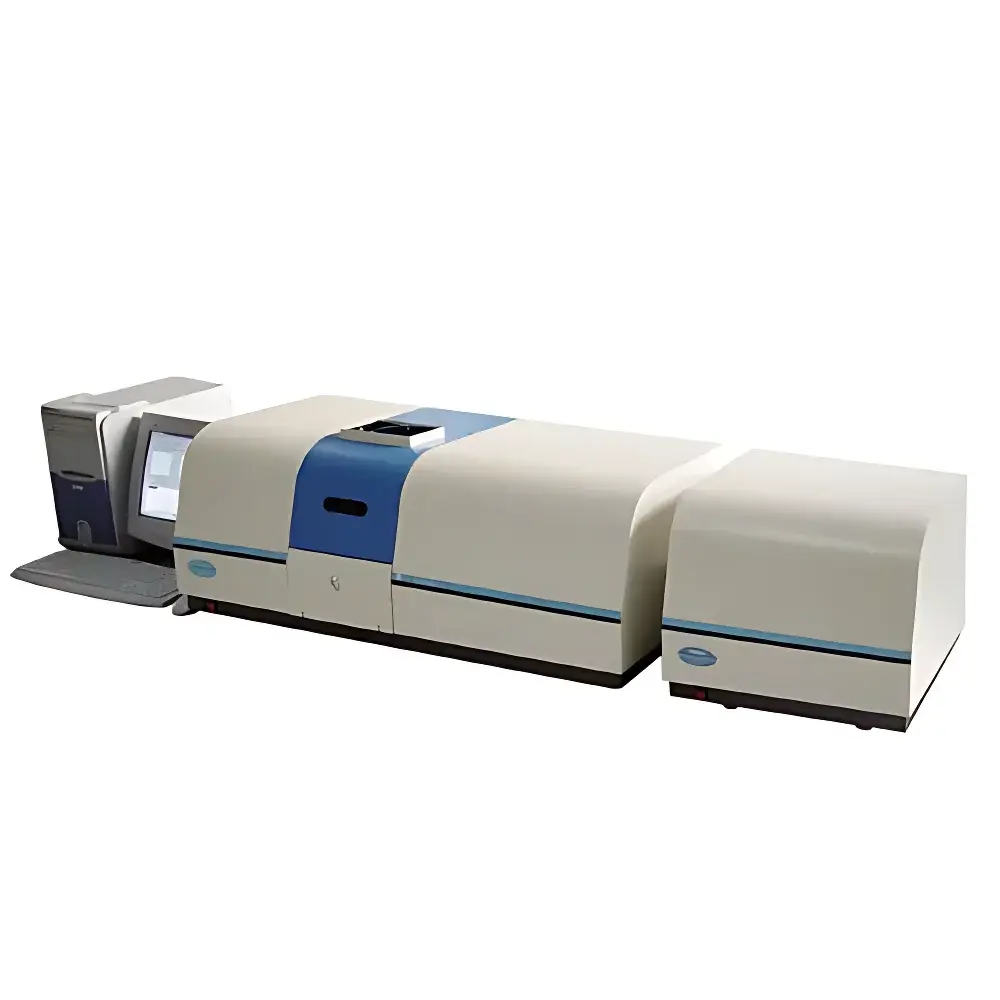
Persee TAS-986 Flame and Graphite Furnace Atomic Absorption Spectrophotometer
| Brand | Persee |
|---|---|
| Origin | Beijing, China |
| Manufacturer Type | Original Equipment Manufacturer (OEM) |
| Instrument Type | Flame and Graphite Furnace AAS |
| Monochromator | Concave Grating |
| Optical System | Double-Beam |
| Detector | Photomultiplier Tube (PMT) |
| Background Correction | Deuterium Lamp + Self-Reversal Method |
| Wavelength Accuracy | ±0.25 nm |
| Spectral Bandwidth | ≤0.15 nm |
| Detection Limit (Flame, Cu) | 0.006 µg/mL |
| Detection Limit (GFAAS, Cd) | 1.0 pg |
| Characteristic Concentration (Cu) | <0.04 µg/mL per 1% absorption |
| Baseline Stability (Static) | ±0.004 A/30 min |
| RSD (Flame Cu) | <1% |
| RSD (GFAAS Cu) | <3.0% |
| RSD (GFAAS Cd) | <4.0% |
Overview
The Persee TAS-986 is a dual-mode atomic absorption spectrophotometer engineered for high-precision elemental quantification in environmental, pharmaceutical, clinical, and industrial laboratories. It integrates flame atomic absorption spectroscopy (FAAS) and graphite furnace atomic absorption spectroscopy (GFAAS) within a single platform, enabling trace- to ultra-trace metal analysis across diverse sample matrices. The instrument operates on the fundamental principle of atomic absorption—measuring the attenuation of narrow-line radiation from element-specific hollow cathode lamps as ground-state atoms in a flame or graphite tube absorb photons at characteristic wavelengths. Its double-beam optical architecture compensates for source drift and lamp intensity fluctuations, ensuring long-term photometric stability. The concave grating monochromator delivers high spectral resolution with minimal stray light, while the photomultiplier tube detector provides excellent signal-to-noise ratio and dynamic range. Designed and manufactured in Beijing by Persee General Instruments Co., Ltd.—a certified ISO 9001 OEM—the TAS-986 meets rigorous international design and manufacturing standards for analytical instrumentation.
Key Features
- Integrated flame and transversely heated graphite furnace (THGA) atomization systems, supporting both routine and ultra-trace analysis
- Real-time flame status monitoring—including ignition verification, flame height optimization, and flame-out detection—to enhance operational safety and method robustness
- Comprehensive gas and cooling subsystem monitoring: integrated sensors track acetylene/oxygen pressure, argon flow rate, and cooling water flow, triggering interlocks upon deviation from preset thresholds
- Dual background correction: deuterium lamp continuum correction for broad-band absorption and self-reversal (SR) correction for structured background in graphite furnace mode—enabling accurate measurement in complex matrices such as biological digests and wastewater
- Automated wavelength scanning and peak search with ±0.25 nm wavelength accuracy and ≤0.15 nm spectral bandwidth
- Thermally stabilized optical bench and low-drift electronics, achieving ±0.004 A baseline stability over 30 minutes under static conditions
Sample Compatibility & Compliance
The TAS-986 accommodates liquid samples ranging from aqueous standards and acid-digested environmental extracts to organic-solvent-based pharmaceutical formulations. With its THGA system, it supports direct solid sampling (via slurry introduction) and micro-volume injection (5–20 µL), minimizing matrix interference and memory effects. The instrument complies with core regulatory frameworks governing elemental testing: methods developed on the TAS-986 are compatible with EPA Methods 200.7, 200.9, and 7000B; ASTM D1688 (copper in fuel oils); ISO 11885 (water quality—determination of elements by AAS); and USP and for elemental impurities in drug substances. Its hardware architecture supports audit-ready operation under GLP and GMP environments, including secure user access control, electronic signature capability, and full method parameter logging—facilitating alignment with FDA 21 CFR Part 11 requirements when paired with compliant LIMS or data management software.
Software & Data Management
The TAS-986 is operated via Persee’s proprietary AAS Control Suite—a Windows-based application offering intuitive method setup, real-time spectral visualization, multi-point calibration (linear and quadratic), and QC charting (Levey-Jennings, Shewhart). All acquisition parameters—including lamp current, slit width, integration time, furnace temperature ramp profiles, and background correction mode—are fully programmable and stored with metadata (operator ID, timestamp, instrument serial number). Raw absorbance data, peak area/height integrals, and calibration curves are exported in CSV and XML formats for third-party statistical analysis or integration into enterprise laboratory informatics systems. Audit trails record all critical events: method edits, calibration updates, and result overrides—ensuring full traceability required for ISO/IEC 17025 accreditation.
Applications
- Environmental monitoring: quantification of Pb, Cd, As, Cr, and Ni in drinking water, soil leachates, and industrial effluents per regulatory action levels
- Pharmaceutical quality control: verification of catalyst residues (e.g., Pd, Pt) in active pharmaceutical ingredients (APIs) per ICH Q2(R2) validation guidelines
- Clinical toxicology: determination of serum Zn, Cu, and Se in nutritional assessment panels
- Food safety: screening for heavy metals in infant formula, seafood, and fortified cereals against Codex Alimentarius limits
- Geochemical research: multi-element analysis of rock digests using standard addition and matrix-matched calibration strategies
FAQ
What atomization modes does the TAS-986 support?
It supports both air-acetylene flame atomization and transversely heated graphite furnace atomization, with automated switching between modes.
Is the instrument compliant with FDA 21 CFR Part 11?
The hardware and firmware support Part 11–aligned workflows—including electronic signatures and audit trails—when implemented with validated software configurations and administrative controls.
Can the TAS-986 perform sequential multi-element analysis?
It is a single-channel instrument optimized for high-sensitivity, element-specific analysis; sequential multi-element capability requires manual lamp exchange and method reconfiguration.
What maintenance intervals are recommended for the graphite furnace?
Graphite tube replacement is typically required after 200–500 firings depending on matrix load; platform cleaning and furnace alignment checks are advised every 50 runs.
Does the system include compliance documentation for ISO/IEC 17025?
Factory calibration certificates, traceable to NIST SRMs, and performance verification reports (including detection limit, precision, and linearity data) are supplied with each unit to support laboratory accreditation efforts.
Related Products




