
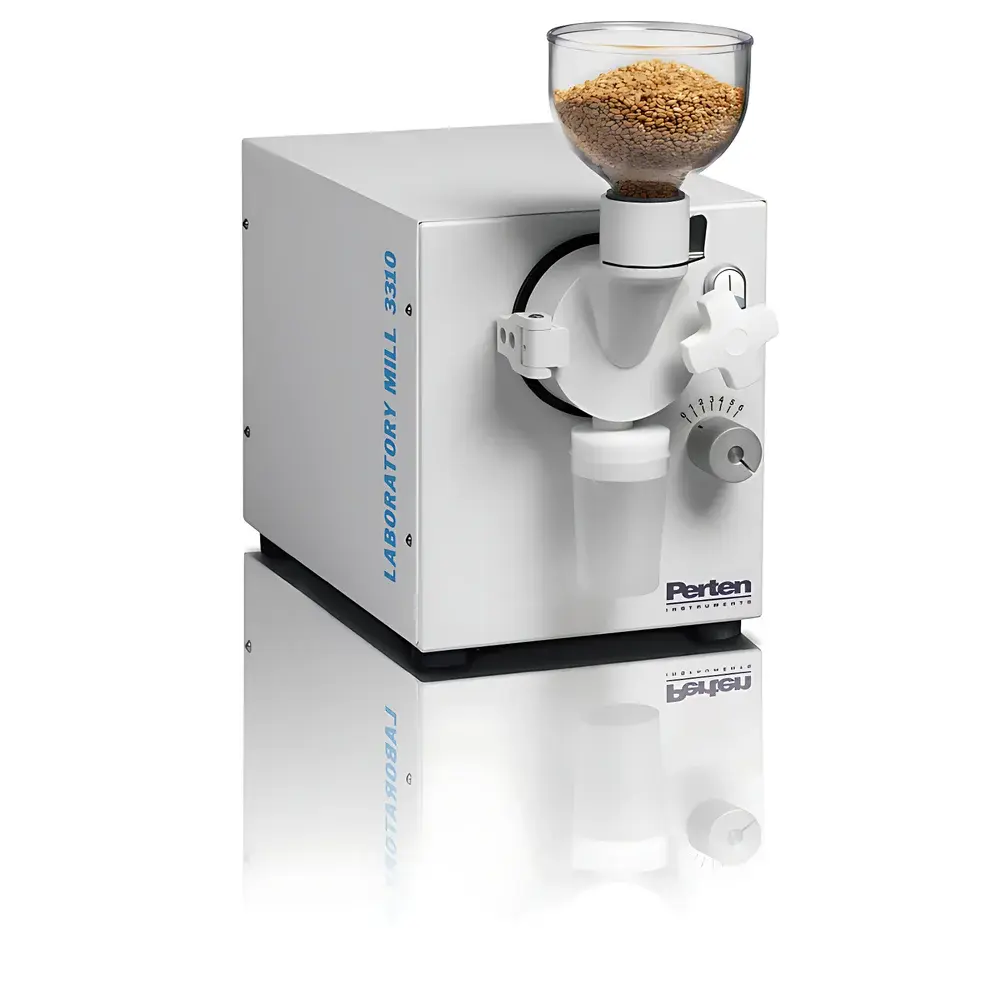
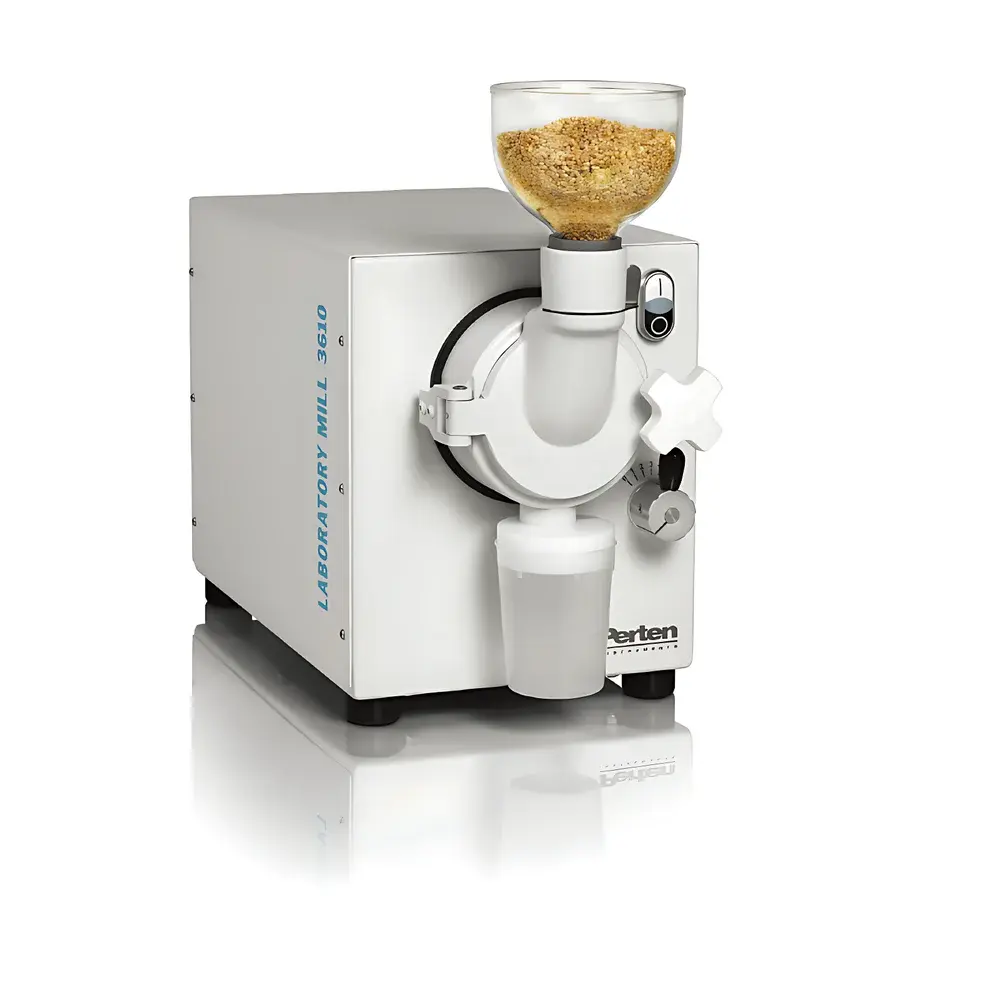
Perten 3310 & 3600 Disc Mill
| Brand | Perten |
|---|---|
| Origin | Finland |
| Model | 3310 and 3600 |
| Sample Type | Hard, low-fat grains (≤20% fat) |
| Feed Size | 40–80 mesh |
| Output Particle Size | ≥0.5 mm |
| Batch Capacity | ≤150 g |
| Grinding Disc Diameter | 75 mm (3310), 100 mm (3600) |
| Motor Power | 0.5 kW |
| Voltage/Frequency | 110/220/440 V, 50/60 Hz, single- or three-phase |
| Net Weight | 33 kg (3310), 34 kg (3600) |
| Dimensions (L×W×H) | 440×550×260 mm (3310), 560×445×220 mm (3600) |
| Disc Adjustment | 6-position gap setting |
| Disc Types | Type I (standard, moisture analysis), Type II (fine, PSI testing), Type III (coarse, high-moisture oats/barley) |
| Optional Accessory | 3170 Motorized Feeder with rubber impeller |
Overview
The Perten 3310 and 3600 Disc Mills are precision-engineered laboratory disc mills designed for reproducible, low-heat sample comminution of cereals, legumes, and other low-fat botanical materials (≤20% fat content). Operating on the principle of shear-driven particle size reduction between two parallel, counter-rotating abrasive discs, these mills minimize thermal degradation and moisture loss—critical for accurate moisture determination by oven-drying (AOAC 925.10, ISO 712) or near-infrared (NIR) spectroscopy. Unlike impact or rotor-based grinders, the disc geometry ensures uniform compressive-shear stress distribution across the sample bed, yielding consistent particle morphology and bulk density essential for downstream analytical methods including NIR calibration, protein quantification, and particle size index (PSI) assessment per AACC Method 55-30.
Key Features
- Disc gap adjustment with six discrete positions enables precise control over output particle coarseness without tooling—optimized for method-specific requirements (e.g., moisture vs. PSI).
- Three interchangeable disc types: Type I (standard, ASTM D7423-compliant for moisture prep), Type II (fine-grind, for PSI and hardness profiling), and Type III (coarse-grind, engineered for high-moisture, fibrous grains like oats and barley).
- Direct-drive motor (0.5 kW) eliminates belt slippage and delivers stable rotational torque; grinding cycle time is 10–15 seconds for 50 g batches, ensuring throughput without thermal accumulation.
- Robust cast-metal housing and ergonomic one-hand latch door facilitate rapid access, cleaning, and maintenance under GLP-compliant lab workflows.
- Low-noise operation (<72 dB(A)) meets ISO 7779 acoustic emission standards for shared laboratory environments.
- 250 mL polypropylene sample cup with optional snap-lock lid supports traceable sample handling, transport, and archival storage—compatible with automated weighing and NIR vial loading systems.
Sample Compatibility & Compliance
These mills are validated for use with hard, dry-to-moderately moist botanical matrices: wheat, corn, soybean, pea, barley, and rice (dehulled or hulled). They are explicitly approved by AOAC International and AACC for sample preparation in official methods—including moisture analysis (AACC 44-15A, ISO 712), protein NIR calibration (AACC 39-10), and particle size index determination (AACC 55-30). The absence of measurable moisture loss (<0.15% w/w deviation vs. unground reference) satisfies USP and FDA 21 CFR Part 11 requirements for documented analytical sample integrity. All models comply with CE Machinery Directive 2006/42/EC and IEC 61000-6-3 EMC standards.
Software & Data Management
While the 3310/3600 operate as standalone mechanical instruments, their output is fully integrated into digital quality management ecosystems. Perten’s GrainCheck™ and Infratec™ software platforms accept batch metadata (grind time, disc type, gap setting, operator ID) via manual entry or barcode-scanned sample labels. Audit trails record all parameter changes per GLP Annex 11 and 21 CFR Part 11 requirements. Optional integration with LIMS (e.g., Thermo Fisher SampleManager, LabWare) enables automatic propagation of grind parameters to associated NIR spectra or moisture assay records.
Applications
- Preparation of homogenized cereal samples for oven-dry moisture determination and NIR calibration modeling.
- Generation of standardized particle distributions for AACC 55-30 Particle Size Index (PSI) measurement—correlating with wheat hardness classification.
- Routine grinding of feedstock prior to protein, starch, or fiber analysis by HPLC, enzymatic assays, or enzymatic digestion protocols.
- High-reproducibility comminution of certified reference materials (CRMs) used in inter-laboratory proficiency testing (e.g., ICC 173, AOAC Proficiency Testing Programs).
- Supporting GMP-compliant release testing in grain receiving and milling facilities where raw material specification compliance is governed by ISO 22000 or BRCGS standards.
FAQ
What sample types are incompatible with the 3310/3600 Disc Mill?
Samples with fat content exceeding 20% (e.g., oilseeds, nuts, animal tissues) are not recommended due to potential disc clogging and inconsistent heat dissipation. Fibrous or elastic materials (e.g., dried grasses, rubbery roots) may cause uneven wear and require pre-drying or alternative milling strategies.
Can the 3310/3600 be used for regulatory submissions?
Yes—the mills are referenced in AOAC Official Methods of Analysis and AACC Approved Methods, and their performance data meet ISO/IEC 17025 method validation criteria for sample preparation steps when operated per Perten’s SOP-GRIND-01.
Is the 3170 Feeder necessary for routine operation?
It is optional but strongly recommended for high-moisture (>14% wb), shelled, or irregularly shaped grains (e.g., paddy rice, oat groats) to ensure uniform feed rate and prevent bridging or disc overload.
How often should grinding discs be replaced?
Under normal use (≤500 batches/year), Type I and II discs maintain dimensional stability for ≥1,200 grinding cycles; Type III coarse discs last ≥800 cycles. Perten provides a disc wear gauge kit (Part No. 3310-004) for routine verification per ISO 17025 internal calibration procedures.



