
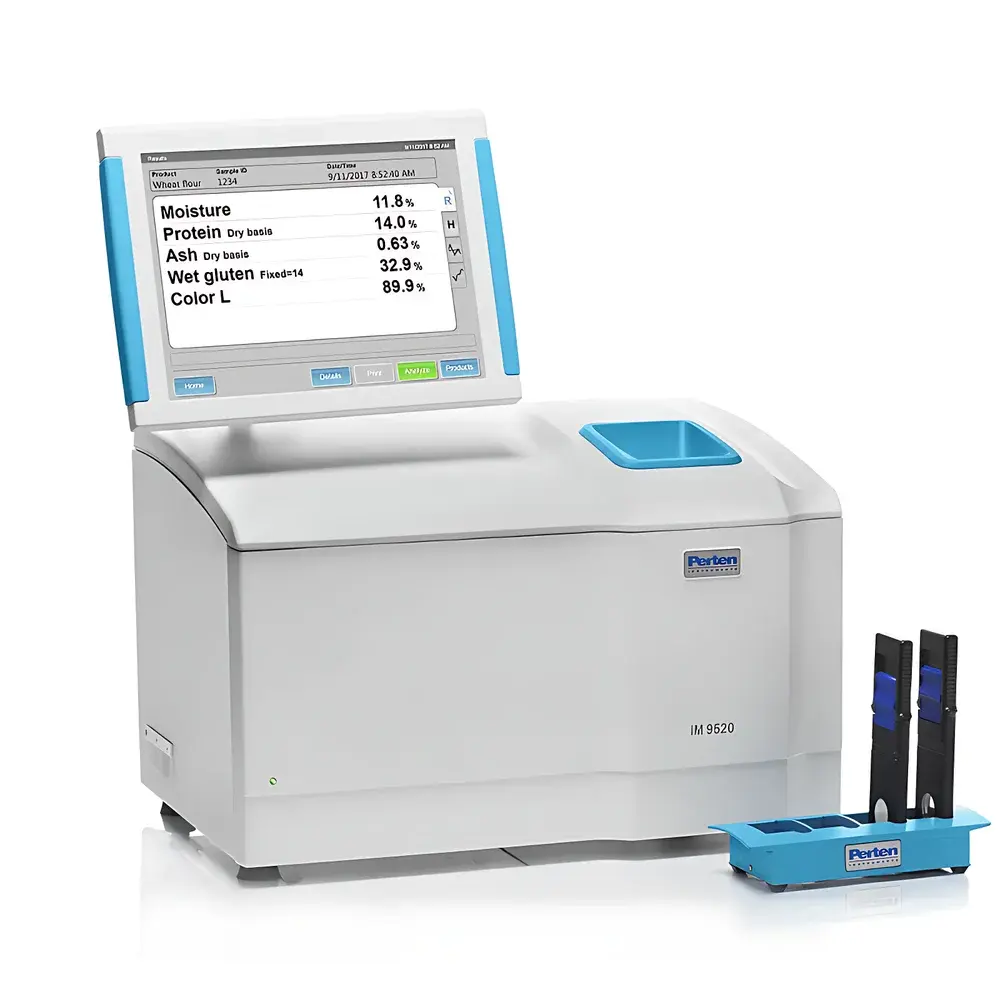
Perten IM9520 Dedicated Flour Near-Infrared Spectrometer
| Brand | Perten |
|---|---|
| Origin | Sweden |
| Model | IM9520 |
| Instrument Type | Benchtop Laboratory NIR Spectrometer |
| Application Domain | Cereal Grains & Milled Flour |
| Optical Principle | Grating Scanning Transmission NIR |
| Wavelength Range | 570–1100 nm |
| Scan Speed | 10 scans/minute |
| Data Acquisition Interval | 6 seconds per measurement |
| Sample Mode | Transmission |
| Chemometrics Software | Unscrambler® |
| Calibration Framework | NIST-traceable wavelength calibration |
| Compliance | ASTM D6341 (NIR for cereal analysis), ISO 12099:2017 (Animal feeding stuffs — General guidelines for the determination of chemical constituents by NIR spectroscopy), GLP-compliant data audit trail support via NetPlus™ |
Overview
The Perten IM9520 Dedicated Flour Near-Infrared Spectrometer is an industrial-grade benchtop analyzer engineered specifically for rapid, non-destructive quantification of critical compositional parameters in milled wheat flour, rye flour, semolina, bran, and related cereal powders. Operating on the principle of transmission-mode near-infrared spectroscopy with a precision grating scanning optical system, the IM9520 captures spectral response across a validated 570–1100 nm range—optimized for strong absorption features of water (O–H stretch overtones), protein (N–H and C–H combinations), ash-related minerals (via matrix scattering effects), and starch-related chromophores. Each instrument undergoes factory calibration against NIST-traceable wavelength standards, ensuring spectral fidelity and cross-instrument method transferability without revalidation. Designed for integration into both QC laboratories and pilot-scale milling environments, the IM9520 delivers repeatable quantitative results—including moisture, protein, ash, wet gluten, and color—in approximately 25 seconds per sample, supporting real-time process monitoring and specification compliance verification.
Key Features
- Flour-optimized optical path: Fixed transmission geometry with single-block quartz optics ensures long-term stability, minimal alignment drift, and resistance to dust and humidity ingress (IP54-rated enclosure).
- Intuitive 12-inch color touchscreen interface with context-aware workflow menus—designed for operation by technicians with no prior spectroscopy training.
- Dedicated cuvette loading station enabling consistent sample presentation, eliminating operator-induced variability in packing density and layer thickness.
- Integrated brush-cleaning port for rapid, residue-free cuvette maintenance between analyses—critical for maintaining spectral baseline integrity across high-throughput workflows.
- Multi-algorithm regression engine supporting Partial Least Squares (PLS), Artificial Neural Networks (ANN), and Honig’s Regression (HR) for robust calibration modeling across diverse wheat varieties and milling conditions.
- Full Ethernet and USB 2.0 connectivity (4 ports) enabling direct integration with LIMS, ERP systems, and automated data archival infrastructure.
Sample Compatibility & Compliance
The IM9520 is validated for homogeneous, free-flowing dry milled products including hard red winter wheat flour, soft white flour, durum semolina, rye flour, oat flour, and wheat bran. Sample particle size distribution must conform to ASTM D6341 requirements (i.e., ≤ 0.5 mm nominal sieve opening). The instrument complies with ISO 12099:2017 for NIR-based cereal analysis methodology, supports 21 CFR Part 11–compliant electronic signatures and audit trails when deployed with Perten NetPlus™ software, and meets GLP documentation requirements for calibration history, performance verification logs, and user access control. Optional certified reference materials (CRM) kits—including traceable ash, moisture, and protein check samples—are supplied with NIST-aligned certificate of analysis and defined acceptance limits for daily system suitability testing.
Software & Data Management
Data acquisition, preprocessing, and quantification are managed through Unscrambler® X (v10.5 or later), licensed and pre-configured with Perten-specific flour calibration packages. All calibrations are developed using >30 years of global grain spectral libraries and validated per AOAC Official Method 2014.02. Raw spectra, second-derivative transforms, residual plots, and prediction confidence intervals are stored in HDF5 format with embedded metadata (operator ID, timestamp, environmental RH/T, instrument serial number). NetPlus™ cloud platform provides role-based remote access to real-time results, historical trend dashboards, multi-instrument comparison reports, and automated alerting for out-of-specification events—accessible via secure HTTPS from any modern browser without local client installation.
Applications
- Mill QC: Real-time verification of flour specifications pre-bagging; detection of blending anomalies or mill stream contamination.
- Bakery R&D: Correlation of NIR-predicted protein quality indices (e.g., gluten strength proxies) with rheological test outcomes (Farinograph, Mixolab).
- Grain procurement: Rapid assessment of incoming wheat lots for protein and moisture grading prior to cleaning and tempering.
- Regulatory reporting: Generation of auditable records for ISO 22000, BRCGS, or FSSC 22000 food safety management systems.
- Process optimization: Statistical process control (SPC) charting of ash and moisture trends across shifts to identify grinding roll wear or conditioning variability.
FAQ
Is the IM9520 suitable for whole grain or intact kernels?
No—the IM9520 is designed exclusively for finely milled, homogenized powders. Whole grains require reflectance-mode instrumentation with specialized sample holders and different chemometric models.
Can existing Inframatic 9500 calibrations be migrated to the IM9520?
Yes—due to NIST-traceable wavelength alignment and identical optical architecture, legacy PLS models from the Inframatic 9500 series are directly transferable with only minor slope/offset adjustment validation.
What maintenance is required beyond routine cuvette cleaning?
Annual wavelength verification using Perten-supplied CRMs and biannual lamp intensity checks are recommended; no optical alignment or detector recalibration is field-serviceable.
Does the system support custom calibration development?
Yes—Perten offers full-service calibration development, including sample collection strategy, spectral acquisition protocol design, model validation per ISO 12099 Annex B, and documentation for regulatory submission.
How is data security ensured in NetPlus™ deployments?
All communications use TLS 1.2+ encryption; user authentication follows OAuth 2.0; audit logs record all data exports, calibration modifications, and user logins with immutable timestamps.
Related Products





