
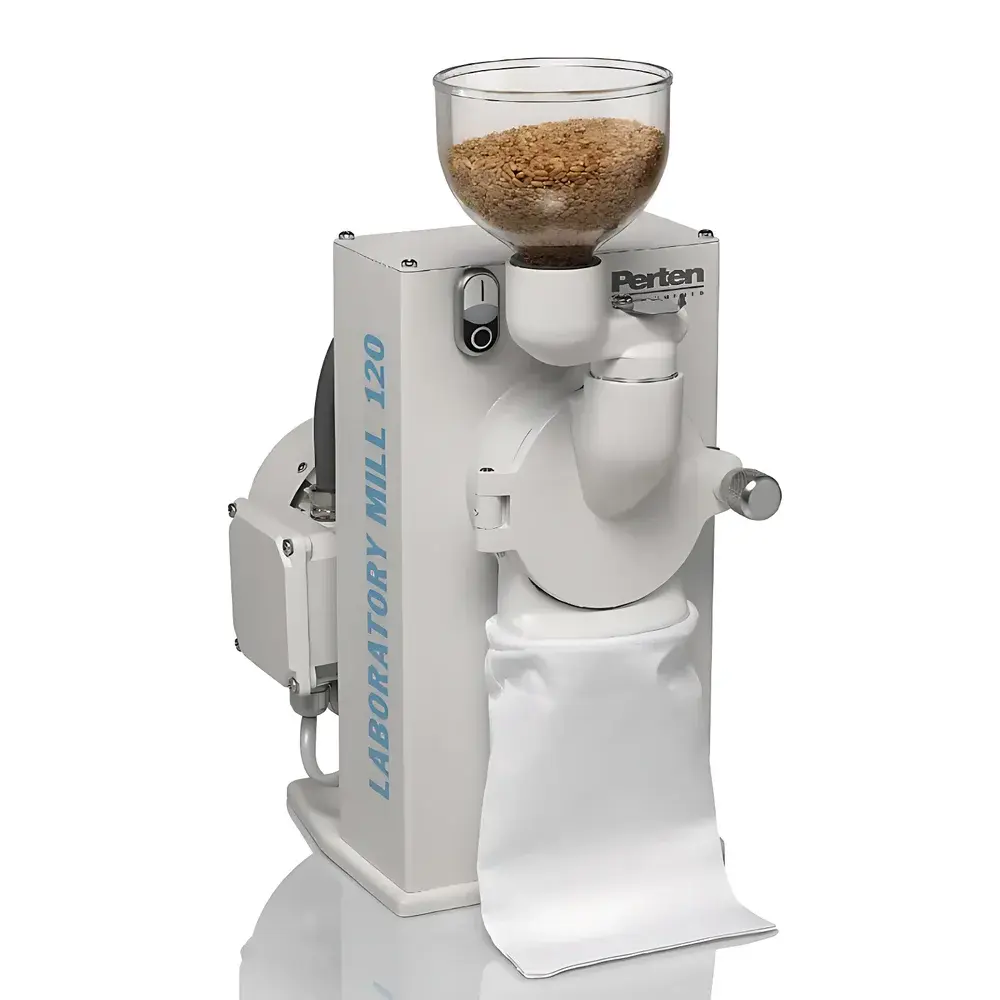
Perten LM120 Hammer Mill Laboratory Grinder
| Brand | Perten |
|---|---|
| Origin | Sweden |
| Model | LM120 |
| Sample Type | Hard, granular, and fibrous materials (e.g., cereals, feed, meat) |
| Feed Size | 40–80 mesh |
| Output Particle Size | 0.5–2.0 mm (standard sieve: 0.8 mm) |
| Batch Capacity | ≤300 g |
| Rotor Speed | 16,800 rpm |
| Grinding Time | 30–50 s per 300 g batch |
| Noise Level | ≤75 dB(A) with acoustic enclosure |
| Power Supply | 110–440 V, 1/3-phase, 50/60 Hz, 1.1 kW |
| Dimensions | 545 × 460 × 240 mm |
| Optional Accessories | 3170 Motorized Feeder |
| Compliance | Designed for GLP-compliant laboratories |
Overview
The Perten LM120 Hammer Mill Laboratory Grinder is a high-speed, air-assisted cyclonic milling system engineered for reproducible, dust-controlled comminution of hard, heterogeneous, and moisture-variable biological samples—including whole grains, pelleted feed, dried meat, and coarse agricultural commodities. Its operational principle relies on centrifugal hammer impact within a rotating rotor assembly, where hardened steel hammers strike incoming material at 16,800 rpm, fracturing particles against the internal mill wall and stainless-steel sieve surface. Simultaneously, controlled airflow transports milled particles through interchangeable sieves (0.5–2.0 mm), enabling precise particle size distribution control critical for downstream analytical methods such as near-infrared spectroscopy (NIRS), falling number analysis, gluten quantification, and Kjeldahl or Dumas combustion nitrogen determination. The integrated acoustic enclosure ensures operator safety and regulatory compliance in shared laboratory environments, while the self-cleaning cyclone separator minimizes cross-contamination between sequential batches—eliminating manual disassembly or brush cleaning under routine operation.
Key Features
- High-efficiency hammer impact grinding: 16,800 rpm rotor speed delivers consistent mechanical energy input for rapid size reduction of dense, fibrous, or high-moisture samples (up to 25% w/w moisture content).
- Adjustable pneumatic feed regulation: Airflow-controlled sample introduction ensures uniform loading and prevents clogging—even with irregularly shaped or hygroscopic feedstocks such as barley, oats, or paddy rice.
- Interchangeable stainless-steel sieve system: Standard 0.8 mm sieve included; optional 0.5, 1.0, 1.5, and 2.0 mm sieves enable method-specific particle size targeting aligned with ISO, AOAC, and AACC standard operating procedures.
- Self-cleaning cyclonic separation: Integrated vortex chamber separates fine particles from carrier air via centrifugal force; milled material collects directly into an accessible stainless-steel container while filtered air recirculates, reducing ambient dust to <0.1 mg/m³.
- Safety-integrated interlock system: Motor activation is inhibited unless the access door is fully latched; immediate shutdown occurs upon door opening—meeting IEC 61000-6-2 EMC and EN 60204-1 machinery safety requirements.
- Modular feeder compatibility: Optional Perten 3170 motorized feeder employs elastomeric impeller technology to meter high-moisture or shelled grains at consistent volumetric rates, improving repeatability in regulated QC workflows.
Sample Compatibility & Compliance
The LM120 is validated for use with cereal grains (wheat, maize, rye, sorghum), compound animal feed, dried protein matrices, and botanical solids requiring homogenization prior to chemical or spectral analysis. It conforms to sample preparation requirements specified in ISO 712 (moisture determination), ISO 5982 (crude protein by Kjeldahl), AOAC 991.20 (fiber analysis), and AACC 26–20A (particle size for NIR calibration). Its closed-loop airflow path and HEPA-class filtration meet OSHA PEL and EU Directive 2004/37/EC occupational exposure limits for respirable particulate matter. All contact surfaces are electropolished 316 stainless steel, supporting cleaning validation per FDA 21 CFR Part 11–compliant SOPs when paired with traceable logbook documentation.
Software & Data Management
While the LM120 operates as a standalone electromechanical instrument, its process parameters—including grinding duration, sieve specification, and batch weight—are documented manually or integrated into LIMS via external barcode-scanned batch logs. For full auditability, Perten recommends pairing the grinder with the Perten GrainCheck™ or Inframatic™ software suite, which links sample IDs, grinding settings, and analytical results in a single metadata chain. All operational records—including door-open events, runtime counters, and sieve change logs—can be exported in CSV format for GLP/GMP audit trails and 21 CFR Part 11–aligned electronic signatures when deployed with validated third-party document management systems.
Applications
- Preparation of homogeneous subsamples for NIR calibration modeling and routine quality control in grain elevators and feed mills.
- Standardized comminution of cereal flour and meal prior to falling number testing (ISO 3093) and gluten index measurement (AACC 38–12).
- Routine particle size conditioning for combustion-based nitrogen analysis (Dumas method, AOAC 992.15) and ash determination (AOAC 942.05).
- Homogenization of rendered animal tissues and pet food formulations for proximate analysis and contaminant screening (e.g., mycotoxin extraction).
- Method development support for regulatory submissions requiring documented sample homogeneity (e.g., EFSA, USDA-FAS, and CFIA reference methods).
FAQ
What is the maximum moisture content the LM120 can handle without clogging?
The LM120 reliably processes samples with up to 25% moisture when used with the optional 3170 motorized feeder and adjusted airflow settings.
Can the LM120 be used for regulatory-compliant testing under GLP or GMP?
Yes—when operated with documented sieve changes, batch logs, and maintenance records, it fulfills sample prep traceability requirements for GLP studies and ISO/IEC 17025-accredited laboratories.
Is the 0.5 mm sieve available as standard equipment?
No—the 0.5 mm sieve is an optional accessory; the standard configuration includes a 0.8 mm stainless-steel sieve.
Does the LM120 require compressed air or external vacuum?
No—it uses internally generated airflow driven by the rotor’s centrifugal effect; no external utilities are required beyond standard AC power.
How often should the hammers and sieve be inspected or replaced?
Perten recommends visual inspection after every 500 batches; typical service life exceeds 2,000 batches under normal cereal grinding conditions—replacement intervals depend on abrasive load and moisture content.
Related Products



