
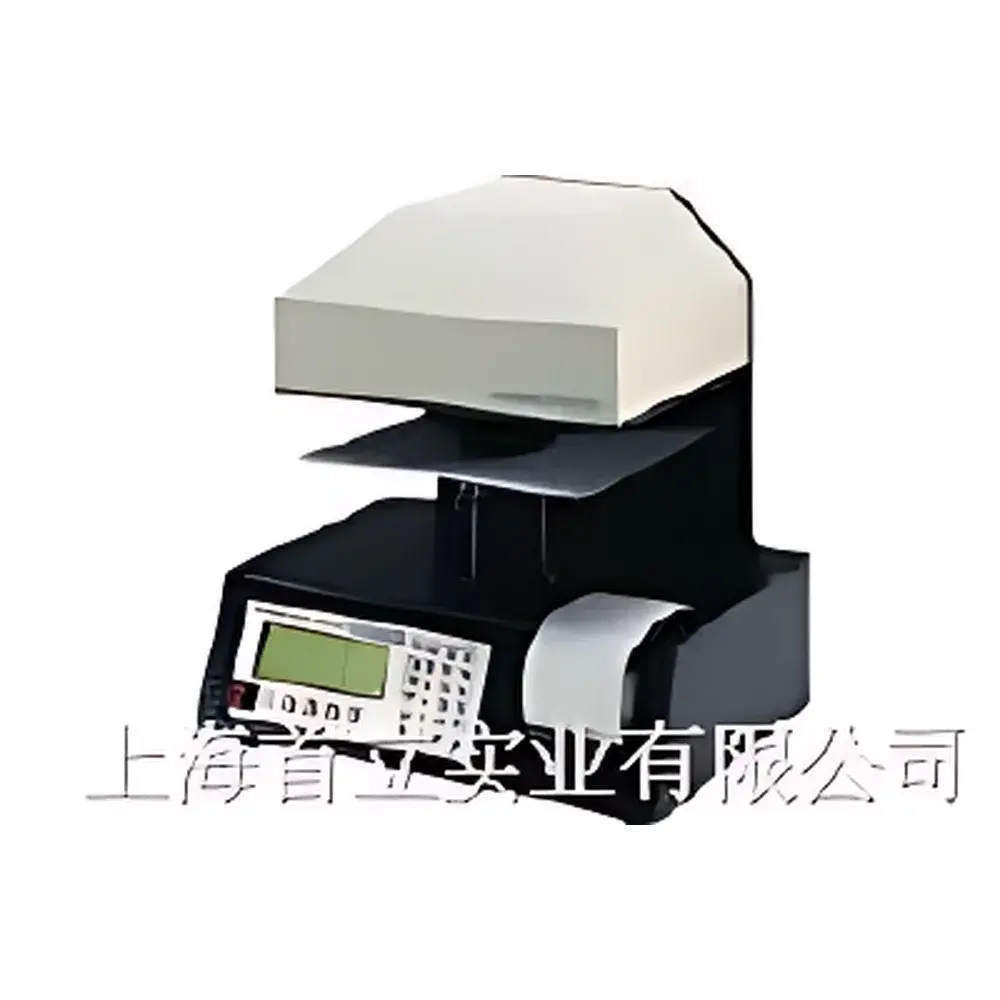
PF-10 Spectrophotometric Whiteness Meter for Paper and Paperboard
| Origin | Japan |
|---|---|
| Manufacturer Type | Authorized Distributor |
| Origin Category | Imported Instrument |
| Model | PF-10 |
| Price Range | USD 1,400 – 4,200 |
| Measurement Principle | Diffuse Illumination / 0° Viewing (d/0°) |
| Spectral Range | 400–700 nm (10 nm intervals) |
| Aperture | Ø30 mm |
| Compliance | JIS P 8148 (Type B), ISO 2469, ISO 2470, ISO 2471, TAPPI T525 |
| Colorimetric Systems | CIE XYZ, CIELAB (L*a*b*), CIELCH°, Yxy, HVC, YI, WH, WB, BR, ΔE*ab, ΔE00, ΔL*a*b*, ΔLCH°, ΔYI, ΔWH, ΔWB, ΔBR |
| Fluorescence Compensation | Dual-filter selectable mode (UV-included / UV-excluded) |
| Repeatability | ΔE*ab ≤ 0.02 (using STFI fluorescent reference paper and white calibration tile) |
| Dimensions | 370 × 450 × 410 mm (W × D × H) |
| Weight | 25 kg |
| Power Supply | AC 100–240 V, 50/60 Hz |
| Lamp | Pulsed Xenon Flash Lamp |
| Optional Accessories | Windows-compatible color management software, RS-232C interface cable, calibration verification kits |
Overview
The PF-10 Spectrophotometric Whiteness Meter is a precision optical instrument engineered for objective, traceable evaluation of whiteness, color, color difference, fluorescence intensity, and opacity in paper and paperboard substrates. Designed in strict accordance with JIS P 8148 “Whiteness of Paper and Paperboard — Determination by the Diffuse Reflectance Method (ISO Whiteness)” — specifically meeting its Type B spectral requirements — the PF-10 implements the d/0° (diffuse illumination / 0° viewing) geometry defined in ISO 2469 and ISO 2470. This configuration ensures consistent measurement of total reflectance, including both reflected and fluorescent components, under standardized illuminant D65 and 10° observer conditions. The pulsed xenon flash lamp provides stable, broadband spectral output across 400–700 nm at 10 nm resolution, eliminating thermal drift and lamp aging effects common in tungsten-halogen or LED-based systems. Each unit undergoes factory calibration using STFI-certified fluorescent reference paper and NIST-traceable white calibration tiles, enabling direct compliance with GLP documentation requirements and supporting audit-ready validation protocols.
Key Features
- Pulsed xenon light source delivering high-intensity, spectrally uniform illumination with >10⁶ flash cycles lifetime and negligible spectral shift over time
- Dual-mode fluorescence measurement: user-selectable UV-included and UV-excluded filter paths to isolate and quantify optical brightener agent (OBA) contribution per ISO 2470-2 Annex A
- Integrated spectral reflectance acquisition (400–700 nm, 10 nm steps) with real-time curve visualization and export capability
- Comprehensive colorimetric reporting across 18 industry-standard metrics including CIELAB (L*a*b*), CIELCH°, YI (ASTM E313), WH (TAPPI T485), WB (CIE Whiteness), BR (Brightness), and multiple ΔE variants (ΔE*ab, ΔE00)
- Ø30 mm measurement aperture optimized for macro-scale paper evaluation while maintaining edge-effect minimization per ISO 2471 opacity test constraints
- Robust mechanical architecture with vibration-damped optical bench, temperature-stabilized detector array, and sealed optical path to ensure long-term photometric stability
Sample Compatibility & Compliance
The PF-10 accommodates standard sheet formats up to A4 size and accepts samples ranging from lightweight tissue (≥20 g/m²) to rigid duplex board (≤600 g/m²). Its d/0° geometry conforms to the geometric requirements of JIS P 8148 Type B, ISO 2469 (whiteness), ISO 2470 (brightness), ISO 2471 (opacity), and TAPPI T525 (brightness of pulp). All colorimetric calculations adhere to CIE Publication No. 15:2018 and ISO/CIE 11664 series standards. The instrument supports full traceability through embedded calibration logs, timestamped measurement records, and dual-reference verification (STFI fluorescent standard + certified white tile), fulfilling documentation prerequisites for ISO/IEC 17025-accredited laboratories and FDA-regulated quality control environments operating under 21 CFR Part 11-compliant data governance frameworks.
Software & Data Management
The optional Windows-compatible color management software enables automated batch reporting, statistical process control (SPC) charting, pass/fail threshold configuration, and multi-instrument fleet synchronization. Raw spectral data (.csv/.spc), reflectance curves, and color coordinates are exportable in ASCII format for integration with LIMS, SAP QM, or Minitab. Audit trails record operator ID, calibration events, parameter changes, and measurement timestamps — all digitally signed and tamper-evident per ALCOA+ principles. Software modules support IQ/OQ documentation templates aligned with GMP Annex 11 and ISO 13485 medical device manufacturing requirements.
Applications
- Quality assurance of bleached chemical pulps and mechanical pulps during mill production
- Whiteness grading of printing/writing papers, packaging boards, and label stocks against TAPPI/ISO specifications
- Fluorescent whitening agent (FWA) dosage optimization in coating formulations
- Opacity validation for duplex cartons and folding boxboard used in pharmaceutical primary packaging
- Color consistency monitoring across multi-shift production runs and supplier qualification programs
- Research-grade spectral analysis of aging-induced yellowing in archival documents and conservation science
FAQ
Does the PF-10 comply with ISO/IEC 17025 calibration requirements?
Yes — each instrument ships with a factory calibration certificate referencing STFI fluorescent standards and NIST-traceable white tiles, and supports periodic verification using certified reference materials per ISO 17025 Clause 6.5.
Can the PF-10 measure coated versus uncoated paper without reconfiguration?
Yes — the Ø30 mm aperture and d/0° geometry eliminate gloss dependency; no gloss trap or mode switching is required for comparative measurement across surface finishes.
Is spectral data export supported for third-party spectral analysis tools?
Yes — full 31-point spectral reflectance data (400–700 nm) is exportable in CSV format with wavelength headers, compatible with MATLAB, Python (NumPy/Pandas), and commercial spectroscopy platforms.
What maintenance is required beyond routine calibration?
No consumables or lamp replacements are needed within 5 years of typical use; only annual verification with supplied reference standards is recommended to maintain metrological integrity.
How is fluorescence quantified independently from base reflectance?
By acquiring two spectra — one with UV component active (UV-included) and one with UV filtered out (UV-excluded) — the instrument computes fluorescence intensity as the integrated area difference between curves above 420 nm, following ISO 2470-2 methodology.



