
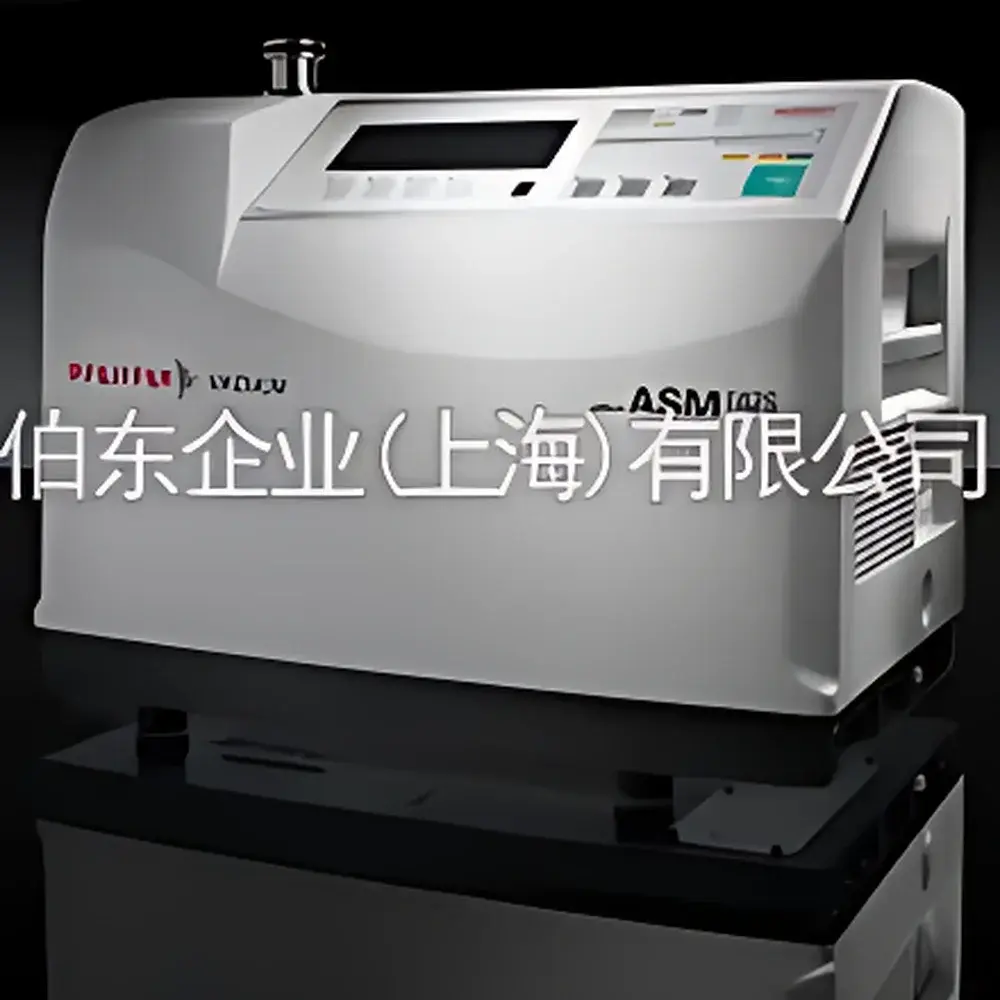
Pfeiffer ASM 142 S Helium Mass Spectrometer Leak Detector
| Brand | Pfeiffer Vacuum |
|---|---|
| Origin | USA |
| Manufacturer Type | Authorized Distributor |
| Origin Category | Imported |
| Model | ASM 142 S |
| Detection Limit (He) | 1 × 10⁻⁸ Pa·m³/s |
| Measurement Range (He) | 1 × 10⁻⁷ to 1 mbar·L/s |
| Forepump | Oil-Sealed Rotary Vane Pump |
| Detectable Gas | ⁴He |
| Operating Temperature | 0–45 °C |
| Acoustic Noise Level | < 57 dB(A) |
| Dimensions (W × D × H) | 517 × 357 × 420 mm |
| Warm-up Time | 2 min |
| Detection Mode | Sniffer (Probe-Based) |
| Weight | 55 kg |
| Standard Probe | 5 m Flexible Hose with 9 cm Rigid Nozzle |
| Power Supply Options | 110–130 V AC (North America) or 200–240 V AC (Europe) |
| Interface | RS-232 / USB / Optional PLC Integration |
| Display Language Options | English, French, German, Chinese |
Overview
The Pfeiffer ASM 142 S Helium Mass Spectrometer Leak Detector is a high-sensitivity, portable sniffer-type leak detection system engineered for rapid, on-site identification of helium-traced leaks in pressurized components and assemblies. Based on quadrupole mass spectrometry, the instrument selectively ionizes and separates helium atoms (mass-to-charge ratio m/z = 4) from background gases, enabling quantitative leak rate measurement with exceptional specificity and immunity to interference from nitrogen, oxygen, water vapor, or hydrocarbons. Designed for industrial maintenance, vacuum system commissioning, HVAC integrity verification, and semiconductor tool qualification, the ASM 142 S operates under ambient pressure conditions and requires no evacuation of the test object—making it ideal for positive-pressure applications such as refrigerant lines, gas distribution manifolds, sealed enclosures, and hermetic packaging. Its compact benchtop architecture integrates a dedicated oil-sealed forepump, mass filter, ion source, and detector array within a single enclosure, minimizing footprint while maintaining thermal and mechanical stability for repeatable measurements.
Key Features
- Helium-specific detection limit of 1 × 10⁻⁸ Pa·m³/s—compliant with ISO 20486:2020 for fine-leak testing in critical systems
- Sniffer-mode operation with interchangeable 5 m flexible probe hose and rigid 9 cm nozzle for ergonomic access to confined or elevated joints
- Real-time leak rate display via integrated front-panel LCD or optional handheld remote controller with backlight and multilingual support (English, French, German, Chinese)
- Fast warm-up time (< 2 minutes) and stable baseline drift < 5 % over 8-hour continuous operation
- RS-232 and USB communication interfaces for data logging, remote control, and integration into automated QA/QC workflows
- PLC-compatible digital I/O (optional) for synchronized start/stop triggering and pass/fail signal output in production line environments
- Robust mechanical design rated for industrial floor use: IP20 enclosure, shock-absorbing feet, and vibration-damped internal mounting
Sample Compatibility & Compliance
The ASM 142 S is validated for use across a broad range of pressurized systems including stainless steel piping networks, aluminum heat exchangers, welded vacuum chambers, MEMS packages, medical gas manifolds, and aerospace hydraulic fittings. It complies with key international standards for leak detection methodology, including ASTM E499-22 (Standard Test Method for Leak Detection Using Helium Mass Spectrometry), ISO 10110-10 (Optics and photonics — Preparation of drawings for optical elements and systems — Part 10: Surface imperfections), and EN 1318-1 (Leak testing — Vocabulary — Part 1: General terms). For regulated industries, the device supports audit-ready operation through timestamped data export, user-access-level configuration locks, and optional GLP/GMP-compliant software modules that meet FDA 21 CFR Part 11 requirements for electronic records and signatures when paired with certified host software.
Software & Data Management
The ASM 142 S supports native ASCII-based serial protocol for seamless integration with custom SCADA, MES, or LabVIEW environments. Optional Pfeiffer Vacuum Control Software (v3.2+) provides full instrument parameterization—including sensitivity calibration, background subtraction, alarm threshold setting, and dynamic range adjustment—as well as time-stamped CSV export of leak rate vs. time profiles. All measurement sessions are stored with metadata (operator ID, probe location tag, ambient temperature/humidity if externally logged), and exported files include checksum validation for data integrity assurance. Remote firmware updates are supported via USB drive without requiring factory service intervention.
Applications
- Pre-shipment validation of high-pressure gas cylinders and cryogenic dewars
- In-line leak screening of automotive airbag inflators and EV battery coolant loops
- Post-weld inspection of pharmaceutical isolator gloveports and cleanroom ductwork
- Maintenance diagnostics for semiconductor process chambers, sputtering targets, and e-beam evaporators
- Qualification of hermetic seals in implantable medical devices per ISO 11607-2
- Field verification of HVAC refrigerant circuit integrity following ASHRAE Standard 110
FAQ
What is the minimum detectable leak rate for helium using the ASM 142 S?
The specified lower detection limit is 1 × 10⁻⁸ Pa·m³/s under standard operating conditions (23 °C, 50 % RH, clean helium supply at 1 bar gauge pressure).
Can the ASM 142 S be used in vacuum mode (vacuum-integrated testing)?
No—the ASM 142 S is exclusively configured for sniffer (pressure-rise) mode. It is not designed for vacuum chamber connection or vacuum-integrated testing.
Is calibration traceable to NIST or equivalent national standards?
Yes—factory calibration is performed using certified helium permeation standards traceable to PTB (Physikalisch-Technische Bundesanstalt) and includes full uncertainty budget documentation upon request.
Does the instrument require periodic mass spectrometer tuning?
No routine tuning is required; the quadrupole filter is pre-aligned and sealed. Annual verification of sensitivity and background noise is recommended per ISO/IEC 17025 guidelines.
What safety certifications does the ASM 142 S hold?
It carries CE marking per EU Machinery Directive 2006/42/EC and EMC Directive 2014/30/EU, UL/cUL recognition for North America (UL 61010-1), and RoHS 3 compliance.
Related Products




