
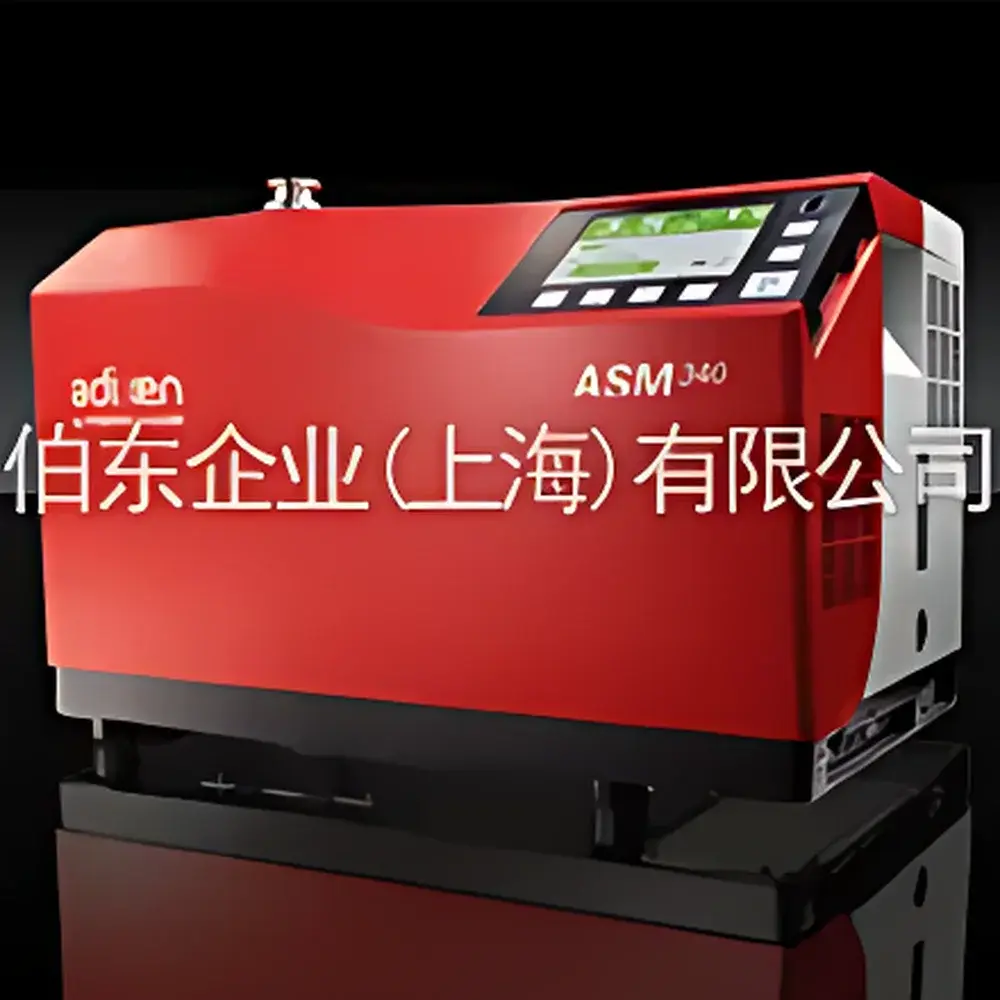
Pfeiffer ASM 340 Helium Mass Spectrometer Leak Detector for Heat Exchanger Integrity Testing
| Brand | Pfeiffer Vacuum |
|---|---|
| Origin | Germany (manufactured in Germany, distributed globally) |
| Model | ASM 340 |
| Detection Principle | Quadrupole Mass Spectrometry with Helium Carrier Gas |
| Minimum Detectable Leak Rate | ≤5 × 10⁻¹² mbar·L/s (helium) |
| Operating Mode | Positive-Pressure Sniffing & Vacuum-Coupled Testing |
| Pumping System | Integrated Turbomolecular Pump + Forepump |
| Mass Filter | 4-amu Resolution Quadrupole Analyzer |
| Response Time | <100 ms (typical) |
| Compliance | CE, RoHS, ISO 9001 Certified |
| Interface | RS-232, Ethernet, Analog Output (0–10 V) |
| Software Compatibility | Pfeiffer VacuGraph® PC Control Suite |
Overview
The Pfeiffer ASM 340 Helium Mass Spectrometer Leak Detector is an industrial-grade, high-sensitivity vacuum metrology instrument engineered for quantitative leak integrity verification of heat exchangers and other hermetic pressure vessels. Based on quadrupole mass spectrometry, the ASM 340 selectively detects helium (mass-to-charge ratio m/z = 4) as a tracer gas with exceptional specificity and signal-to-noise ratio. Its core architecture integrates a turbomolecular pumping stage directly coupled to the mass analyzer—eliminating external pump delays and ensuring stable base pressure (<1 × 10⁻⁷ mbar) during continuous sniffing or vacuum-mode operation. Unlike traditional hydrostatic or pressure-decay methods, the ASM 340 delivers trace-level detection capability down to 5 × 10⁻¹² mbar·L/s (He), enabling early-stage defect identification in tube-to-tubesheet welds, U-bend regions, and header joints—critical failure points in shell-and-tube, plate-fin, and brazed aluminum heat exchangers used across chemical processing, refrigeration, power generation, and HVAC manufacturing.
Key Features
- Integrated high-vacuum system: 160 L/s turbomolecular pump with active magnetic bearing and oil-free forepump ensures rapid pump-down and long-term operational stability.
- Dual-mode operation: Supports both positive-pressure sniffing (for localized weld/joint inspection) and vacuum-coupled testing (for whole-unit sensitivity validation).
- Real-time quantitative output: Displays leak rate numerically (mbar·L/s) with logarithmic scaling and audible/visual alarm thresholds configurable per ASTM E1871-20.
- Ruggedized industrial enclosure: IP54-rated housing with shock-absorbing mounting points designed for factory floor deployment near welding stations or final assembly lines.
- Helium-specific ion source: Optimized electron multiplier detector with low-background noise and calibrated response factor traceable to NIST standards.
- Self-diagnostic firmware: Continuous monitoring of filament emission, detector gain, and vacuum integrity with automated error logging compliant with ISO/IEC 17025 documentation requirements.
Sample Compatibility & Compliance
The ASM 340 is validated for use with standard industrial heat exchanger geometries—including multi-pass shell-and-tube units up to 3 m length, compact plate-and-frame assemblies, and microchannel evaporators. It accommodates test pressures from atmospheric to 1.5 bar(g) in positive-pressure mode and supports vacuum-mode testing under ≤1 × 10⁻³ mbar background conditions. The system meets essential regulatory frameworks for quality-critical manufacturing: compliance with ISO 13305 (leak testing of heat transfer equipment), ASTM E432-17 (practice for helium mass spectrometer leak testing), and supports audit-ready data generation aligned with FDA 21 CFR Part 11 when paired with VacuGraph® software and electronic signature modules. All calibration certificates are issued with measurement uncertainty budgets referenced to PTB (Physikalisch-Technische Bundesanstalt) helium flow standards.
Software & Data Management
VacuGraph® PC Control Suite provides full remote operation, real-time trend visualization, and structured data export (CSV, XML, PDF). Each test record includes timestamp, operator ID, ambient temperature/pressure, helium concentration baseline, peak leak rate, spatial coordinates (when integrated with XYZ motion stages), and pass/fail status per user-defined acceptance criteria. Audit trails retain all parameter changes, alarm events, and calibration actions with immutable timestamps—fully satisfying GLP and GMP documentation requirements. Optional OPC UA integration enables direct linkage to MES/SCADA systems for SPC-based process control and automated nonconformance reporting.
Applications
- Final QA verification of welded tube-to-tubesheet joints in petrochemical heat exchangers prior to hydrotest.
- In-process leak screening of brazed aluminum cores in automotive HVAC condensers and evaporators.
- Root cause analysis of field failures by correlating leak locations with radiographic or ultrasonic NDT data.
- Validation of cleaning and passivation efficacy in pharmaceutical-grade sanitary heat exchangers (ASME BPE-compliant).
- Leak mapping of large-scale air-cooled condensers using robotic sniffer arms with position-encoded feedback.
FAQ
What is the recommended helium concentration for positive-pressure testing of heat exchangers?
Typical helium partial pressure ranges from 5% to 20% v/v in dry nitrogen or air; higher concentrations improve signal-to-noise but require strict ventilation control per OSHA 29 CFR 1910.1200.
Can the ASM 340 detect leaks in stainless steel versus titanium heat exchangers equally well?
Yes—the detection limit is independent of base material; however, surface outgassing rates differ, necessitating optimized bake-out protocols for titanium alloys prior to vacuum-mode testing.
Is third-party calibration required annually for ISO 17025 accreditation?
Yes—Pfeiffer-certified calibration labs provide traceable verification against certified helium leak standards (e.g., DCM-100 series) with full uncertainty reporting per ISO/IEC 17025:2017 Clause 6.5.
How does the ASM 340 handle interference from hydrogen or methane in industrial environments?
The quadrupole’s 4-amu resolution and helium-specific ion source suppress H₂⁺ (m/z = 2) and CH₄⁺ fragments (m/z = 16); optional high-resolution tuning further reduces cross-sensitivity per ASTM E1871 Annex A2.
Does the system support automated pass/fail decision logic for inline production testing?
Yes—VacuGraph® allows programmable threshold matrices per component zone, with digital I/O outputs for PLC integration and automatic rejection flagging in conveyor-based test cells.





