
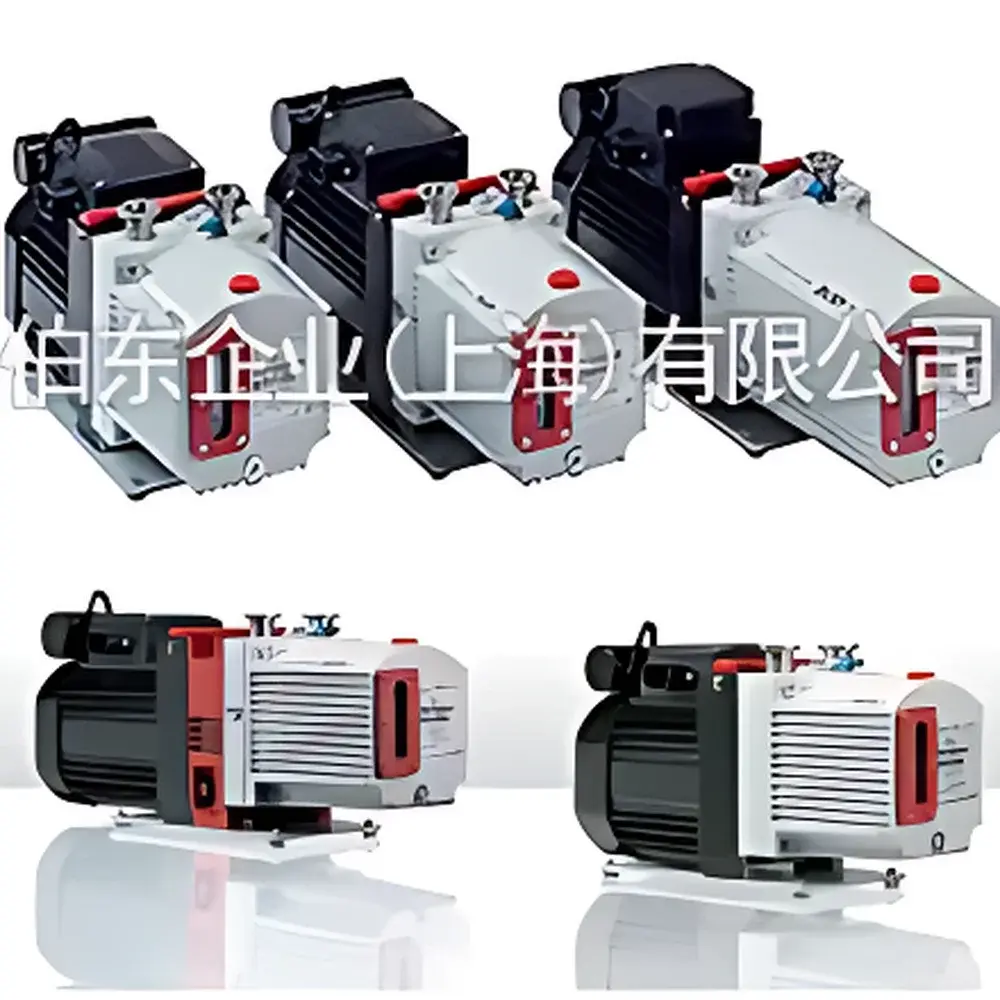
Pfeiffer DuoLine Dual-Stage Rotary Vane Vacuum Pump
| Brand | Pfeiffer Vacuum |
|---|---|
| Origin | Germany |
| Pump Type | Oil-Lubricated Rotary Vane |
| Series | DuoLine |
| Ultimate Pressure | 2–7 × 10⁻³ hPa (depending on model) |
| Operating Temperature Range (Duo 3 DC) | −20 °C to +60 °C |
| Motor Options | Single-phase / Three-phase / 24 V DC |
| Noise Level | 48–75 dB(A) |
| Weight | 7–380 kg |
Overview
The Pfeiffer DuoLine dual-stage rotary vane vacuum pump is a precision-engineered, industrial-grade vacuum source designed for reliable operation across medium to low vacuum ranges (10⁰ to 10⁻³ hPa). Based on proven positive displacement technology, the DuoLine series utilizes two sequentially staged rotors with sliding vanes immersed in high-stability mineral oil to achieve continuous, stable evacuation. Its dual-stage architecture enables higher compression ratios and improved ultimate vacuum performance compared to single-stage alternatives—critical for applications demanding consistent base pressure stability and resistance to process gas backstreaming. Manufactured in Germany under strict DIN EN ISO 9001 quality management systems, each pump undergoes full factory calibration and endurance testing prior to shipment. The DuoLine platform serves both as a standalone roughing pump and as a robust fore-vacuum stage for high-vacuum systems—including turbomolecular pumps, diffusion pumps, and cryogenic vacuum assemblies.
Key Features
- Magnetic coupling design (M and MC variants): Eliminates radial shaft seals, preventing oil leakage and cross-contamination—essential for cleanroom, analytical, and semiconductor environments.
- Integrated gas ballast valve: Enables continuous operation with condensable or mildly corrosive vapors (e.g., water, solvents), minimizing oil degradation and extending service intervals.
- Dual-stage compression architecture: Delivers superior ultimate vacuum (as low as 2 × 10⁻³ hPa) and enhanced pumping speed stability under variable inlet pressures.
- Wide motor compatibility: Models available with single-phase (95–240 V, 50/60 Hz), three-phase (220–480 V, 50/60 Hz), and 24 V DC (Duo 3 DC) configurations—enabling integration into mobile, automotive, and embedded OEM systems.
- Corrosion-resistant variant (MC series): Features fluoropolymer-coated internal components and chemically resistant seals for handling aggressive gases such as HCl, Cl₂, and SO₂.
- Standardized ISO-KF and ISO-F flange interfaces (DN 16 to DN 100): Ensures seamless mechanical and sealing compatibility with global vacuum system standards.
- Low-noise operation: Acoustic emissions range from 48 dB(A) (Duo 1.6 M) to 75 dB(A) (Duo 255 M), meeting ISO 3744 noise certification requirements for laboratory and production floor deployment.
Sample Compatibility & Compliance
The DuoLine series supports a broad spectrum of process gases—including air, nitrogen, argon, water vapor, hydrocarbons, and select halogenated compounds—without performance compromise. For aggressive chemical environments, the MC-series models comply with ASTM D471 (fluid resistance) and IEC 60079-0 (explosion-proof component compatibility when integrated into certified enclosures). All units meet CE marking requirements per EU Machinery Directive 2006/42/EC and Electromagnetic Compatibility Directive 2014/30/EU. When deployed in regulated analytical workflows (e.g., GC-MS, residual gas analysis), DuoLine pumps support GLP/GMP traceability through optional analog 0–10 V or digital RS-485 interface modules for external vacuum monitoring and audit logging.
Software & Data Management
While the DuoLine operates as a standalone electromechanical device, it integrates natively with third-party vacuum control platforms via standard analog signals (pump status, temperature, vibration alerts) or Modbus RTU over RS-485. Optional Pfeiffer TPG300-compatible vacuum gauges enable closed-loop pressure regulation when paired with the DuoLine’s gas ballast and speed control functions (available on DC and inverter-driven variants). For compliance-critical environments, the pump’s operational history—including runtime, thermal cycles, and gas ballast actuation—can be logged externally using FDA 21 CFR Part 11–compliant SCADA or LIMS systems, provided the host controller implements appropriate electronic signature and audit trail protocols.
Applications
- Roughing and backing for turbomolecular and cryogenic high-vacuum systems in semiconductor processing, thin-film deposition (PVD/CVD), and electron microscopy.
- Vacuum drying, freeze-drying, and degassing in pharmaceutical manufacturing and R&D laboratories.
- Resin impregnation, vacuum casting, and metallurgical outgassing in aerospace and automotive component production.
- Gas chromatography-mass spectrometry (GC-MS) fore-vacuum supply for Agilent, Thermo Fisher, and Bruker instruments.
- Coating system backing for optical lens manufacturing (Oerlikon), decorative PVD (Hauzer), and vacuum brazing furnaces (Sevenstar).
- Mobile and field-deployable vacuum applications enabled by the 24 V DC Duo 3 DC model—validated for operation from −20 °C to +60 °C without derating.
FAQ
What is the difference between the ‘M’ and standard DuoLine models?
The ‘M’ designation indicates magnetic coupling drive, which replaces the conventional shaft seal with a hermetic torque transfer system—eliminating oil leakage risk and enabling use in ultra-clean or contamination-sensitive processes.
Can the DuoLine pump handle corrosive gases?
Yes—the MC-series models feature fluoropolymer-coated rotors, vanes, and corrosion-resistant elastomers, validated for continuous exposure to HCl, Cl₂, HF, and other moderately aggressive process gases per ISO 15735 guidelines.
Is the Duo 3 DC suitable for battery-powered instrumentation?
Yes. The Duo 3 DC operates directly from a stabilized 24 V DC input with peak current draw ≤12 A, making it compatible with uninterruptible power supplies (UPS), vehicle electrical systems, and portable analytical platforms.
What maintenance intervals are recommended for routine operation?
Under typical clean-air conditions, oil change is required every 3,000 operating hours; gas ballast use or condensable vapor exposure reduces this interval to 1,000–2,000 hours. Full service kits—including vanes, oil, and filter elements—are available as genuine Pfeiffer OEM parts with batch-traceable documentation.
Does the DuoLine series support remote monitoring and diagnostics?
All M- and MC-series pumps offer analog output (0–10 V) for real-time temperature and status feedback. Optional RS-485 communication modules enable integration with industrial PLCs and predictive maintenance platforms using standard Modbus RTU protocol.
Related Products



