
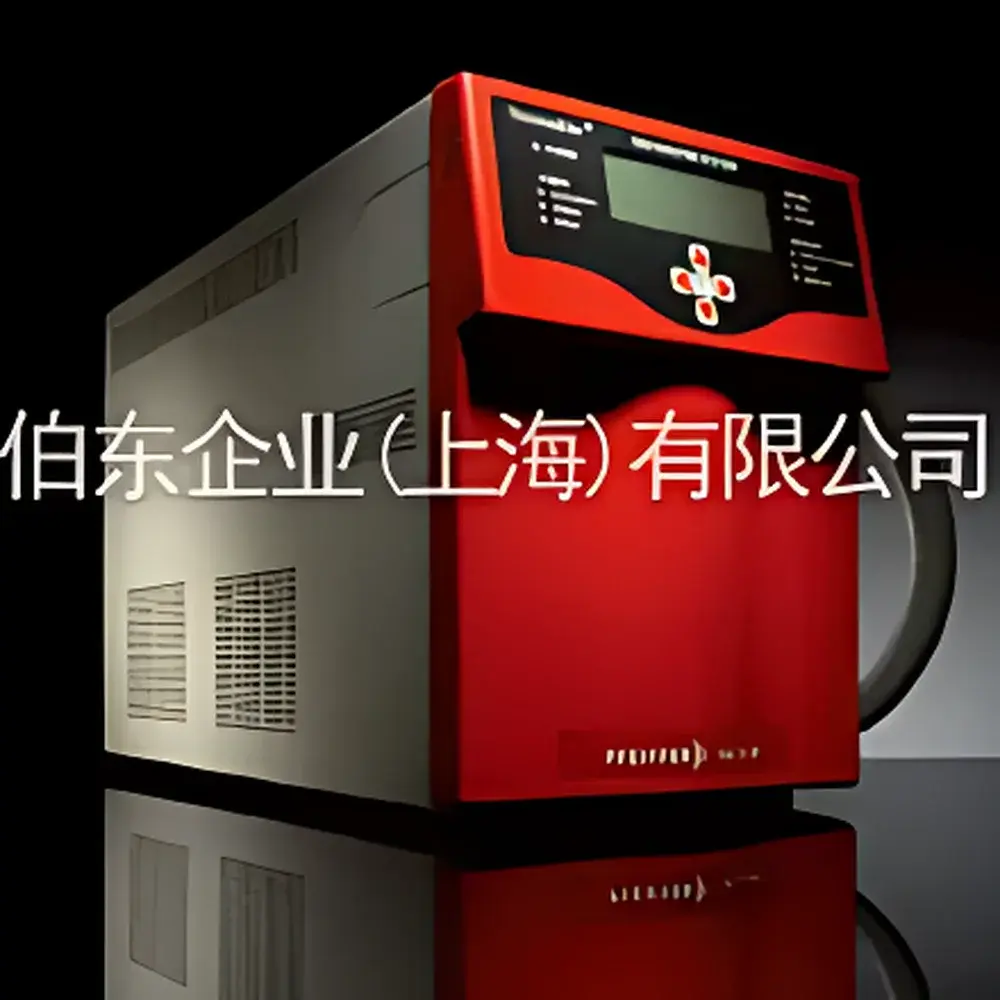
Pfeiffer Thermostar Online Mass Spectrometer for TGA-MS Coupling
| Brand | Pfeiffer Vacuum |
|---|---|
| Origin | Germany |
| Model | Thermostar GSD301 |
| Mass Range | 1–300 u |
| Ion Source | Gas-Tight Dual-Filament |
| Inlet Temperature | Up to 350 °C (Quartz Capillary) |
| Detection Modes | Full Scan (1–100 / 1–200 / 1–300 u), MID (128 ions), MCD (128 gases) |
| Vacuum System | Integrated HiPace 80 Turbo-Molecular Pump |
| Software | QuadStar™ (Qualitative & Quantitative, Real-Time & Post-Processing) |
| Compliance | Designed for GLP/GMP environments |
Overview
The Pfeiffer Thermostar GSD301 is a dedicated online quadrupole mass spectrometer engineered for seamless hyphenation with thermogravimetric analyzers (TGA) in laboratory and industrial R&D settings. Operating on the principle of electron ionization (EI) coupled with mass-selective detection via a radiofrequency-driven quadrupole mass filter, the Thermostar enables real-time identification and quantification of volatile and semi-volatile species evolved during controlled thermal decomposition. Its design centers on high transmission efficiency, low detection limits (sub-ppb for selected gases), and robust signal stability under dynamic gas flow conditions—critical requirements for coupling with TGA instruments where effluent composition changes rapidly across temperature ramps (e.g., 0.1–20 °C/min). Unlike benchtop GC-MS systems, the Thermostar eliminates chromatographic separation, delivering millisecond-level response times essential for correlating mass loss events (from TGA) with instantaneous gas evolution profiles.
Key Features
- Gas-tight, dual-filament ion source ensures long-term emission stability and redundancy for uninterrupted operation during extended thermal runs (e.g., 72-h polymer degradation studies).
- Integrated quartz capillary inlet with programmable heating up to 350 °C prevents condensation of high-boiling-point volatiles (e.g., plasticizers, oligomers, residual monomers) and maintains molecular integrity prior to ionization.
- Dedicated HiPace 80 turbo-molecular pump delivers >80 L/s pumping speed at the inlet, sustaining stable base pressure (<5×10⁻⁸ mbar) even during high-flow TGA effluent introduction (up to 50 mL/min).
- Three user-selectable full-scan mass ranges (1–100 u, 1–200 u, 1–300 u) support flexible method development—from simple moisture/CO2 tracking to complex polymer pyrolysis fingerprinting.
- MID (Multi-Ion Detection) mode enables simultaneous monitoring of up to 128 pre-defined m/z channels with <10-ms dwell time per ion, ensuring precise kinetic modeling of parallel decomposition pathways.
- MCD (Multi-Concentration Detection) algorithm applies calibrated sensitivity factors to convert ion currents into real-time partial pressures (mbar) or concentration values (ppm/ppb), traceable to NIST-certified gas standards.
Sample Compatibility & Compliance
The Thermostar interfaces natively with all major TGA platforms—including Netzsch STA 449, Mettler Toledo TGA/DSC 3+, TA Instruments Q500, Setaram Setsys Evolution, Linseis L63, and Seiko EXSTAR TG/DTA—via standardized heated transfer lines (ISO-KF 16/25 flanges). It accommodates solid powders, thin films, fibers, catalysts, pharmaceutical tablets, and composite laminates without sample preparation beyond standard TGA pan loading. All hardware and firmware comply with IEC 61000-6-3 (EMC) and IEC 61010-1 (safety). When deployed in regulated environments (e.g., pharmaceutical stability testing per ICH Q1A–Q5C), QuadStar™ software can be configured with electronic signatures, audit trails, and user access controls aligned with FDA 21 CFR Part 11 and EU Annex 11 requirements. Instrument qualification documentation (IQ/OQ/PQ protocols) is available upon request.
Software & Data Management
QuadStar™ is a Windows-based acquisition and analysis suite providing synchronized data ingestion from both TGA and MS channels. It supports time-aligned overlay of mass traces (m/z vs. time), derivative thermograms (dTGA), and 3D contour plots (intensity vs. m/z vs. temperature). Batch processing enables automated peak deconvolution using library matching (NIST/EPA/NIH mass spectral databases) and isotopic pattern recognition. Export formats include ASCII, CSV, and .tdf (for third-party kinetics tools like Kinetics Neo or Thermo-Calc). Raw data files are stored in vendor-neutral HDF5 format, ensuring long-term readability independent of software version upgrades. Remote monitoring and control via Ethernet (TCP/IP) allow integration into centralized lab informatics systems (e.g., LabVantage, STARLIMS).
Applications
- Quantitative residual solvent analysis in APIs (e.g., dichloromethane, acetone, ethanol) per USP and ICH Q3C guidelines.
- Thermal stability assessment of battery cathode materials (e.g., LiCoO2, NMC) under inert/oxidizing atmospheres, identifying O2, CO, CO2, and HF evolution onset temperatures.
- Decomposition mechanism elucidation in flame-retardant polymers, distinguishing phosphorous-containing volatiles (e.g., PO•, HPO2•) from halogenated fragments.
- In-situ monitoring of catalytic reactions in TGA–MS–FTIR triple-hyphenated setups, correlating mass signals with functional group changes.
- Moisture sorption/desorption kinetics in MOFs and zeolites, resolving H2O, N2, and Ar release profiles during stepwise heating.
FAQ
What vacuum interface options are available for coupling with TGA instruments?
The Thermostar includes a standard heated quartz capillary (OD 0.3 mm, ID 0.15 mm) rated to 350 °C. Optional stainless-steel capillaries with ceramic insulation or direct-flange-mounted skimmer cones are available for high-flow or corrosive gas applications.
Can the Thermostar detect noble gases such as He or Ar?
Yes—it resolves He+ (m/z 4), Ne+ (m/z 20), Ar+ (m/z 40), and Kr+ (m/z 84) with unit mass resolution and sub-ppb detection limits under optimized EI conditions.
Is calibration required before each TGA-MS run?
No. The system employs factory-calibrated sensitivity factors traceable to ISO 17025-accredited gas standards. Daily verification using a 1% CO2/N2 check gas is recommended for quantitative work.
How is data synchronization achieved between TGA and MS?
Hardware-level TTL triggers synchronize start/stop timestamps; QuadStar™ applies linear interpolation to align TGA mass-loss points with corresponding MS spectra based on shared system clock (±10 ms accuracy).
Does Pfeiffer provide application support for method development?
Yes—Pfeiffer’s global Application Lab offers remote and on-site method optimization, including m/z selection for target analytes, dwell time optimization, and background subtraction strategies for complex matrices.
Related Products







