
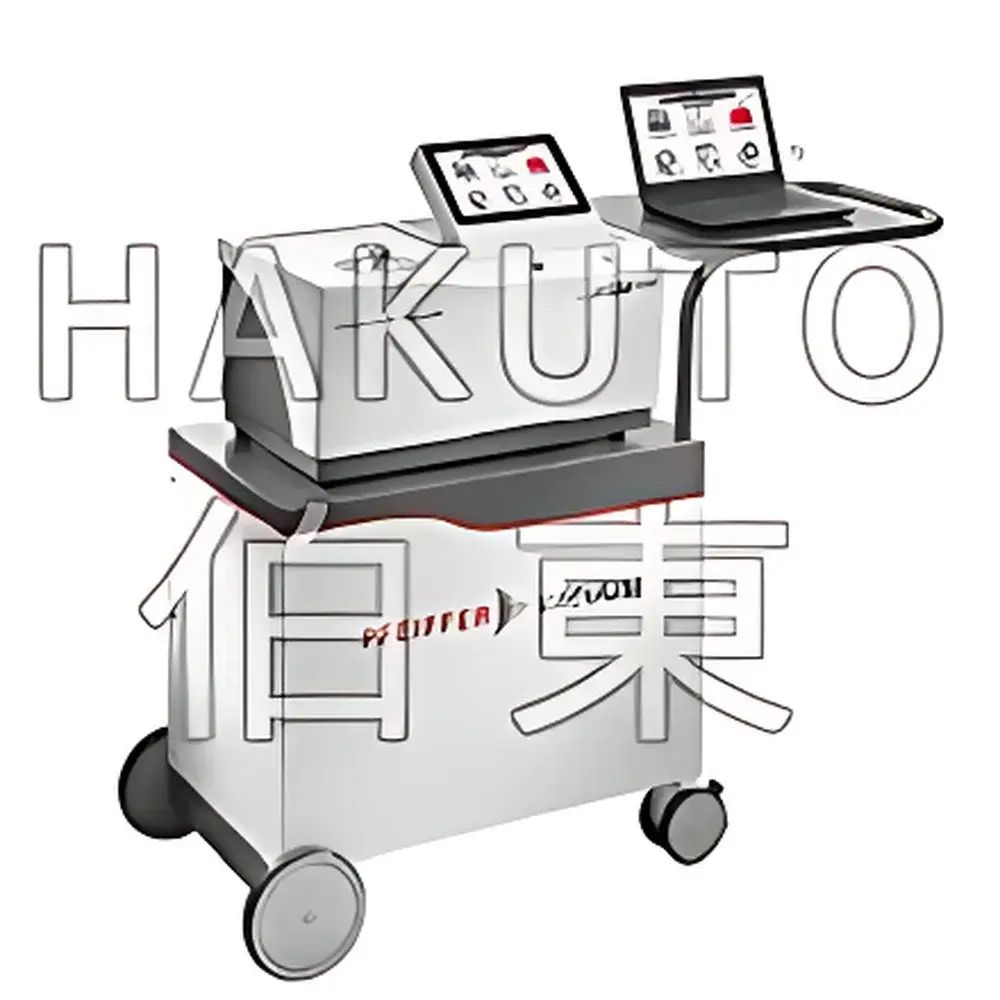
Pfeiffer Vacuum ASM-2000 Helium Mass Spectrometer Leak Detector for Pharmaceutical Package CCIT Testing
| Brand | Pfeiffer Vacuum |
|---|---|
| Origin | France |
| Model | ASM-2000 |
| Detection Principle | Helium Mass Spectrometry (Quadrupole) |
| Measurement Methods | Vacuum Mode & Sniffer Mode |
| Quantitative Sensitivity (Vacuum Mode) | 1×10⁻⁸ – 1×10⁻⁵ mbar·L/s |
| Qualitative Sensitivity (Sniffer Mode) | >1×10⁻⁵ mbar·L/s |
| Calibration | Automatic, traceable to NIST-certified standard leak |
| Operating Temperature | 15–25 °C |
| Relative Humidity | 30–80 % RH |
| Power Supply | 90–250 V AC, 50–60 Hz |
| Typical Power Consumption | 3,750 W |
| Compressed Air (ISO 8573-1 Class 1.3.1) | 4.5–10 bar(g) |
| Helium Supply Pressure | 0.5–8 bar(g) |
| Nitrogen Supply Pressure | 0.5–8 bar(g) |
| User Interface | 10" multi-touch full-HD color display |
| Software | GMP-compliant Windows 10 OS with 4-tier user access control, PDF report generation (test, calibration, audit trail), FDA 21 CFR Part 11 readiness |
| Connectivity | 1× LAN, 2× USB 3.0, 1× HDMI |
| Dimensions (L×W×H, incl. trolley) | 1,409 × 575 × 1,194 mm |
| Weight (incl. trolley) | 140 kg |
| Acoustic Noise Level | <53 dB(A) |
Overview
The Pfeiffer Vacuum ASM-2000 is a purpose-engineered helium mass spectrometer leak detector designed explicitly for Container Closure Integrity Testing (CCIT) in regulated pharmaceutical manufacturing and quality control environments. It operates on the principle of quadrupole mass spectrometry, selectively detecting helium (mass-to-charge ratio m/z = 4) as a tracer gas with high specificity and minimal interference from background atmospheric constituents. Unlike pressure decay or dye ingress methods, helium mass spectrometry delivers quantitative, trace-level leakage detection—enabling verification against Maximum Allowable Leakage Limits (MALL) defined in ASTM F2391-22 and aligned with USP <1207> guidance. The ASM-2000 integrates vacuum-mode testing (for sealed package evaluation under controlled low-pressure conditions) and sniffer-mode localization (for rapid leak site identification during troubleshooting or process development). Its architecture supports both routine QC release testing and formal validation studies per ICH Q5A, ISO 13485, and EU Annex 1 requirements.
Key Features
- Automated, NIST-traceable calibration using certified standard leak sources—ensuring metrological continuity across instrument lifetime and inter-laboratory comparability.
- Dual-mode operation: high-sensitivity vacuum testing (1×10⁻⁸–1×10⁻⁵ mbar·L/s) for quantitative CCIT of vials, syringes, cartridges, and blister packs; and responsive sniffer-mode detection (>1×10⁻⁵ mbar·L/s) for spatial leak localization without package destruction.
- Integrated helium dosing module with programmable fill/evacuate cycles, optimized for residual helium background suppression—critical for achieving reproducible low-leakage detection thresholds in high-throughput settings.
- GMP-ready software platform running on embedded Windows 10, featuring four-tier role-based user access (Administrator, Supervisor, Operator, Viewer), electronic signatures, and automated PDF report generation compliant with 21 CFR Part 11 data integrity expectations.
- Modular mechanical design with customizable test fixtures—engineered to accommodate diverse primary packaging geometries (e.g., 2R–50R vials, prefilled syringes, aluminum-plastic blisters) while maintaining consistent vacuum sealing and helium exposure uniformity.
- Robust environmental tolerance: operational within tightly controlled 15–25 °C ambient temperature and 30–80 % RH ranges—meeting stringent HVAC requirements for cleanroom-adjacent QC laboratories.
Sample Compatibility & Compliance
The ASM-2000 is validated for use with non-porous, rigid, and semi-rigid pharmaceutical packaging formats including glass and polymer vials, pre-filled syringes, cartridges, ampoules, and cold-form blister trays. Its vacuum chamber configuration adheres to ASTM F2391-22 protocols for helium tracer introduction (internal pressurization or external spray), ensuring method equivalence across product families. All firmware, calibration logs, and test records maintain full audit trails with timestamped metadata, satisfying GLP/GMP documentation standards and facilitating regulatory inspection readiness. Instrument qualification documentation (IQ/OQ/PQ templates) and risk-based validation support are available upon request—aligned with FDA, EMA, and PMDA expectations for CCIT method lifecycle management.
Software & Data Management
The embedded control software provides intuitive workflow navigation via its 10-inch multi-touch HD interface. Test sequences—including helium injection duration, evacuation ramp rates, dwell times, and sensitivity thresholds—are fully programmable and stored in encrypted project files. Raw spectral data, real-time helium ion current traces, and pass/fail decision logic are retained with immutable timestamps. Reports export in PDF format with embedded digital signatures, instrument ID, operator ID, calibration status, and environmental monitoring snapshots. Network connectivity enables seamless integration into LIMS via LAN, barcode scanner synchronization for sample tracking, and secure remote diagnostics—without compromising data sovereignty or cybersecurity boundaries.
Applications
- Quantitative CCIT for sterile injectables undergoing stability studies or lot release per USP <1207> Chapter 4 (Probabilistic Risk Assessment).
- Leak rate mapping during container-closure system design transfer and component supplier qualification.
- Root cause analysis of seal failures in lyophilized product lines—correlating leak location with stopper seating force or crimp torque variation.
- Method suitability assessment for new packaging formats (e.g., cyclic olefin copolymer vials, silicone-oil-free syringes) where traditional deterministic methods lack sufficient sensitivity.
- Supporting regulatory submissions requiring analytical method validation (ICH Q2(R2))—including specificity, linearity, limit of detection (LOD), limit of quantitation (LOQ), and robustness evidence.
FAQ
Is the ASM-2000 compliant with FDA 21 CFR Part 11 for electronic records and signatures?
Yes—the system implements role-based authentication, audit-trail logging of all critical actions, and PDF reports with embedded digital signatures meeting Part 11 technical and procedural requirements.
Can the ASM-2000 be qualified for use in Grade A/B cleanroom environments?
While the instrument itself is not classified for direct Grade A placement, its compact footprint, low acoustic emissions (<53 dB(A)), and HEPA-filtered exhaust options enable safe deployment in adjacent Grade C/D support labs with validated material transfer protocols.
Does the system support automated fixture changeover for multi-product facilities?
Yes—modular fixture mounting plates and programmable stage positioning allow rapid reconfiguration between vial, syringe, and cartridge test setups without recalibration.
What helium purity is required for compliant operation?
Helium ≥99.999% (5.0 grade) is recommended to minimize background interference; supply pressure must remain within 0.5–8 bar(g) as specified in the operating manual.
How frequently must the mass spectrometer be calibrated?
Automatic daily zero-point calibration is performed at startup; full sensitivity verification using NIST-traceable standard leaks is recommended prior to each batch of critical testing or at least every 24 hours during continuous operation.
Related Products




