
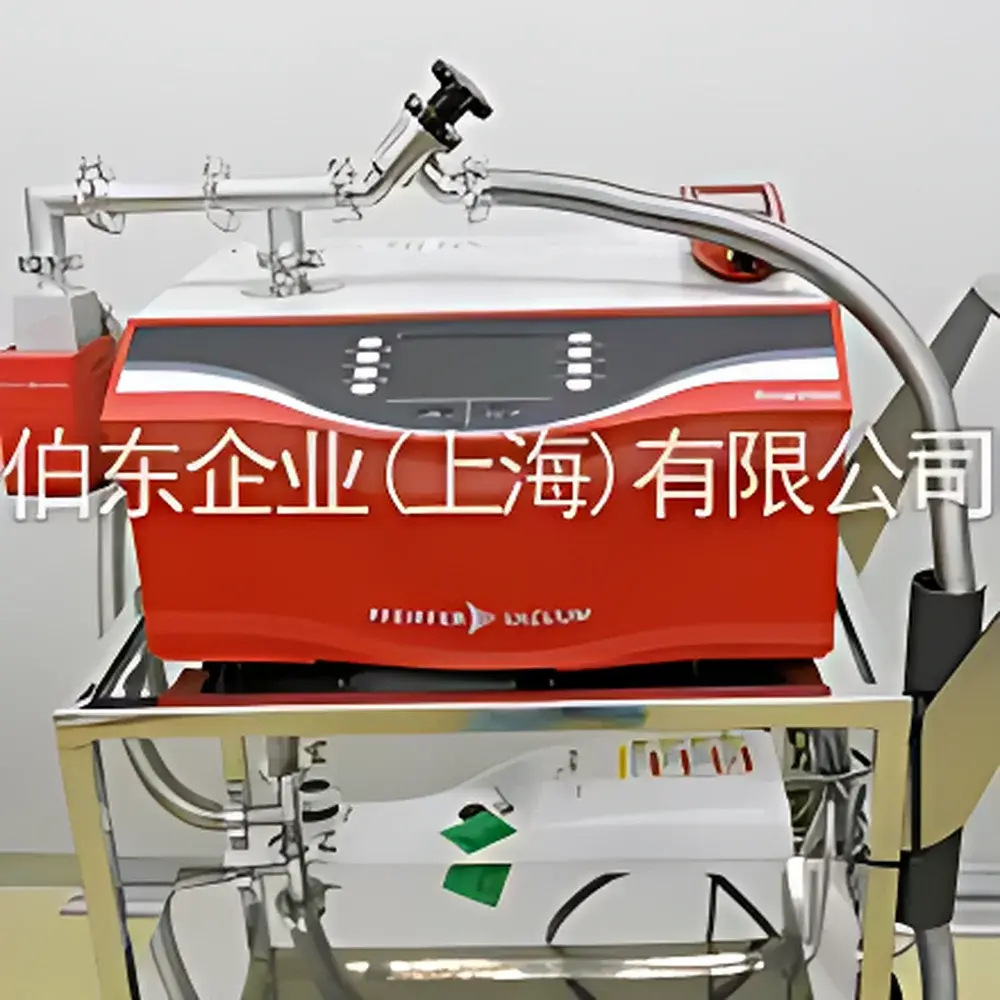
Pfeiffer Vacuum ASM 340WET Helium Mass Spectrometer Leak Detector for MOCVD Process Equipment
| Brand | Pfeiffer Vacuum |
|---|---|
| Origin | France |
| Model | ASM 340WET |
| Detection Principle | Helium-Specific Quadrupole Mass Spectrometry |
| Operating Mode | Vacuum (Hard-Line) Mode |
| Pumping Configuration | Integrated with ACP 28 Dry Scroll Vacuum Pump |
| Compliance | CE, RoHS, ISO 9001 Certified |
| Interface | RS-232 / Ethernet (Optional), Analog Output (0–10 V) |
| Minimum Detectable Leak Rate | ≤5 × 10⁻¹² mbar·L/s (He) |
| Response Time | < 0.5 s (typical) |
| Mass Filter | Quadrupole with 4 amu resolution at 4 He peak |
Overview
The Pfeiffer Vacuum ASM 340WET is a high-sensitivity, production-grade helium mass spectrometer leak detector engineered specifically for demanding vacuum-integrated applications in semiconductor and compound semiconductor manufacturing—particularly Metalorganic Chemical Vapor Deposition (MOCVD) systems. Utilizing a robust quadrupole mass filter tuned exclusively to the 4 amu helium ion signal, the ASM 340WET achieves exceptional selectivity and immunity to background gases such as hydrogen, water vapor, and hydrocarbons. Its design conforms to the stringent requirements of cleanroom-compatible, continuous-operation environments where detection of ultra-fine leaks—down to 5 × 10⁻¹² mbar·L/s—is essential to prevent hazardous precursor gas leakage (e.g., trimethylgallium, arsine, phosphine), ensure process yield integrity, and maintain occupational safety compliance.
Key Features
- Quadrupole mass spectrometer optimized for helium (4 amu) with real-time ion current measurement and automatic baseline compensation
- Integrated vacuum architecture: Direct hard-line connection to MOCVD vacuum chambers via stainless-steel waveguide or CF flange; compatible with standard ISO-KF and ISO-F 63/100 interfaces
- Pre-configured vacuum sequence logic: Fully automated pump-down, pressure stabilization, and leak detection cycle synchronized with ACP 28 dry scroll pump (oil-free, low-vibration, Class 100 cleanroom rated)
- Dual-stage differential pumping system ensures stable analyzer pressure (<1 × 10⁻⁵ mbar) independent of chamber pressure fluctuations (1 × 10⁻³ to 1 × 10⁻¹ mbar range)
- Industrial-grade enclosure (IP54) with EMI-shielded electronics, conformal-coated PCBs, and thermal management suitable for 24/7 operation in factory-floor environments
- Calibrated leak rate output in SI units (mbar·L/s) traceable to national metrology institutes; supports multi-point calibration using certified reference leaks (1 × 10⁻⁹ to 1 × 10⁻¹¹ mbar·L/s)
Sample Compatibility & Compliance
The ASM 340WET is validated for use across full MOCVD system subassemblies—including precursor delivery manifolds, heated vaporizer lines, reactor chamber weld joints, gas injection nozzles, and abatement exhaust ducting. It complies with ISO 10012 (Measurement Management Systems), ISO/IEC 17025 (for accredited leak testing laboratories), and relevant sections of SEMI S2/S8 for equipment safety and emissions control. When deployed under Good Manufacturing Practice (GMP) or ISO 13485 frameworks, its firmware supports audit-trail logging (user actions, timestamps, test parameters) and optional 21 CFR Part 11-compliant electronic signatures when paired with validated software platforms.
Software & Data Management
The instrument operates natively via front-panel touchscreen interface with intuitive workflow-guided menus. For integration into factory automation systems, it provides native Modbus TCP and OPC UA server functionality. Optional LeakTest Suite software enables centralized fleet monitoring, historical trend analysis of leak rates per subsystem, PDF report generation (including operator ID, timestamp, location tag, and pass/fail status), and export to LIMS or MES platforms via CSV/XML. All data logs are stored internally on encrypted flash memory with configurable retention policies (up to 12 months of continuous operation data).
Applications
- Final acceptance testing of MOCVD reactors prior to commissioning
- Periodic preventive maintenance leak surveys of gas distribution networks in GaN, GaAs, and InP epitaxy lines
- Root-cause analysis of process drift linked to unintended air/water ingress
- Verification of weld integrity after chamber reconditioning or component replacement
- Qualification of new gas panel assemblies before installation into production tools
- Supporting ISO 14644-1 Class 5/ISO 14644-2 compliance audits through documented leak-tightness evidence
FAQ
What vacuum level must the MOCVD chamber reach before initiating a vacuum-mode helium leak test?
Typically between 1 × 10⁻³ and 1 × 10⁻¹ mbar—verified by the ASM 340WET’s integrated Pirani/cold cathode gauge. The instrument automatically gates detection onset once stable base pressure is confirmed.
Can the ASM 340WET detect leaks in pressurized MOCVD subsystems (e.g., precursor bottles)?
No—this model is designed exclusively for vacuum-mode (hard-line) detection. Pressurized sniffer-mode testing requires separate instrumentation (e.g., ASM 182 or ASM 340SN).
Is helium recovery supported during high-volume MOCVD line testing?
Not natively; however, third-party helium recapture modules (e.g., CryoTraps or membrane separators) can be installed upstream of the ACP 28 pump inlet without compromising detection sensitivity.
How frequently does the quadrupole require recalibration in a 24/7 LED manufacturing environment?
Under stable operating conditions and routine preventive maintenance (per Pfeiffer Vacuum Service Bulletin SB-ASM340-2023), annual calibration is sufficient; however, quarterly verification using a 1 × 10⁻¹⁰ mbar·L/s reference leak is recommended for GMP-aligned operations.
Does the ASM 340WET support remote diagnostics and firmware updates?
Yes—via secure HTTPS-enabled web interface or Pfeiffer’s proprietary VacuumControl software suite, with TLS 1.2 encryption and role-based access control (admin/operator/viewer).
Related Products






