
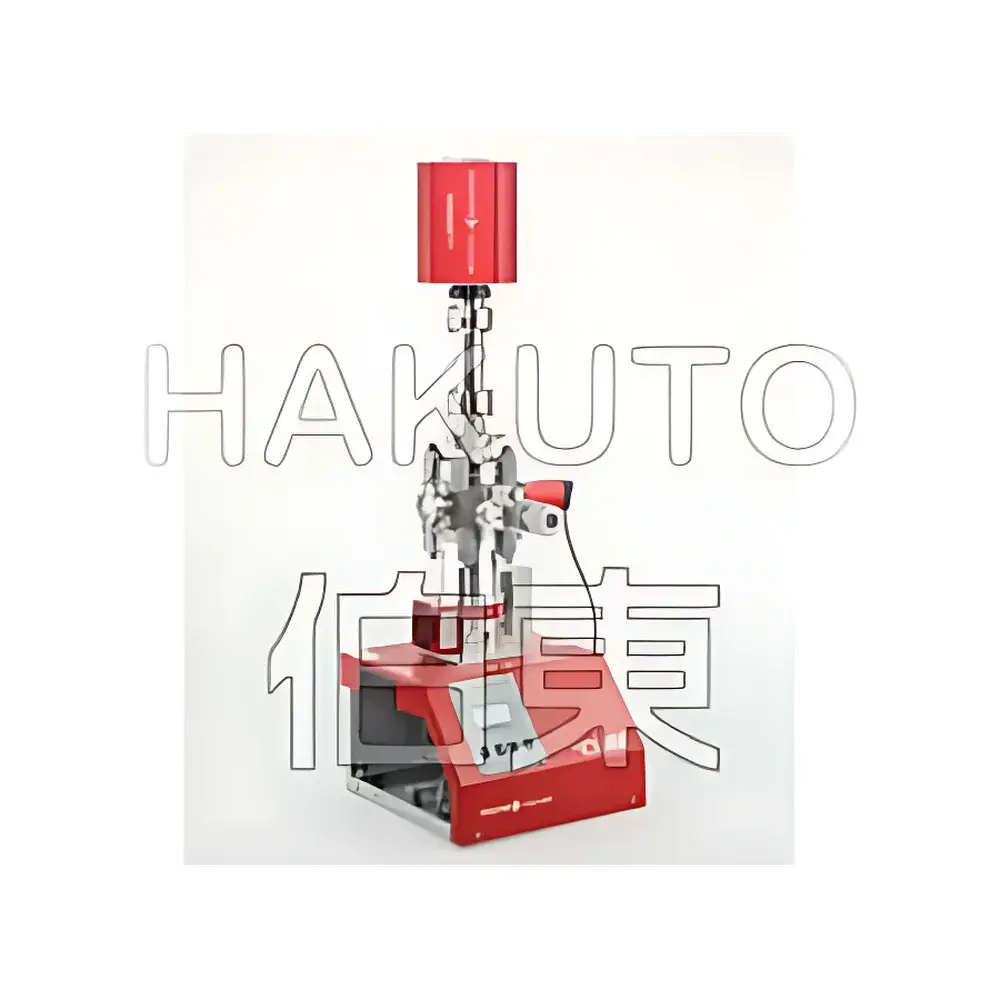
Pfeiffer Vacuum HiCube RGA Residual Gas Analyzer
| Brand | Pfeiffer Vacuum |
|---|---|
| Origin | Germany |
| Model | HiCube RGA |
| Mass Range | 1–300 u |
| Detection Modes | Faraday (F) and C-SEM/Faraday (M) |
| Minimum Detectable Pressure (M) | 3×10⁻¹⁵ hPa |
| Resolution | <10–50 ppm adjacent peak interference |
| Quadrupole Dimensions | 6 mm Ø × 125 mm |
| Operating Temperature (Analyzer) | ≤200 °C (≤150 °C with SEM) |
| Bakeout Temperature | 300 °C |
| Inlet Flange | DN 40 CF-F |
| Data Acquisition | Ethernet interface |
| Power Supply | 100–240 V AC, 50/60 Hz |
| Weight | 25.5–26.2 kg |
| Turbo Pump | HiCube™ Eco (N₂ speed: 67 L/s |
| power | 170 W) |
| Forevacuum Pump | 1 m³/h at 50 Hz |
| Vacuum Gauge | PKR 361 (range: 1×10⁻⁹ – 1×10³ hPa) |
| Integrated Valve | EVN 116 (adjustable conductance: 5×10⁻⁶ – 3×10³ hPa·L/s) |
| Inlet Port | DN 16 ISO-KF |
| Dwell Time | 1 ms – 16 s/amu |
| Peak Ratio Reproducibility | ±0.5 % |
Overview
The Pfeiffer Vacuum HiCube RGA is a compact, high-performance residual gas analyzer engineered for real-time qualitative and semi-quantitative analysis of gas composition in vacuum environments ranging from atmospheric pressure down to ultra-high vacuum (UHV). It integrates a PrismaPro quadrupole mass spectrometer with a HiCube™ Eco turbomolecular pump station—delivering robust, stable operation without external cooling or complex infrastructure. The system operates on the principle of quadrupole mass filtering: ions generated by electron impact ionization are separated according to their mass-to-charge ratio (m/z) via radiofrequency (RF) and direct current (DC) fields applied across four parallel rods. This enables selective detection of species across a mass range of 1–300 u with high mass resolution and low background noise. Designed for continuous duty in industrial and research vacuum systems, the HiCube RGA supports both routine residual gas analysis (RGA) and helium leak detection—making it suitable for vacuum integrity validation, process endpoint determination, and contamination diagnostics in semiconductor fabrication, thin-film deposition, accelerator physics, and space simulation chambers.
Key Features
- Integrated vacuum architecture: Combines PrismaPro QMG 250 series quadrupole mass spectrometer (selectable configurations: F1/F2/F3/M1/M2/M3) with HiCube™ Eco turbo pump (67 L/s N₂ speed, 170 W power consumption) and PKR 361 cold cathode gauge (1×10⁻⁹ – 1×10³ hPa range).
- Dual detection capability: Faraday cup (F) for high-current, stable signal acquisition and channeltron-based C-SEM/Faraday hybrid detector (M) for trace-level sensitivity—achieving minimum detectable partial pressures as low as 3×10⁻¹⁵ hPa (M-mode, m/z = 4 for He).
- Intelligent inlet control: EVN 116 precision gas metering valve enables dynamic pressure regulation (5×10⁻⁶ – 3×10³ hPa·L/s conductance range) and fast isolation via integrated shut-off function—critical for leak localization and pressure-stabilized process monitoring.
- Thermally robust design: Analyzer head rated for continuous operation up to 200 °C (150 °C maximum when C-SEM active); bakeout-capable to 300 °C for UHV compatibility and contaminant desorption management.
- Real-time data handling: Ethernet interface (TCP/IP) supports remote configuration, spectral acquisition, and alarm-triggered digital I/O outputs—enabling seamless integration into PLC-controlled vacuum systems and SCADA networks.
- High reproducibility: Peak intensity ratios repeat within ±0.5 % under identical operating conditions; adjacent peak interference limited to <10–50 ppm depending on mass resolution setting.
Sample Compatibility & Compliance
The HiCube RGA is compatible with all common process and residual gases—including H₂, He, H₂O, CO, CO₂, N₂, O₂, Ar, CH₄, and hydrocarbon fragments—without requiring sample pre-treatment or dilution. Its DN 40 CF-F analyzer flange ensures UHV-compatible metal-sealed mounting, while the DN 16 ISO-KF inlet allows flexible integration into existing vacuum manifolds. The system complies with CE marking requirements and meets electromagnetic compatibility (EMC) standards per EN 61326-1. While not intrinsically certified for hazardous areas, its operational safety profile aligns with IEC 61010-1 for laboratory and industrial measurement equipment. For regulated environments, raw spectral data and instrument logs can be exported in ASCII or CSV formats to support GLP/GMP documentation workflows; audit trails and user access controls are managed via optional Quadera software modules compliant with FDA 21 CFR Part 11 requirements.
Software & Data Management
Control and analysis are performed using Pfeiffer’s Quadera software platform—a Windows-based application supporting full spectral acquisition, multi-mass trending, alarm threshold assignment, and automated report generation. Users may define up to 100 mass channels for simultaneous monitoring, assign individual dwell times (1 ms – 16 s/amu), and configure digital output triggers based on absolute or differential intensity thresholds. All acquired spectra and time-stamped process data are stored locally with metadata (date/time, operator ID, system status) and remain accessible during ongoing measurement—enabling retrospective correlation with chamber events or process steps. Export functions include .txt, .csv, and .xml formats for third-party statistical analysis or LIMS integration. Firmware updates and configuration backups are handled over Ethernet without interrupting vacuum operations.
Applications
- Residual gas analysis: Identification and relative quantification of outgassing species (e.g., H₂O, CO, hydrocarbons) during pump-down and bakeout—providing insight into surface cleanliness, material degassing kinetics, and vacuum chamber conditioning status.
- Helium leak detection: Selective m/z = 4 scanning with optimized dwell time and C-SEM amplification enables sub-10⁻¹¹ mbar·L/s sensitivity; software-assisted peak mapping accelerates leak localization in complex vacuum manifolds.
- In-situ process monitoring: Real-time tracking of reactive gas ratios (e.g., Ar/O₂ in sputtering, SiH₄/NH₃ in PECVD) or byproduct evolution (e.g., HF in etch processes) to verify stoichiometry, endpoint detection, and fault condition recognition.
- Quality assurance in coating systems: Quantitative verification of precursor purity, detection of air/water ingress during load-lock transfer, and post-deposition residual analysis to validate film integrity and adhesion reliability.
- Accelerator and fusion research: Continuous monitoring of beam-induced desorption products and cryopump regeneration efficiency in high-radiation, ultra-high-vacuum beamlines and plasma confinement vessels.
FAQ
What vacuum level is required for optimal HiCube RGA performance?
The analyzer achieves best signal-to-noise ratio and mass resolution at pressures between 1×10⁻⁷ and 1×10⁻⁴ hPa. Operation up to 1×10⁻³ hPa is possible with reduced sensitivity; above this, filament protection logic automatically limits emission current to prevent damage.
Can the HiCube RGA operate continuously during chamber bakeout?
Yes—the analyzer head is rated for bakeout temperatures up to 300 °C. However, the electronics housing (including turbo controller and gauge electronics) must remain below 50 °C; thermal shielding or remote mounting is recommended for extended bake cycles.
Is helium leak detection mode enabled by default?
No. Helium-specific scanning parameters (e.g., m/z = 4 dwell optimization, C-SEM gain calibration, background subtraction algorithms) are activated only when the dedicated “Leak Detection” module is licensed and configured in Quadera software.
How is calibration performed for quantitative analysis?
Absolute partial pressure calibration requires known gas standards introduced via a calibrated leak or dosing system. Relative composition is determined using built-in sensitivity factors (e.g., for Ar, N₂, O₂) referenced to manufacturer-provided cross-section data; these values are adjustable per user-defined reference conditions.
Does the HiCube RGA support remote diagnostics and firmware updates?
Yes—Ethernet connectivity enables secure remote access for configuration review, log retrieval, and over-the-air firmware upgrades using standard SSH/TFTP protocols, provided network security policies permit inbound connections to port 22 or 69.





