
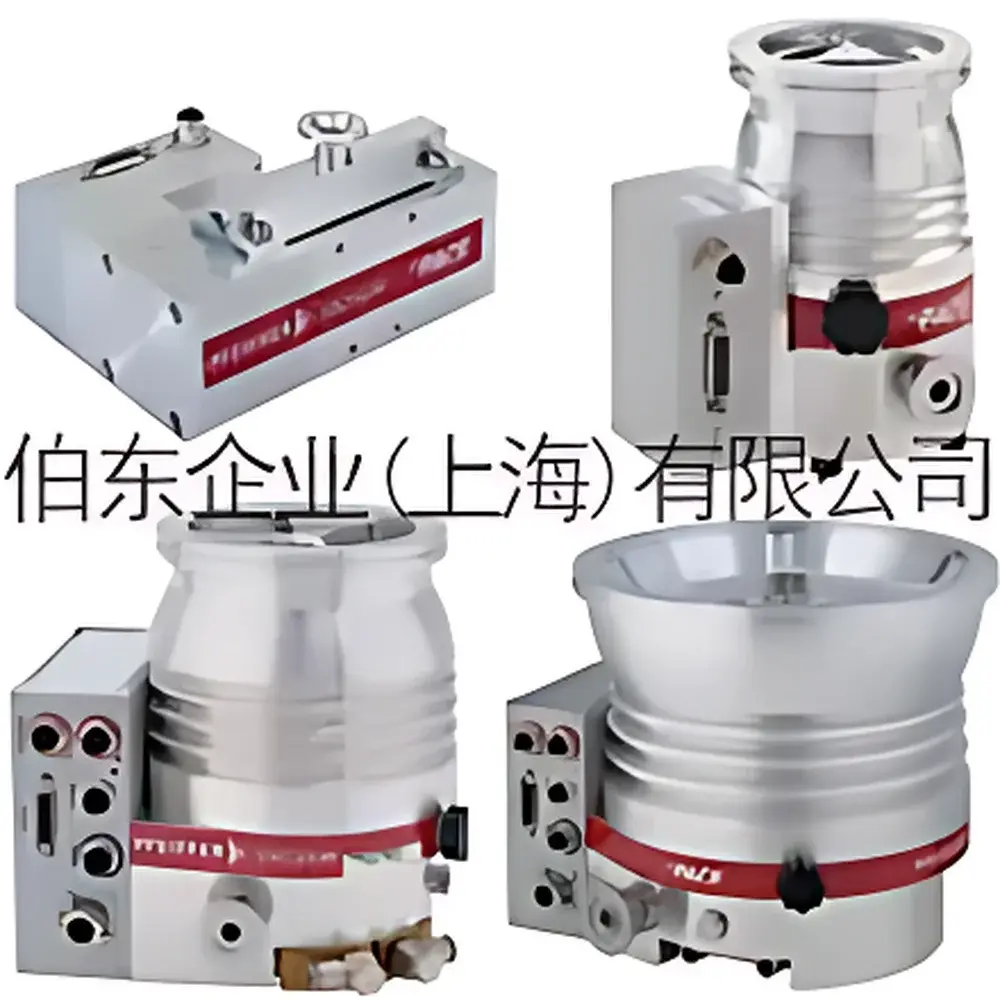
Pfeiffer Vacuum HiPace 10–800 Series Turbo Molecular Pumps
| Brand | Pfeiffer Vacuum |
|---|---|
| Origin | Germany |
| Model | HiPace 10–800 |
| Pump Type | Oil-free Turbo Molecular Pump |
| Ultimate Pressure | < 1 × 10⁻⁷ hPa (N₂) |
| Weight Range | 12.8 – 19.1 kg |
| Integrated Controller Options | TC 110, TC 400 |
| Communication Interfaces | Profibus, DeviceNet, E74 |
| Ingress Protection | IP54 |
| Certifications | SEMI S2, UL Listed |
| Mounting Flexibility | Omnidirectional (360°) Installation |
| Cooling | Integrated High-Efficiency Thermal Management System |
| Bearing Maintenance | Field-Replaceable Bearings |
| Corrosion-Resistant Variant Available | HiPace C Series |
| Industrial-Dust Resistant Variant | HiPace P Series |
Overview
The Pfeiffer Vacuum HiPace 10–800 series represents a high-performance family of oil-free turbo molecular pumps engineered for demanding ultra-high vacuum (UHV) and high-vacuum (HV) applications across research, industrial, and analytical environments. Operating on the principle of momentum transfer—where rapidly rotating titanium or stainless-steel blades impart directional kinetic energy to gas molecules—the HiPace pumps achieve compression ratios exceeding 10¹¹ for nitrogen and maintain ultimate pressures down to < 1 × 10⁻⁷ hPa (N₂), with select configurations reaching < 5 × 10⁻⁸ hPa under optimized conditions. Designed and manufactured in Germany, each unit integrates a brushless DC motor, advanced magnetic bearing technology (in higher-end models), and a compact rotor-stator architecture that enables stable operation at rotational speeds up to 90,000 rpm. The series spans nominal pumping speeds from 10 L/s to 800 L/s, supporting scalable vacuum system design—from benchtop mass spectrometers to large-scale semiconductor process chambers.
Key Features
- Full-speed range coverage: HiPace 10 (10 L/s), HiPace 60/80 (60–80 L/s), HiPace 300/400/700/800 (260–800 L/s), enabling precise matching to chamber volume, outgassing rate, and process gas load.
- Integrated digital controller options (TC 110 or TC 400) with real-time monitoring of speed, temperature, vibration, and power consumption—enabling predictive maintenance and operational transparency.
- Omnidirectional mounting capability: Rotor dynamics and thermal expansion compensation allow secure installation at any orientation (horizontal, vertical, inverted), reducing system layout constraints.
- IP54-rated enclosure ensures reliable operation in industrial cleanrooms and production floors subject to dust, humidity, and minor particulate exposure.
- Modular cooling architecture: Air-cooled variants feature optimized fin geometry and forced convection; water-cooled options (HiPace Plus) provide enhanced thermal stability for continuous-duty applications.
- Field-serviceable components: Bearings, drive electronics, and sensor modules are designed for replacement without full pump disassembly—minimizing downtime and extending service intervals beyond 15,000 operating hours under typical load profiles.
- Dedicated variants: HiPace C series employs corrosion-resistant materials (e.g., Hastelloy-coated rotors, ceramic bearings) for aggressive process chemistries (Cl₂, NF₃, WF₆); HiPace P series incorporates particle-tolerant seals and inlet filters for dusty industrial vacuum environments.
Sample Compatibility & Compliance
The HiPace 10–800 series is compatible with inert, reactive, and mildly corrosive gases—including N₂, Ar, He, H₂, O₂, CO, CO₂, and process gases used in plasma etching and PVD/CVD systems. All models comply with EU Machinery Directive 2006/42/EC and Electromagnetic Compatibility Directive 2014/30/EU. Certified to SEMI S2-0217 (safety guidelines for semiconductor manufacturing equipment) and UL 61010-1 (laboratory equipment safety), units meet functional safety requirements for integration into ISO Class 5–7 cleanroom toolsets. For regulated analytical instrumentation (e.g., GC-MS, TEM, XPS), HiPace pumps support GLP/GMP-aligned validation protocols through traceable calibration reports, audit-ready controller logs, and optional 21 CFR Part 11-compliant software extensions (via Pfeiffer’s Vacuum Control Suite).
Software & Data Management
Pfeiffer’s Vacuum Control Suite (VCS) provides native Windows-based configuration, remote operation, and data logging via Ethernet or RS-485. The TC 400 controller supports OPC UA server functionality for seamless integration into SCADA and MES platforms. Real-time telemetry includes rotational speed (±0.1% accuracy), bearing temperature (±0.5 °C), motor current, and estimated remaining service life based on cumulative vibration spectral analysis. Historical datasets are exportable in CSV or HDF5 format for post-process trending, failure mode analysis, and preventive maintenance scheduling. Firmware updates are delivered via signed binary packages with SHA-256 verification to ensure integrity and traceability.
Applications
- Analytical instrumentation: Primary vacuum backing for electron microscopes (SEM, TEM), residual gas analyzers (RGA), time-of-flight mass spectrometers (TOF-MS), and surface science tools (AES, XPS).
- Semiconductor fabrication: Load-lock evacuation, process chamber roughing and high-vacuum maintenance in etch, deposition (PVD, ALD), and ion implantation tools.
- Optical coating: High-rate sputtering and evaporation systems requiring stable base pressure < 1 × 10⁻⁶ hPa and low hydrocarbon background.
- Vacuum metallurgy: Furnace evacuation for brazing, sintering, and zone refining where oxygen partial pressure must remain below 10⁻⁷ hPa to prevent oxidation.
- Leak detection: Integration with helium leak detectors (HLD) for sensitivity down to 5 × 10⁻¹² mbar·L/s in automotive fuel systems, medical device packaging, and aerospace components.
- Fusion research & particle physics: Cryo-pumped UHV beamlines, neutral beam injectors, and tokamak diagnostic ports requiring long-term stability and radiation-hardened electronics (HiPace Plus variants).
FAQ
What is the recommended fore-vacuum pressure range for optimal HiPace pump performance?
HiPace pumps require a pre-evacuated backing pressure between 0.1–10 hPa (typically achieved with a dry scroll or diaphragm forepump). Operation outside this range may trigger automatic shutdown or reduce bearing lifetime.
Can HiPace pumps operate continuously at full speed under high gas loads?
Yes—provided thermal management capacity is maintained and inlet gas composition remains within specified limits. Continuous operation at >80% nominal speed with >10% of max throughput requires water-cooling (HiPace Plus) or active air flow optimization.
Is vibration isolation required during installation?
While HiPace rotors are dynamically balanced to ISO 1940 G2.5, vibration-sensitive applications (e.g., electron microscopy) benefit from elastomeric mounts or active damping systems to suppress structure-borne transmission below 50 Hz.
How often should the pump bearings be replaced under typical lab use?
Under standard analytical instrument duty cycles (8 hrs/day, moderate gas load), mean time between bearing replacements exceeds 18,000 hours. Field replacement kits include torque-calibrated tools and alignment gauges for repeatable reassembly.
Does the HiPace C series support halogen-based etch chemistries?
Yes—HiPace C models feature nickel-aluminum-bronze housings, ceramic-coated stators, and fluorocarbon-compatible seals, validated for sustained operation with Cl₂, BCl₃, and SF₆ at temperatures up to 120 °C.



