
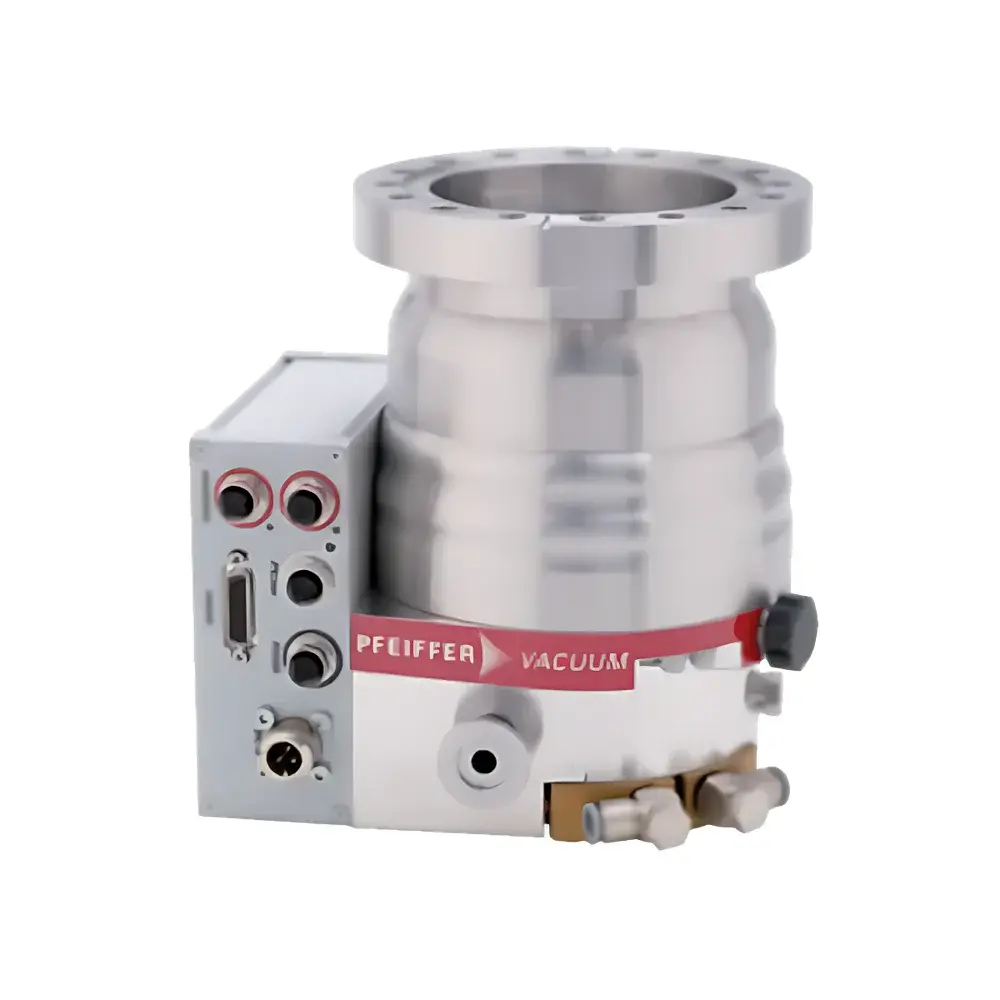
Pfeiffer Vacuum HiPace 300 Turbo Molecular Pump
| Brand | Pfeiffer Vacuum |
|---|---|
| Origin | Germany |
| Model | HiPace 300 |
| Nominal Pumping Speed for N₂ | 260 L/s |
| Protection Rating | IP54 |
| Certifications | UL/CSA, CE, compliant with EN 61000-6-2/-4 and EN 61000-3-2 |
| Integrated Drive Electronics | TC 400 |
| Cooling | Integrated water-cooling system |
| Mounting | Flange-compatible (DN 100 CF/KF optional) |
| Application Class | High and ultra-high vacuum (UHV) systems |
Overview
The Pfeiffer Vacuum HiPace 300 is a compact, high-performance turbo molecular pump engineered for reliable operation in demanding high vacuum (HV) and ultra-high vacuum (UHV) environments. Based on proven drag-stage and turbine-stage hybrid rotor architecture, it achieves a nominal pumping speed of 260 L/s for nitrogen — delivering rapid evacuation and stable base pressures down to <1 × 10⁻⁹ mbar when paired with appropriate backing pumps. Its monolithic rotor design, manufactured from high-strength titanium alloy and dynamically balanced to ISO 1940 G0.4 precision, ensures exceptional mechanical stability and long-term rotational integrity under continuous duty cycles. The pump operates at a fixed rotational speed of 90,000 rpm, optimized for laminar gas flow dynamics and minimal vibrational coupling into sensitive vacuum chambers — a critical requirement in surface science, electron microscopy, and thin-film deposition systems.
Key Features
- Integrated TC 400 drive electronics housed within the pump body, eliminating external controller cabinets and reducing footprint and cable complexity
- IP54-rated enclosure providing protection against dust ingress and water splashing — validated for industrial environments including semiconductor tool integration and analytical instrumentation OEMs
- Factory-integrated water cooling circuit compatible with standard deionized water supply (flow rate: 1.2–2.0 L/min; ΔT ≤ 10 K), enabling sustained thermal management during high-load gas throughput
- Standard DN 100 ISO-KF or CF flange interface (custom flanges available), supporting direct mounting in vertical, horizontal, or inverted configurations without reorientation hardware
- Real-time operational telemetry via RS-485 (Modbus RTU) and analog I/O (0–10 V), enabling seamless integration into PLC-controlled vacuum systems and SCADA architectures
- Compliance with electromagnetic compatibility standards EN 61000-6-2 (immunity) and EN 61000-6-4 (emission), as well as harmonic current limits per EN 61000-3-2
Sample Compatibility & Compliance
The HiPace 300 is designed for inert and non-corrosive process gases (N₂, Ar, He, H₂, O₂, CO, CO₂) typical in physical vapor deposition (PVD), residual gas analysis (RGA), and accelerator beamline applications. It is not rated for condensable vapors, aggressive halogenated compounds, or particulate-laden streams without upstream trapping. All materials in gas path contact — including rotor blades, stator plates, and bearing housings — conform to ASTM F86 and ASTM F1137 for vacuum service cleanliness. The pump meets UL 61010-1 and CSA C22.2 No. 61010-1 safety requirements for laboratory and industrial equipment. Full traceability documentation (including RoHS and REACH declarations) is provided with each unit to support GLP/GMP audit readiness and ISO 9001-certified manufacturing workflows.
Software & Data Management
The TC 400 controller supports firmware-upgradable operation via USB-C and provides native Modbus RTU register mapping for third-party software integration (e.g., LabVIEW, Python-based control suites, TSP-1000 vacuum system managers). Real-time parameters — rotational speed, bearing temperature, motor current, vibration amplitude (via integrated piezoelectric sensor), and fault logs — are timestamped and stored in non-volatile memory with configurable retention (up to 10,000 entries). Audit-trail functionality complies with FDA 21 CFR Part 11 requirements when deployed with validated host software, ensuring electronic record integrity for regulated pharmaceutical and medical device manufacturing vacuum processes.
Applications
- Ultra-high vacuum chambers in synchrotron beamlines and scanning transmission electron microscopes (STEM)
- Load-lock and transfer chambers in cluster tool platforms for semiconductor wafer processing
- Residual gas analyzers (RGAs) and quadrupole mass spectrometers requiring stable, low-vibration pumping
- Research-grade atomic layer deposition (ALD) and molecular beam epitaxy (MBE) systems
- Calibration standards laboratories maintaining reference vacuum environments per ISO 3529-3
- Space simulation test chambers operating under thermal cycling conditions (−40 °C to +85 °C ambient)
FAQ
What is the maximum allowable inlet pressure for continuous operation?
The HiPace 300 is rated for continuous operation up to 1 × 10⁻³ mbar inlet pressure when backed by a suitable dry scroll or diaphragm pump (e.g., Duo 0.5 or MVP 300). Short-term excursions to 1 × 10⁻² mbar are permissible with active thermal monitoring.
Can the pump be operated in inverted orientation?
Yes — the rotor assembly and magnetic bearing system are orientation-independent. Mounting in inverted configuration requires verification of cooling water flow direction and drainage compliance per Pfeiffer Vacuum Installation Manual Rev. 4.2.
Is helium leak testing supported out-of-the-box?
The pump itself is not a leak detector, but its high N₂ speed and low ultimate pressure enable effective helium leak testing when used downstream of a helium mass spectrometer leak detector (e.g., ASM 340) in sniffing or vacuum-mode configurations.
Does the TC 400 controller support analog setpoint control?
No — the TC 400 operates at fixed nominal speed. Speed modulation is not implemented; instead, process control is achieved via throttle valve integration or backing pump regulation.
What maintenance intervals are recommended for routine operation?
Under clean, particle-free conditions, the HiPace 300 requires no scheduled maintenance for 15,000 operating hours or 5 years — whichever occurs first. Bearing health diagnostics are continuously monitored and reported via the TC 400 interface.



