
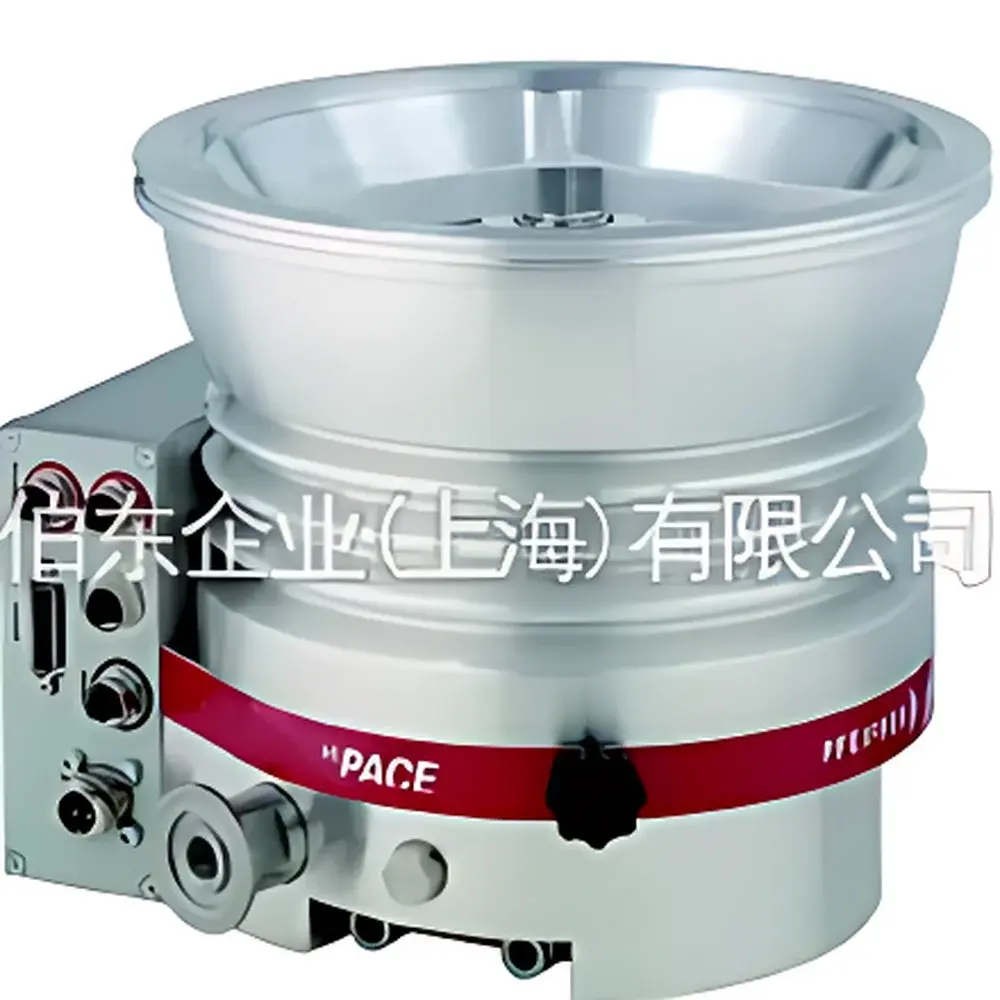
Pfeiffer Vacuum HiPace 800 Turbo Molecular Pump
| Brand | Pfeiffer Vacuum |
|---|---|
| Origin | Germany |
| Pump Type | Oil-Free Turbo Molecular Pump |
| Model | HiPace 800 |
| Nominal Pumping Speed (N₂) | 790 L/s |
| Compression Ratio (N₂) | >1×10¹¹ |
| Ultimate Pressure (N₂) | <1×10⁻⁷ hPa |
| Maximum Starting Pressure (N₂) | 11 mbar |
| Gas Flow Rate (N₂, full speed) | 6.5–19.1 hPa·L/s |
| Startup Time | ≤2.8 min |
| Weight | 21 kg |
| Inlet Flange Options | DN 200 ISO-K / ISO-F / CF-F |
| Protection Rating | IP54 |
| Industrial Certifications | SEMI S2, UL/cUL, CSA |
| Controller Options | TC 400 or TCP 350 |
| Variant | HiPace 800P (enhanced particulate resistance) |
Overview
The Pfeiffer Vacuum HiPace 800 is a high-performance, oil-free turbo molecular pump engineered for demanding ultra-high vacuum (UHV) and high-vacuum (HV) applications across research laboratories, semiconductor fabrication, analytical instrumentation, and industrial thin-film deposition systems. Operating on the principle of momentum transfer—where rapidly rotating titanium-aluminum alloy blades impart directional kinetic energy to gas molecules—the HiPace 800 achieves exceptional pumping speeds and compression ratios without reliance on lubricants or hydrocarbon vapors. Its compact footprint (DN 200 inlet), integrated drive electronics, and robust mechanical architecture make it suitable for space-constrained installations and mission-critical environments requiring continuous, contamination-free operation. Designed and manufactured in Germany to stringent DIN EN ISO 9001 standards, the HiPace 800 delivers reproducible performance under variable load conditions, including transient gas loads typical in sputtering, evaporation, and plasma etch processes.
Key Features
- Oil-free operation ensures zero hydrocarbon backstreaming—critical for electron microscopy, surface science, and residual gas analysis where sample integrity and detector sensitivity must be preserved.
- Integrated controller electronics eliminate external cabling complexity and reduce electromagnetic interference (EMI); compliant with EMC Directive 2014/30/EU.
- IP54-rated housing provides protection against dust ingress and water splashing—enabling reliable deployment in non-cleanroom industrial settings such as lamp manufacturing or roll-to-roll coating lines.
- SEMI S2-certified design meets safety requirements for semiconductor equipment integration, including thermal management, fault response, and electrical isolation.
- HiPace 800P variant features reinforced bearing seals and optimized blade geometry for extended service life in environments with elevated particulate concentrations (e.g., PVD chambers with flaking target material).
- Compatible with both TC 400 (basic control, analog I/O, RS-232/RS-485) and TCP 350 (advanced diagnostics, Ethernet/IP, real-time vibration monitoring, and configurable alarm thresholds).
Sample Compatibility & Compliance
The HiPace 800 is compatible with inert, reactive, and corrosive process gases—including N₂, He, H₂, Ar, O₂, and CF₄—within its specified compression ratio envelope. It is not intended for condensable vapors (e.g., solvents, oils) or abrasive particulates without upstream trapping or filtration. The pump conforms to multiple international regulatory frameworks: UL 61010-1 and CSA C22.2 No. 61010-1 for electrical safety; CE marking per Machinery Directive 2006/42/EC and Low Voltage Directive 2014/35/EU; and RoHS 2011/65/EU compliance for hazardous substance restriction. For GLP/GMP-regulated environments, optional TCP 350 controllers support audit-trail logging and user-access-level configuration—facilitating alignment with FDA 21 CFR Part 11 requirements when integrated into validated vacuum systems.
Software & Data Management
Pfeiffer’s VacuGraph® software (v3.0+) enables remote configuration, real-time parameter visualization (rotational speed, bearing temperature, vibration amplitude, power consumption), and historical trend analysis via Ethernet or USB connection. All TCP 350 units support Modbus TCP and EtherNet/IP protocols for seamless integration into SCADA and MES platforms. Event logs record timestamped operational states—including startup sequence, overtemperature events, and emergency shutdowns—with retention configurable up to 30 days. Firmware updates are delivered via signed .hex packages to ensure integrity and traceability during field maintenance.
Applications
- Surface Analysis: Electron spectroscopy (XPS, AES), secondary ion mass spectrometry (SIMS), and low-energy electron diffraction (LEED) systems requiring stable base pressures below 1×10⁻⁷ hPa.
- Semiconductor Processing: PVD/CVD cluster tools, ion implantation beamlines, and wafer inspection stations where particulate-free vacuum and rapid pump-down cycles are essential.
- Research & Nanotechnology: Molecular beam epitaxy (MBE), cryogenic quantum device fabrication, and nanomaterial synthesis reactors operating under controlled reactive gas environments.
- Analytical Instrumentation: High-resolution mass spectrometers (HRMS), residual gas analyzers (RGA), and helium leak detectors demanding high-speed, low-noise pumping stages.
- Industrial Coating: Optical thin-film deposition (AR/HR coatings), solar cell manufacturing (PECVD, sputtering), and decorative metallization lines with frequent chamber venting and regeneration cycles.
FAQ
What is the recommended forevacuum pressure range for safe operation?
The HiPace 800 requires a backing pressure between 0.1 and 11 mbar (N₂ equivalent) for stable startup and continuous operation. A two-stage rotary vane or dry scroll pump is typically used as the forepump.
Can the HiPace 800 be operated vertically or horizontally?
Yes—it supports both orientations; however, vertical mounting (inlet upward) is preferred for optimal particle shedding and bearing lubrication distribution in long-term operation.
Is the HiPace 800 compatible with aggressive halogen-based process chemistries?
While the standard version tolerates brief exposure to Cl₂ or F₂ at low partial pressures, prolonged use requires optional corrosion-resistant coatings (e.g., nickel-phosphorus plating) and consultation with Pfeiffer Vacuum Application Engineering.
How often does preventive maintenance need to be performed?
Under typical laboratory conditions (8 hrs/day, clean environment), bearing inspection and cleaning are recommended every 12,000 operating hours; in industrial settings with particulate exposure, intervals may be reduced to 6,000 hours—documented in the maintenance log per ISO 13374 condition monitoring guidelines.
Does the HiPace 800 meet vacuum class requirements for UHV systems (≤1×10⁻⁹ hPa)?
Yes—when paired with appropriate bake-out procedures, all-metal sealing (CF), and cryo- or getter-assisted pumping stages, the HiPace 800 serves as a primary high-vacuum stage in certified UHV systems meeting ISO 20484 Class 1 specifications.



