
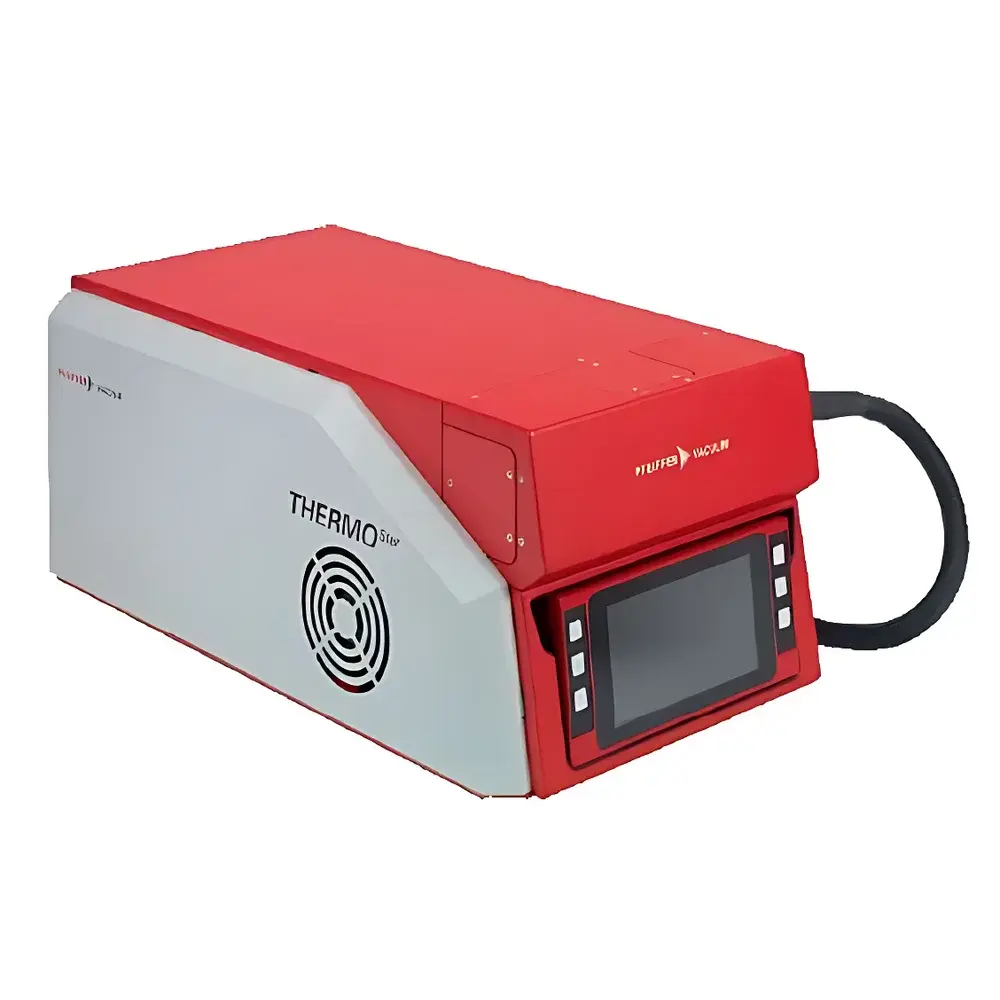
Pfeiffer Vacuum OmniStar® and ThermoStar® Online Process Mass Spectrometers (Distributed by Shanghai Bohong)
| Brand | Pfeiffer Vacuum |
|---|---|
| Origin | USA |
| Manufacturer Type | Authorized Distributor |
| Origin Category | Imported |
| Model | OmniStar® GSD 350 / ThermoStar® GSD 350 |
| Mass Range | 1–100 amu / 1–200 amu / 1–300 amu |
| Inlet Capillary | Stainless Steel (OmniStar®) or Quartz (ThermoStar®) |
| Max Capillary Temp | 350 °C |
| Sample Pressure | up to 1000 hPa (mbar) |
| Gas Flow Rate | 1–2 sccm |
| Detection Limit (C-SEM) | < 100 ppb |
| Resolution (10% valley) | Adjustable 0.5–2.5 amu |
| Dwell Time | 1 ms–16 s/amu |
| Mass Peak Separation (e.g., m/z 40/41) | < 10 ppm / < 20 ppm / < 50 ppm |
| Detector | C-SEM and Faraday |
| Analyzer | PrismaPro® Quadrupole Mass Filter |
| Dimensions (L×W×H) | 615 × 358 × 274 mm |
| Weight | 23 kg |
| Software | PV MassSpec |
Overview
The Pfeiffer Vacuum OmniStar® and ThermoStar® are high-performance, benchtop online process mass spectrometers engineered for real-time, quantitative gas-phase analysis in demanding industrial and research environments. Based on quadrupole mass filter technology with a PrismaPro® analyzer platform, these instruments operate on the principle of mass-selective ion transmission—where gaseous samples are ionized via electron impact (EI), separated according to their mass-to-charge ratio (m/z), and detected using either a continuous-dynode secondary electron multiplier (C-SEM) or Faraday cup. The system’s two-stage heated inlet—featuring a temperature-controlled capillary (stainless steel in OmniStar®, fused quartz in ThermoStar®) capable of operation up to 350 °C—ensures complete volatilization of condensable species and eliminates adsorption or fractionation artifacts common in unheated sampling lines. This architecture enables direct, isobaric introduction of process gases at pressures up to 1000 hPa without prior separation or dilution, distinguishing it from optical techniques such as FTIR or NDIR that suffer from spectral overlap and limited dynamic range.
Key Features
- Real-time gas analysis with dwell times configurable from 1 ms to 16 s per mass unit, enabling rapid transient monitoring or high-sensitivity integration
- Heated capillary inlet (up to 350 °C) with software-controlled pneumatic valves; prevents condensation of vapors (e.g., H₂O, solvents, organometallics) and maintains sample integrity
- Modular design with interchangeable inlet configurations, detector options (C-SEM/Faraday), and mass range variants (1–100, 1–200, or 1–300 amu)
- Integrated dry diaphragm backing pump and turbomolecular pump ensure oil-free vacuum generation and compatibility with reactive or corrosive process streams
- 7-inch color touchscreen interface and remote web-based control via Ethernet; supports OPC UA and Modbus TCP for seamless integration into DCS/SCADA systems
- Automated tuning, mass calibration, and background subtraction routines reduce operator dependency and support routine GLP/GMP compliance
Sample Compatibility & Compliance
The OmniStar® and ThermoStar® accommodate a broad spectrum of inorganic and organic gases—including permanent gases (H₂, O₂, N₂, CO, CO₂), volatile organics (VOCs), silanes, halogenated compounds, and metal hydrides—without requiring pre-concentration or derivatization. The quartz capillary option (ThermoStar®) provides superior inertness for trace-level analysis of reactive or adsorptive species (e.g., NH₃, Cl₂, HF). Both systems meet essential requirements for regulated environments: vacuum integrity and signal stability are validated per ISO 11140-4 (mass spectrometer performance verification); data acquisition and audit trails comply with FDA 21 CFR Part 11 when deployed with PV MassSpec’s electronic signature and user-access controls; and hardware design conforms to IEC 61000-6-2/6-4 for electromagnetic compatibility in industrial settings.
Software & Data Management
PV MassSpec is a dedicated, Windows-based application providing full instrument control, spectral acquisition, library matching (NIST/EPA/Wiley), and quantitative analysis via internal standardization or response factor calibration. The software supports multi-component quantification across overlapping peaks using deconvolution algorithms and offers customizable reporting templates aligned with ASTM D7504 (standard test method for trace gas analysis by mass spectrometry). Raw data files (.msd) retain full metadata—including timestamped calibration logs, valve states, and pressure readings—for retrospective review. Export formats include CSV, ASCII, and XML, facilitating import into LIMS, MES, or statistical process control (SPC) platforms. Optional API access enables scripted automation of measurement sequences and alarm-triggered data capture.
Applications
These analyzers are deployed across sectors where compositional fidelity, speed, and robustness are critical: semiconductor fab tool exhaust monitoring (etch, CVD, ALD); catalytic reaction profiling in petrochemical R&D; headspace analysis during lyophilization cycle development; off-gas tracking in anaerobic digestion and bioreactor fermentation; impurity detection in high-purity gas supply lines (e.g., Ar, He, N₂ for electronics); and ambient air or stack emission characterization per EPA Method TO-15 and ISO 16000-6. Their ability to resolve isotopic patterns (e.g., ¹²CO vs. ¹³CH₄ at m/z 28) and detect sub-ppb contaminants makes them indispensable for failure analysis, leak detection, and process endpoint determination.
FAQ
What vacuum level is required for optimal operation?
The system achieves operational base pressure ≤ 5 × 10⁻⁷ hPa with the integrated turbomolecular pump; no external roughing pump is needed.
Can the instrument analyze humid or particulate-laden streams?
Yes—provided the heated capillary remains above the dew point and upstream particulate filtration (e.g., sintered metal frit) is installed to protect the analyzer.
Is method transfer between OmniStar® and ThermoStar® straightforward?
Yes—identical PV MassSpec workflows, calibration protocols, and spectral libraries ensure analytical continuity across both platforms.
Does the system support automated daily performance verification?
Yes—scheduled auto-tuning and reference gas (e.g., air/N₂/Ar mixture) checks generate pass/fail reports traceable to instrument log files.
What service and support infrastructure is available outside Germany?
Shanghai Bohong provides local technical support, preventive maintenance contracts, and certified training programs aligned with Pfeiffer Vacuum’s global service standards.





