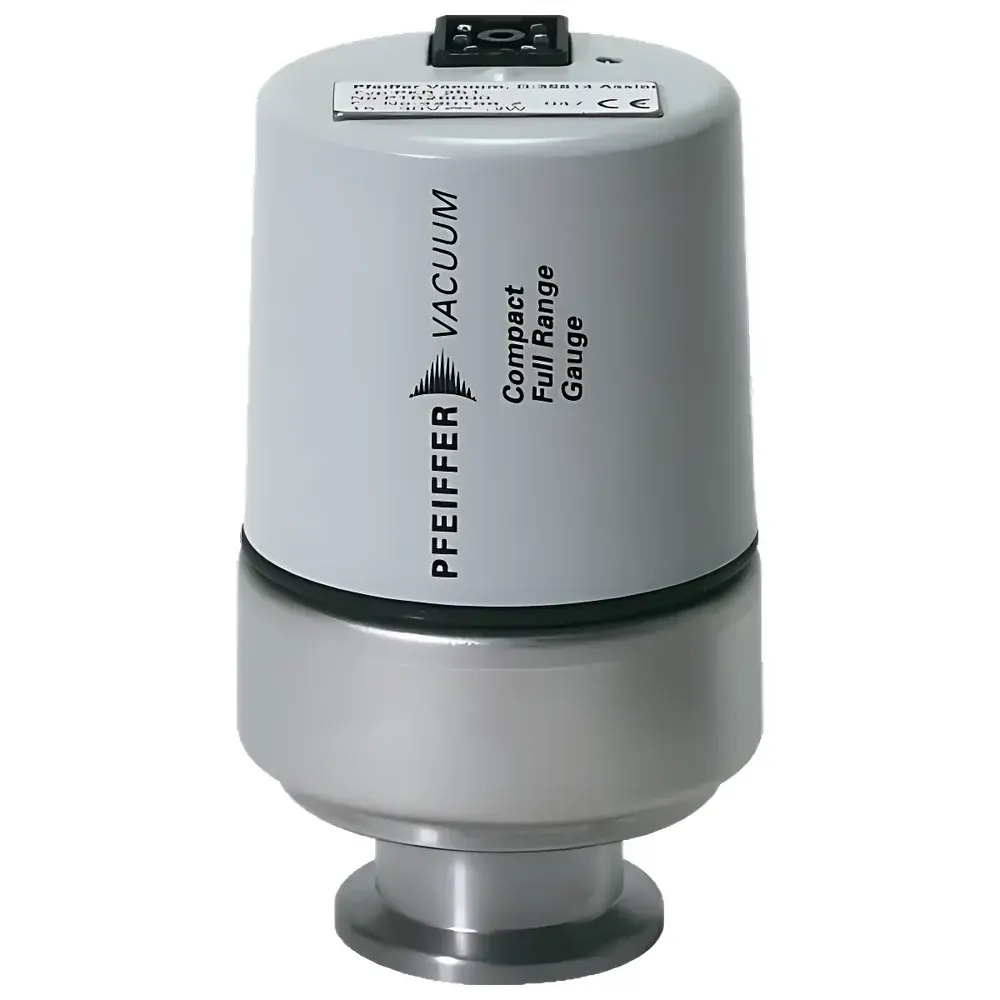
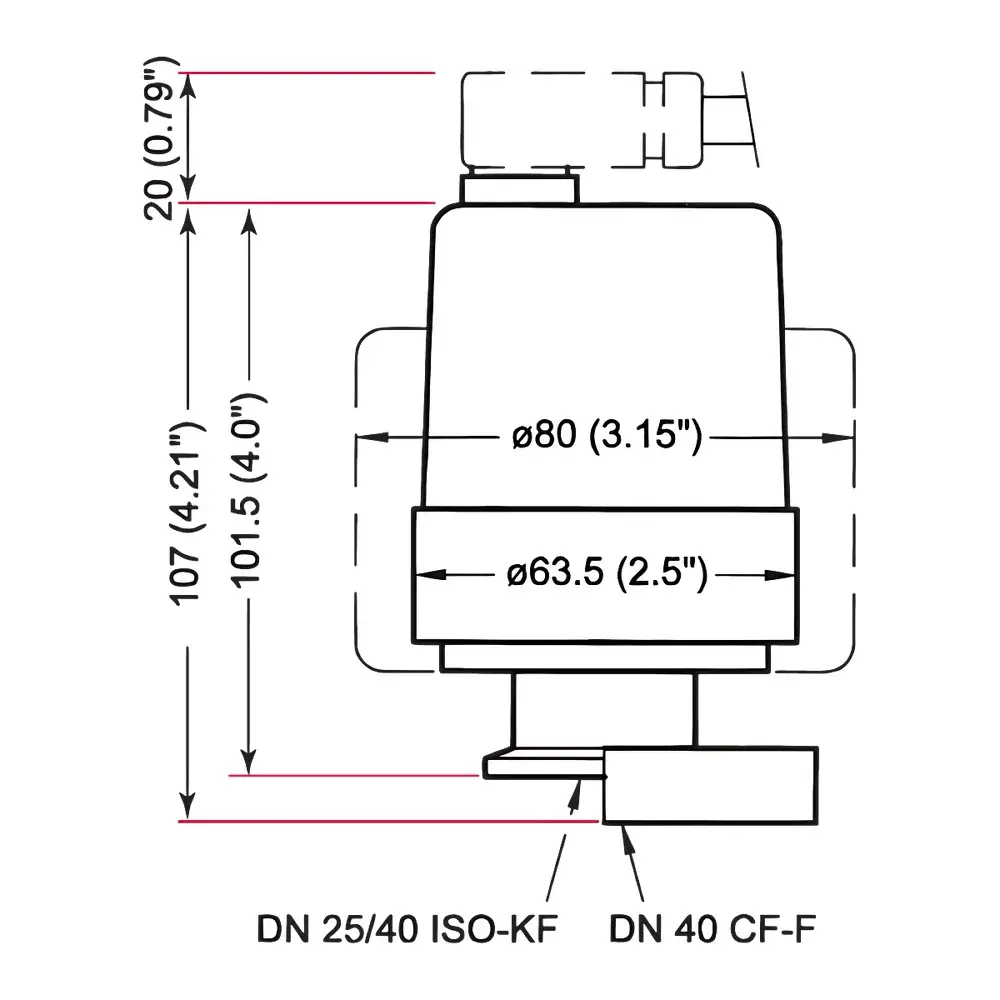
Pfeiffer Vacuum PKR 251 Full-Range Vacuum Gauge
| Brand | Pfeiffer Vacuum |
|---|---|
| Origin | Germany |
| Model | PKR 251 |
| Measurement Principle | Pirani + Cold Cathode |
| Range | 5×10⁻⁹ to 1000 hPa |
| Vacuum Interfaces | KF 25, CF 40, KF 40 |
| Accuracy | ±30% (1×10⁻⁸ to 100 hPa) |
| Repeatability | ±5% |
| Operating Temperature | 5–55 °C |
| Bakeout Temperature | up to 150 °C |
| Power Supply | 15.0–30.0 V DC |
| Max. Power Consumption | ~2 W |
| Output Signal | 0–10.5 V analog voltage |
| Weight | ~700 g |
Overview
The Pfeiffer Vacuum PKR 251 is a compact, dual-sensor full-range vacuum gauge engineered for continuous, reliable pressure monitoring across an exceptionally wide dynamic range—from rough vacuum (1000 hPa) to high vacuum (5×10⁻⁹ hPa). Its hybrid sensing architecture integrates a thermally compensated Pirani sensor for the low-to-mid vacuum range (1000 to 1×10⁻³ hPa) and a cold cathode (inverted magnetron) gauge for the high-to-ultra-high vacuum domain (1×10⁻³ to 5×10⁻⁹ hPa). Unlike segmented systems requiring manual switching or calibration handoffs, the PKR 251 delivers seamless, single-instrument coverage without range gaps or signal discontinuities. The inverted magnetron design enhances stability under fluctuating magnetic environments and improves immunity to hydrocarbon contamination—critical for long-term operation in industrial vacuum chambers, coating systems, and analytical instrumentation where process integrity must be maintained over extended duty cycles.
Key Features
- Single-device full-range measurement from 5×10⁻⁹ hPa to 1000 hPa (air/N₂ calibrated), eliminating the need for multiple gauges or manual range transitions
- Dual-sensor architecture with automatic cross-over logic ensures continuous output and consistent scaling across the entire range
- Robust stainless-steel housing with interchangeable flange options: DN25 ISO-KF, DN40 ISO-KF, and DN40 CF-F—enabling integration into diverse vacuum architectures including UHV-compatible systems
- High bakeout tolerance up to 150 °C (with metal-sealed variants), supporting applications requiring chamber regeneration or outgassing protocols compliant with ISO 3529-3 and ASTM E1867
- Low-power consumption (~2 W max) and wide DC supply range (15.0–30.0 V) facilitate integration into PLC-controlled vacuum systems and embedded OEM platforms
- Analog voltage output (0–10.5 V, linearly scaled to log pressure) provides direct compatibility with standard data acquisition hardware and SCADA systems without external signal conditioning
Sample Compatibility & Compliance
The PKR 251 is calibrated for nitrogen and dry air; for non-standard gases (e.g., Ar, He, H₂, CO₂), correction factors are available per ISO 20484 and Pfeiffer’s technical documentation. It is not intended for use with reactive, corrosive, or condensable vapors—including halogenated compounds, solvents, or acidic process gases—without prior consultation and optional protective accessories. All variants meet CE marking requirements under the EU Electromagnetic Compatibility Directive 2014/30/EU and Low Voltage Directive 2014/35/EU. Metal-sealed (CF) configurations comply with ISO UHV standards (ISO 10110-7, ISO 3529-3) for ultra-high vacuum integrity, while FPM-sealed KF versions satisfy general-purpose ISO-KF system requirements (ISO 2861). The device supports GLP/GMP-aligned installation qualification (IQ) and operational qualification (OQ) when deployed in regulated manufacturing environments.
Software & Data Management
While the PKR 251 operates as a standalone analog transducer, it is fully compatible with Pfeiffer’s TPG300 series controllers and the digital Vacuum Control Software (VCS) suite via optional analog-to-digital interface modules. When integrated into a networked vacuum control system, the gauge supports audit-trail-capable logging, configurable alarm thresholds (high/low pressure, sensor fault), and timestamped trend recording—all traceable to NIST-traceable calibration certificates. Firmware updates and configuration parameters (e.g., gas correction selection, zero offset, output scaling) are managed through RS485 or USB interfaces using Pfeiffer’s standardized communication protocol (PV-Com), which conforms to industry expectations for deterministic response time (<50 ms) and interoperability in multi-gauge arrays.
Applications
- Industrial vacuum metallurgy and PVD/CVD coating systems requiring stable pressure feedback across pump-down, process, and venting phases
- Research-grade vacuum chambers in physics, materials science, and surface analysis labs—particularly where space-constrained mounting and bakeout capability are essential
- OEM integration into mass spectrometers, electron microscopes, and ion implanters needing robust, low-drift vacuum monitoring with minimal thermal load
- Leak detection support systems where rapid response to pressure transients aids in distinguishing real leaks from outgassing artifacts
- Environmental simulation chambers operating under controlled low-pressure conditions compliant with MIL-STD-810 or IEC 60068-2-41 test profiles
FAQ
What gases can the PKR 251 measure accurately?
The PKR 251 is factory-calibrated for nitrogen and dry air. For other permanent gases (e.g., argon, helium, oxygen), pressure readings require application of published gas-specific correction factors per ISO 20484.
Is the PKR 251 suitable for ultra-high vacuum (UHV) applications?
Yes—when equipped with a DN40 CF-F metal seal and operated within its specified range (down to 5×10⁻⁹ hPa), it meets UHV compatibility criteria for bakeout (≤150 °C) and outgassing performance per ISO 3529-3.
Does the PKR 251 support digital communication protocols?
No—the PKR 251 outputs only analog voltage (0–10.5 V). Digital integration requires an external analog input module or a Pfeiffer TPG300-series controller with analog channel support.
Can the PKR 251 be used in reactive gas environments?
Not without mitigation. Exposure to halogens, silanes, ammonia, or condensable vapors may degrade sensor performance or cause irreversible damage. Consult Pfeiffer’s chemical compatibility guide before deployment.
What is the recommended recalibration interval?
Annual recalibration is advised for GMP/GLP environments; biennial verification suffices for non-regulated R&D applications—provided no mechanical shock, excessive bakeout cycling, or exposure to contaminants has occurred.