
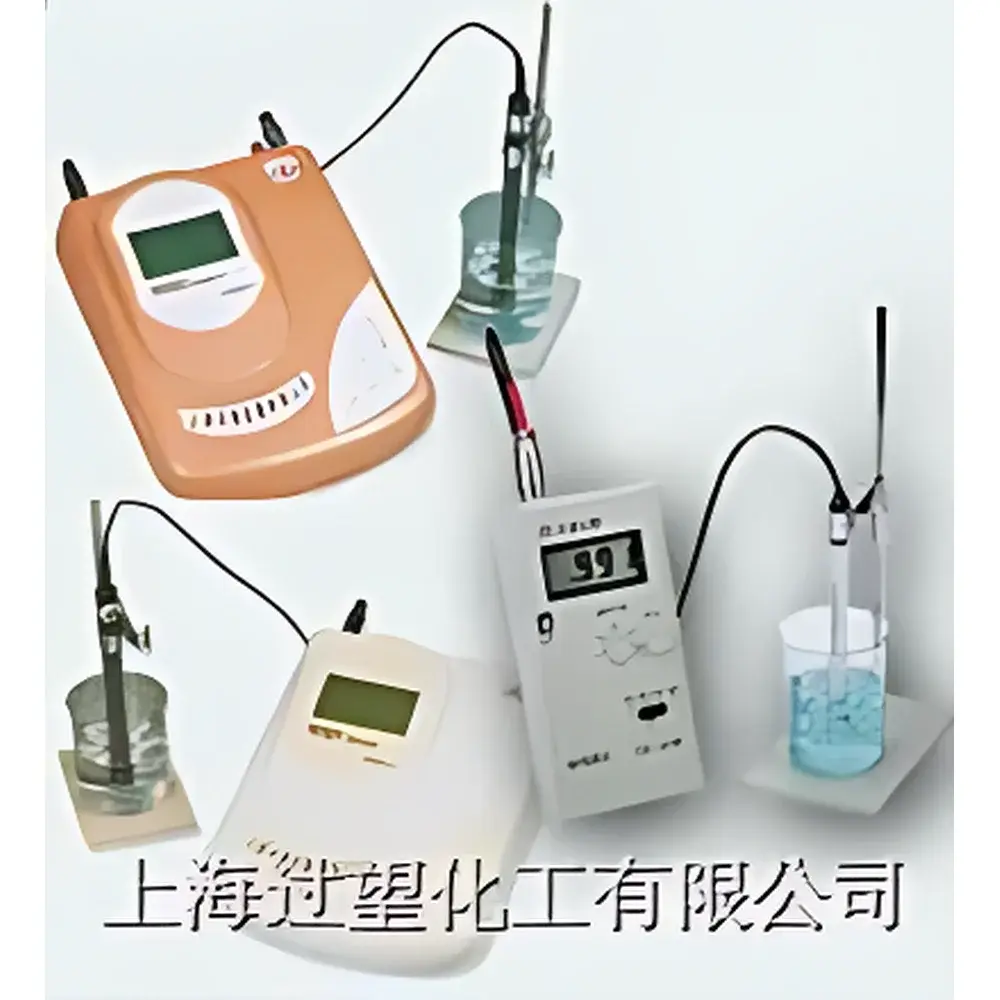
PFS-80 and PFP-208 Fluoride Ion Selective Electrode Meters
| Origin | Shanghai, China |
|---|---|
| Manufacturer Type | Authorized Distributor |
| Product Origin | Domestic (China) |
| Models | PFS-80 (Benchtop), PFP-208 (Portable) |
| Measurement Range | 0–6.00 pF |
| Accuracy | ±0.02 pF |
| Temperature Compensation Range | 0–60 °C |
| pH Measurement Range | 0.00–14.00 (±0.01) |
| mV Range | ±1999 mV (±0.1%) |
| Output Signal | –1999 to +1999 mV |
| Power Supply | AC 220 V ±10%, 50/60 Hz |
| Battery | 9 V (6F22) |
| Net Weight | 1.8 kg (PFS-80), 0.5 kg (PFP-208) |
| Stability | ±0.01 pF/30 min |
Overview
The PFS-80 and PFP-208 Fluoride Ion Selective Electrode Meters are precision potentiometric instruments engineered for the quantitative determination of fluoride ion activity (expressed as pF = –log[F⁻]) in aqueous solutions. Based on the Nernstian response of a solid-state lanthanum fluoride (LaF₃) crystal membrane electrode, these meters deliver stable, reproducible measurements across environmental, industrial, and regulatory laboratory applications—particularly where compliance with drinking water standards (e.g., WHO, EPA Method 300.0, ISO 10304-1) or wastewater discharge limits is required. Unlike optical or colorimetric methods, ion-selective electrode (ISE) technology enables direct, real-time measurement without reagent consumption or sample derivatization. Both models implement two-point calibration (using standard fluoride solutions, typically 10⁻¹ and 10⁻⁴ mol/L NaF), automatic temperature compensation via integrated Pt1000 or thermistor sensors, and dual-function capability for simultaneous pF, pH, and mV readings—ensuring traceability and method flexibility under variable field or lab conditions.
Key Features
- Ion-selective measurement principle using LaF₃-based solid-state membrane electrodes—optimized for selectivity against common interferents including OH⁻, Cl⁻, and NO₃⁻ (selectivity coefficient KF⁻,OH⁻ < 10⁻⁵)
- Dual-mode operation: pF (0.00–6.00), pH (0.00–14.00 ±0.01), and mV (±1999 ±0.1%)—all referenced to Ag/AgCl internal reference systems
- Integrated temperature sensing (0–60 °C range) with automatic Nernst slope correction per IUPAC guidelines
- Benchtop PFS-80 model features isolated analog output (–1999 to +1999 mV) compatible with SCADA, PLC, or data loggers; supports GLP-compliant manual recording
- Portable PFP-208 employs dual-power architecture (AC adapter + replaceable 9 V alkaline battery), enabling >100 hours of continuous field use without recharging
- Stability specification of ±0.01 pF over 30 minutes ensures repeatability suitable for QC/QA protocols in municipal water testing laboratories
Sample Compatibility & Compliance
These meters are validated for use with natural waters (groundwater, surface water, drinking water), treated effluents, fluoride-containing industrial process streams (e.g., aluminum smelting, semiconductor etching baths), and oral care product formulations. Sample matrix requirements include total ionic strength adjustment (TISA) using ionic strength buffer (e.g., TISAB II) to minimize activity coefficient variation and complexation interference from Al³⁺ or Fe³⁺. The instruments comply with fundamental metrological requirements outlined in ISO/IEC 17025 for calibration traceability and support documentation necessary for audits under EPA 136, ASTM D1129, and China’s HJ 488–2009 standard methods. While not inherently 21 CFR Part 11–compliant (lacking electronic signature or audit trail functions), both models generate raw mV/pF data suitable for import into validated LIMS or ELN platforms.
Software & Data Management
The PFS-80 and PFP-208 operate as standalone instruments with no embedded firmware-based software. All calibration data, measurement logs, and temperature records are manually documented or captured externally via the analog output interface. For regulated environments, users integrate the mV output signal into third-party acquisition systems (e.g., LabVIEW, MATLAB, or custom Python scripts) that enforce ALCOA+ data integrity principles—including attributable, legible, contemporaneous, original, and accurate timestamping. Calibration verification checks (e.g., daily mid-range standard check) and electrode performance logs (slope, intercept, response time) are maintained per laboratory SOPs aligned with ISO/IEC 17025 Clause 7.7.
Applications
- Regulatory monitoring of fluoride in public drinking water supplies (target: 0.7–1.2 mg/L per USPHS; ≤1.5 mg/L per WHO)
- Process control in fluoridation plants, where real-time pF feedback adjusts NaF or HF dosing pumps
- Environmental site assessment of fluoride contamination near phosphate fertilizer facilities or geothermal discharges
- Quality control of dental rinses, toothpastes, and fluoride varnishes during pharmaceutical manufacturing
- Educational use in analytical chemistry laboratories for teaching potentiometric titration and ISE theory
FAQ
What electrode types are compatible with the PFS-80 and PFP-208?
The meters are designed for use with standardized LaF₃-based fluoride ISEs (e.g., Orion 96-09, Thermo Scientific) and double-junction reference electrodes with KNO₃ or LiOAc electrolyte to prevent clogging in high-suspended-solids samples.
Is temperature compensation mandatory for accurate pF measurement?
Yes—fluoride electrode response follows the Nernst equation (–59.16 mV/pF at 25 °C), and slope varies with temperature; uncorrected measurements introduce systematic error exceeding ±0.1 pF above 10 °C deviation.
Can these meters measure total fluoride or only free F⁻?
They measure thermodynamically active (free) fluoride ion concentration only; total fluoride requires prior digestion (e.g., steam distillation per APHA 4500-F B) to liberate complexed species.
How often should calibration be performed?
Two-point calibration is recommended before each analytical session; verification with a mid-range standard (e.g., 2.00 pF) is required between sample batches per ISO 17025 Clause 7.7.2.
Are there limitations for high-fluoride industrial samples?
Samples exceeding 6 mg/L (≈3.0 pF) require dilution with TISAB buffer to maintain linear response and avoid saturation; electrode conditioning in 10⁻³ mol/L NaF for 30 minutes restores baseline stability after exposure to concentrated matrices.
Related Products







