
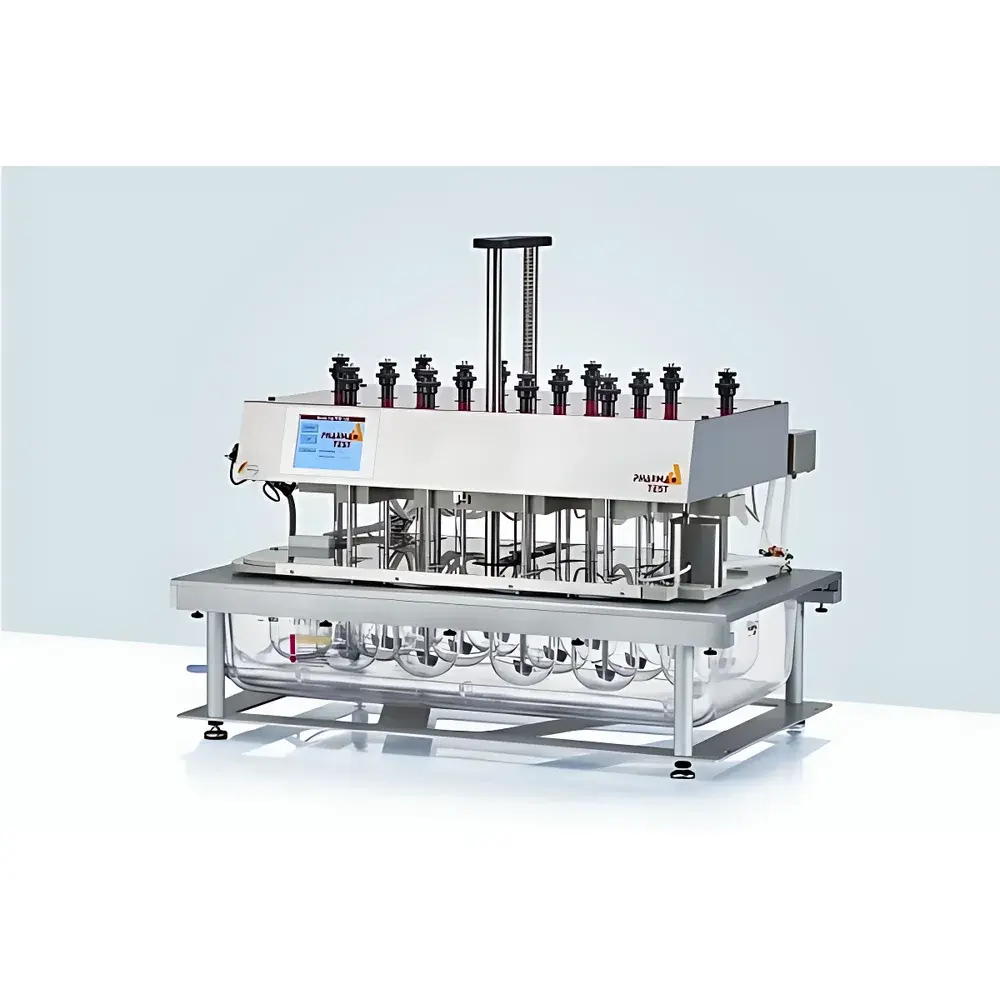
Pharma-test PTWS 1420 14-Position Offline Dissolution Tester
| Brand | Pharma-test |
|---|---|
| Origin | Germany |
| Model | PTWS 1420 |
| Instrument Type | Offline Dissolution Tester |
| Number of Vessels | 14 |
| Temperature Range | 25–45 °C |
| Temperature Accuracy | ±0.2 °C |
| Rotational Speed Range | 25–250 rpm |
| Paddle Wobble | ≤0.2 mm |
| Basket Wobble | ≤0.2 mm |
| Water Bath Temperature Resolution | ±0.2 °C |
| Water Bath Volume | 0.5 m³ |
Overview
The Pharma-test PTWS 1420 is a high-precision, offline dissolution testing system engineered for pharmaceutical quality control laboratories requiring strict compliance with global pharmacopoeial standards. Based on the USP <711> and <724>, European Pharmacopoeia (EP) <2.9.3> and <2.9.4>, British Pharmacopoeia (BP), German Pharmacopoeia (DAB), and Japanese Pharmacopoeia (JP) Chapter <15>, this 14-position instrument integrates dual-motor drive architecture with independent speed control for left- and right-side vessel arrays. Its modular design supports all six USP dissolution apparatus types (I–VI) via Monoshaft™ single-shaft height adjustment—eliminating recalibration during method transitions. The system operates under tightly regulated thermal and mechanical conditions: water bath temperature is maintained within ±0.2 °C across the full 25–45 °C range, while paddle and basket wobble are constrained to ≤0.2 mm per vessel—ensuring reproducible hydrodynamic profiles essential for discriminating formulation performance.
Key Features
- Dual independent motor control enables synchronized yet differentiated rotational speeds across two 7-vessel sub-arrays—critical for comparative dissolution profiling or parallel method validation.
- EPE (Electronic Probe Entry) automatic sampling module precisely positions sampling probes into dissolution media at pre-defined timepoints, minimizing operator intervention and cross-contamination risk.
- ITM (Individual Temperature Monitoring) sensors provide real-time, vessel-specific temperature feedback; TMA (Timed Media Addition) module supports automated dosing of reference standards or pH-adjusting agents.
- Monoshaft™ mechanical architecture allows rapid interchange of USP Apparatus 1 (basket), 2 (paddle), 5 (paddle-over-disk), and 6 (cylinder) without re-leveling or height recalibration—reducing setup time and alignment error.
- Integrated OQ/PQ reminder system logs calibration events and prompts scheduled performance verification per ICH Q2(R2) and FDA guidance, supporting audit-ready documentation.
- DSR-M piston-driven syringe pump features 13-channel programmable sampling, LCD status display, and compatibility with standard HPLC vials (12 × 32 mm) and multi-tube racks—enabling seamless integration with downstream analytical workflows.
- Low-volatility vessel lids minimize solvent evaporation over extended test durations (up to 24 h); 1500 W heating element achieves rapid thermal equilibration in the 0.5 m³ water bath, which is fully detachable for cleaning and maintenance.
- Self-diagnostic startup sequence verifies mechanical integrity, temperature stability, probe positioning, and motor synchronization—reporting status via visual indicators and audible tones.
Sample Compatibility & Compliance
The PTWS 1420 accommodates standard USP-compliant dissolution vessels (900 mL, 1000 mL) and supports both immediate-release and modified-release dosage forms—including tablets, capsules, pellets, and transdermal patches. Two auxiliary heated vessels serve as dedicated media reservoirs or reference standard holders, enabling simultaneous preparation and thermal conditioning of dissolution media. All mechanical tolerances—including shaft concentricity, vessel centering, and immersion depth—conform to USP <711> mechanical calibration requirements. The system is validated for use in GLP- and GMP-regulated environments, with full traceability of method parameters, user actions, and environmental logs—supporting compliance with 21 CFR Part 11 when paired with Pharma-test’s compliant software suite.
Software & Data Management
Method storage and execution are managed via an embedded touchscreen interface with SD card-based archival—capable of storing unlimited dissolution protocols, including multi-stage pH-shift or sink condition adjustments. USB host port enables remote configuration and data export; RS232 serial interface supports direct connection to laboratory printers for hard-copy audit trails. All method changes, user logins, sampling events, and temperature deviations are timestamped and stored locally—providing full electronic records for regulatory review. Optional Pharma-test Dissolution Suite software extends functionality with statistical process control (SPC) charts, multivariate trend analysis, and automated report generation aligned with ICH M4Q(R2) submission templates.
Applications
- Comparative dissolution testing of generic versus innovator products per FDA Bioequivalence Guidance.
- Formulation development and robustness assessment across pH, surfactant concentration, and agitation rate variables.
- Stability-indicating dissolution method development for extended-release matrix tablets and osmotic pump systems.
- Quality control release testing of solid oral dosage forms under routine manufacturing conditions.
- Supporting regulatory submissions requiring dissolution profile similarity (f2 calculation) per ICH Q5A and Q5C.
FAQ
Does the PTWS 1420 support USP Apparatus 4 (flow-through cell)?
No—this model is configured for USP Apparatus 1, 2, 5, and 6 only. Flow-through cell capability requires the separate Pharma-test PTFS series.
Can the DSR-M pump accommodate 2-mL HPLC vials?
Yes—the DSR-M supports 2-mL, 4-mL, and 10-mL vials via interchangeable tube rack adapters included in the standard configuration.
Is the water bath temperature uniformity verified per USP <711>?
Yes—temperature mapping across all 14 vessel positions is performed during factory OQ and documented in the system qualification report; users may repeat mapping using the built-in ITM sensors and Pharma-test’s Validation Toolkit.
How does the system handle media degassing prior to test initiation?
The PTWS 1420 does not include integrated degassing; however, its low-volatility lids and precise thermal control minimize post-degassing CO₂ reabsorption, and it is compatible with external vacuum or sonication degassers via standard lab interfaces.
What user access levels are supported?
Three tiers: Operator (test execution only), Supervisor (method editing and calibration), and Administrator (user management, audit log review, and system configuration).




