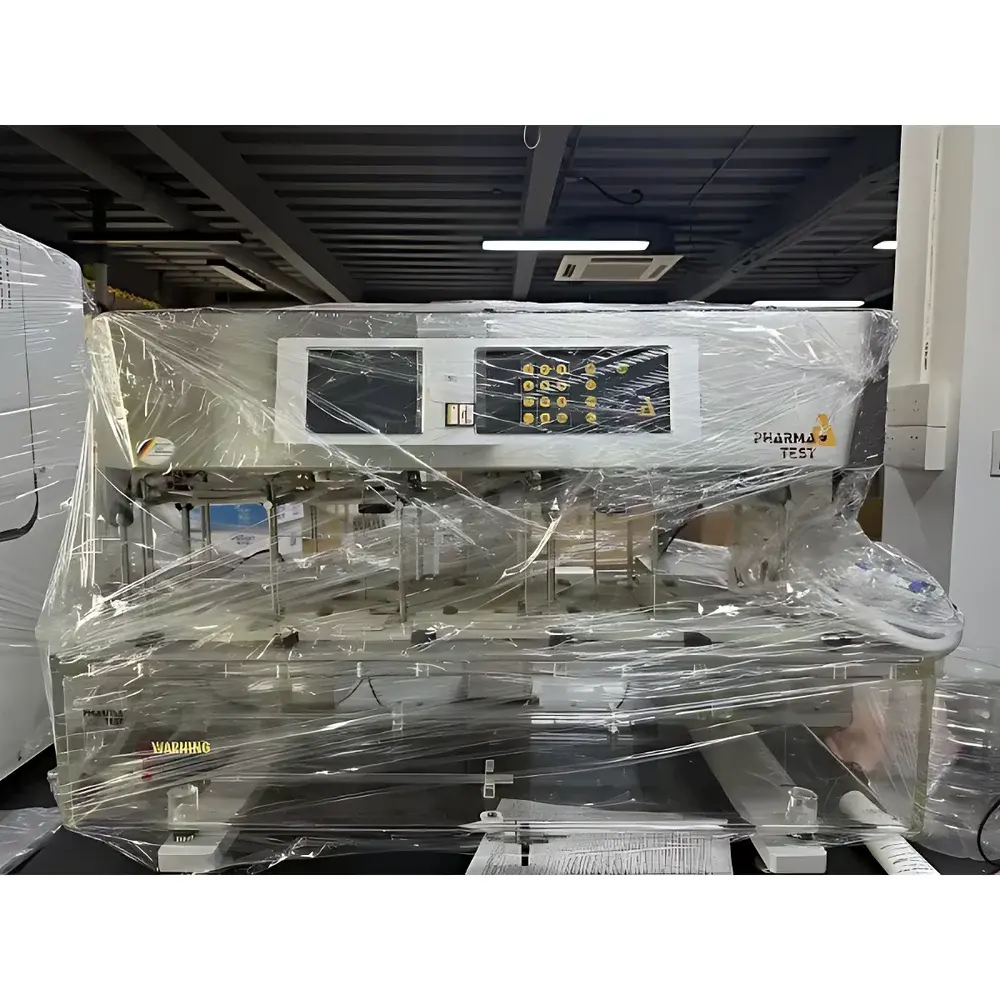
Pharma-test PTWS 610 Dissolution Tester
| Brand | Pharma-test |
|---|---|
| Origin | Germany |
| Model | PTWS 610 |
| Configuration | 8-position, single-drive dissolution apparatus |
| Regulatory Compliance | USP <711>, USP <724>, Ph. Eur. 2.9.3 & 2.9.4, JP <15>, ChP |
| Temperature Control Range | 37.0 ± 0.2 °C (typical operating condition) |
| Sampling Mechanism | Automated timed sampling with optical/audible alerts |
| Data Storage | SD card (user-replaceable, FAT32 formatted) |
| User Access Control | Role-based login (administrator, operator, reviewer) |
| System Diagnostics | Power-on self-test (POST), real-time status monitoring via tri-color LED indicator |
| Calibration & Qualification Support | Built-in OQ/PQ reminder logic, audit-ready event logging |
Overview
The Pharma-test PTWS 610 Dissolution Tester is an 8-position, single-drive automated dissolution system engineered for precise, reproducible performance in pharmaceutical quality control and formulation development laboratories. Designed in accordance with the hydrodynamic principles defined in USP (Dissolution) and USP (Drug Release), as well as Ph. Eur. 2.9.3 (Dissolution Test for Solid Dosage Forms) and 2.9.4 (Apparatus for Drug Release Testing), the PTWS 610 implements paddle (Apparatus 2) and basket (Apparatus 1) configurations per pharmacopoeial requirements. Its core architecture centers on thermal stability, mechanical repeatability, and regulatory traceability—critical attributes for GMP-compliant dissolution testing under ICH Q5C, FDA Guidance for Industry (2022), and WHO TRS No. 1033 Annex 5. The system maintains a water bath temperature of 37.0 °C ± 0.2 °C across all vessels during operation, validated via integrated Pt100 sensors and digital feedback control. Each dissolution vessel is individually addressable and encoded, ensuring unambiguous correlation between physical hardware and test method parameters.
Key Features
- Single-motor drive mechanism with synchronized rotation across all 8 vessels—minimizing inter-vessel variability and enabling strict adherence to USP rotational speed tolerances (±4% of setpoint)
- Motorized vertical lift system for precise, repeatable positioning of paddles or baskets into dissolution media—eliminating manual alignment errors
- Integrated real-time temperature verification at each sampling interval; logged with timestamp and vessel ID to support 21 CFR Part 11-compliant data integrity
- Traffic-light status display (green = ready, yellow = warming/stabilizing, red = fault detected) provides immediate visual system diagnostics without requiring software interface access
- Low-volatility vessel lids reduce evaporation loss (<0.5 mL/h/vessel under standard conditions), preserving sink conditions and assay accuracy over extended test durations (up to 24 h)
- Quick-release water bath assembly enables full removal for cleaning, calibration verification, or maintenance—reducing downtime and supporting ISO 17025-compliant equipment management
- Onboard OQ/PQ reminder engine prompts users at predefined intervals (e.g., quarterly, after maintenance, post-software update) to initiate qualification protocols aligned with ASTM E2503-21 and EU GMP Annex 15
Sample Compatibility & Compliance
The PTWS 610 supports solid oral dosage forms including immediate-release tablets, delayed-release capsules, extended-release granules, and transdermal patches (when used with appropriate accessories). It accommodates standard 1-L USP dissolution vessels and is compatible with both deaerated and non-deaerated media. The instrument meets essential design criteria outlined in ISO/IEC 17025:2017 (clause 6.4.3 – Equipment suitability) and supports GLP/GMP documentation workflows through its role-based user management system. All method files—including rotation speed, temperature setpoint, sampling schedule, and vessel configuration—are digitally signed and stored on removable SD cards, facilitating secure archiving and third-party audit readiness.
Software & Data Management
No proprietary PC software is required for basic operation—the PTWS 610 functions autonomously via its embedded firmware and front-panel interface. However, method files (.ptm) and raw log data (.csv) generated on the SD card are structured for seamless import into LIMS, ELN, or statistical analysis platforms (e.g., JMP, Minitab). Event logs include timestamps, operator IDs, parameter changes, error codes, and temperature deviations—each cryptographically hashed to prevent tampering. Audit trails comply with ALCOA+ principles (Attributable, Legible, Contemporaneous, Original, Accurate, Complete, Consistent, Enduring, Available) and satisfy inspection expectations from FDA, EMA, PMDA, and NMPA.
Applications
- Comparative dissolution profiling for generic drug bioequivalence studies (ICH Q5A, Q5B)
- Stability-indicating release testing during accelerated and long-term storage trials
- Excipient interaction screening in early-phase formulation development
- Validation of manufacturing process robustness across multiple batches
- Regulatory submission support for ANDA, MA, or CTD Module 3 technical documents
FAQ
Does the PTWS 610 support Apparatus 3 (reciprocating cylinder) or Apparatus 4 (flow-through cell)?
No—the PTWS 610 is configured exclusively for Apparatus 1 (basket) and Apparatus 2 (paddle) per USP and Ph. Eur. specifications.
Is the SD card data export compatible with CSV or Excel formats?
Yes—sampling logs, temperature records, and method metadata are exported as plain-text CSV files with UTF-8 encoding and tab-delimited fields.
Can user permissions be customized beyond administrator/operator/reviewer roles?
No—the firmware implements three fixed roles with immutable privilege sets, consistent with ICH GCP E6(R3) Annex 3 requirements for controlled access in clinical trial labs.
What is the maximum allowable deviation in vessel centering tolerance per USP ?
Per USP , the axis of rotation must deviate no more than 2 mm from the geometric center of the vessel; the PTWS 610’s mechanical alignment system achieves ≤1.2 mm deviation across all positions when calibrated per manufacturer instructions.
Is preventive maintenance documentation included with the unit?
Yes—original service manuals, calibration certificates (as available), and OQ/PQ protocol templates are provided on the shipped SD card and in printed form.
Related Products