
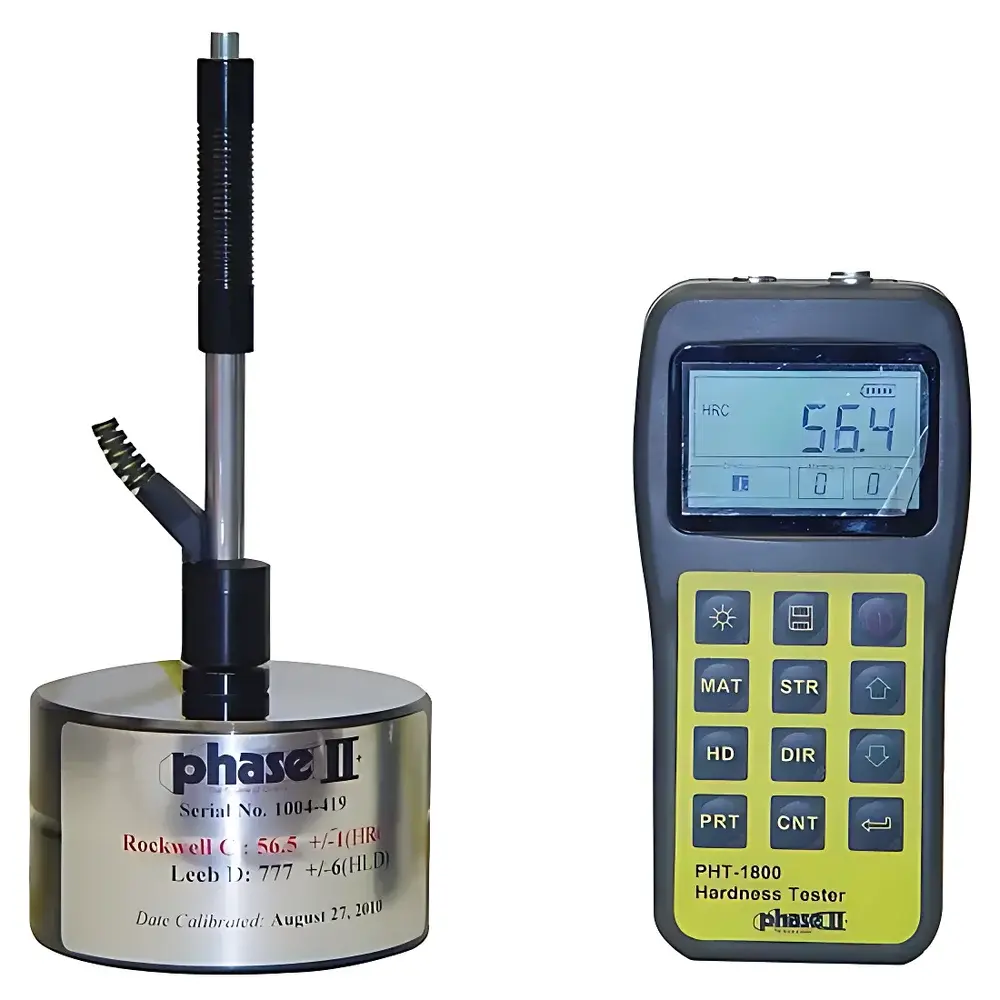
Phase-II PHT-1800 Portable Digital Hardness Tester
| Brand | Cole-Parmer |
|---|---|
| Origin | USA |
| Model | PHT-1800 |
| Hardness Scales | Leeb (HL), Rockwell B & C (HRB/HRC), Brinell (HB), Vickers (HV), Shore (HS) |
| Measurement Range | 200–960 HL, 20–70 HRC, 20–99 HRB, 40–650 HB, 80–970 HV, 30–100 HS |
| Accuracy | ±0.5% (reference = 800 HL) |
| Repeatability | ±4 L units (L = Leeb unit) |
| Dimensions | 152 × 76 × 32 mm (W × H × D) |
| Power Supply | 4 × AA batteries |
| Memory Capacity | 100 test groups |
| Data Interface | USB port |
| Standard Probe | D-type impact device |
| Compliance | ASTM A956, ISO 16852, DIN 50156-2 |
Overview
The Phase-II PHT-1800 Portable Digital Hardness Tester is an industrial-grade, Leeb rebound-based hardness measurement instrument engineered for field and laboratory use where precision, repeatability, and multi-scale interoperability are critical. Unlike traditional static indentation testers, the PHT-1800 employs dynamic impact methodology: a tungsten carbide-tipped diamond indenter is propelled against the test surface by a spring-loaded mass; the ratio of rebound velocity to impact velocity is converted into Leeb hardness units (HL), then algorithmically cross-referenced to standardized Rockwell (HRC/HRB), Brinell (HB), Vickers (HV), and Shore (HS) scales per internationally recognized conversion protocols. Its compact, ergonomic design—measuring only 152 × 76 × 32 mm and powered by four standard AA cells—enables rapid on-site evaluation of large components, weld zones, heat-treated surfaces, and maintenance-critical infrastructure without requiring sample removal or surface preparation beyond basic cleaning and leveling.
Key Features
- Automatic impact device recognition: Detects and configures calibration parameters for D-type probe upon insertion—ensuring correct scale mapping and eliminating manual setup errors.
- Multi-scale hardness conversion: Real-time calculation and display across five major hardness standards (HL, HRC, HRB, HB, HV, HS) in accordance with ASTM A956 and ISO 16852 Annexes.
- Statistical data processing: On-device computation of mean, minimum, maximum, and standard deviation for up to 100 stored test groups—supporting GLP-compliant reporting workflows.
- USB data export: Direct transfer of raw and processed hardness datasets (including timestamp, location tag, and operator ID fields) to Windows-based analysis software for traceable recordkeeping.
- Ruggedized housing and IP54-rated ingress protection: Resists dust and incidental moisture exposure during plant-floor or outdoor inspections.
- Self-diagnostic system with audible and visual alerts: Verifies probe integrity, battery status, and calibration drift before each measurement sequence.
Sample Compatibility & Compliance
The PHT-1800 is validated for testing ferrous and non-ferrous metals—including carbon steels, stainless alloys, aluminum, copper, and cast iron—provided minimum thickness exceeds 10 mm and surface roughness remains below Ra 3.2 µm. Test specimens must be rigidly supported to prevent energy loss through vibration or deflection. The instrument conforms to ASTM A956 (Standard Specification for Portable Hardness Testers Utilizing the Leeb Principle), ISO 16852 (Metallic materials — Portable hardness testers — Leeb method), and DIN 50156-2 (Hardness testing — Portable hardness testers — Part 2: Leeb method). Its firmware architecture supports audit-ready data logging aligned with FDA 21 CFR Part 11 requirements when used in regulated manufacturing environments (e.g., aerospace component verification, pressure vessel QA).
Software & Data Management
The PHT-1800 interfaces with Cole-Parmer’s proprietary Phase-II DataLink software (Windows 10/11 compatible), enabling batch export, histogram generation, trend analysis, and customizable report templates compliant with ISO/IEC 17025 documentation standards. All measurements retain embedded metadata—including test date/time, probe serial number, material designation, and user-defined notes—facilitating full traceability from field acquisition to quality review. Export formats include CSV, XLSX, and PDF; encrypted backup archives support long-term archival under GMP-controlled document retention policies.
Applications
- Quality control of heat-treated gears, shafts, and bearing surfaces in automotive and power transmission manufacturing.
- In-service hardness verification of pipeline welds, boiler tubes, and structural steel joints during NDT inspection campaigns.
- Material verification at receiving inspection points to confirm supplier compliance with purchase specifications (e.g., ASTM A370, EN 10083).
- Tooling and die maintenance: Rapid assessment of surface hardening degradation following repeated thermal cycling.
- Educational laboratories: Demonstrating hardness scale interrelationships and statistical process control fundamentals using real-world metallic samples.
FAQ
What hardness standards does the PHT-1800 directly measure, and how are conversions validated?
The instrument physically measures Leeb hardness (HL) via rebound velocity analysis; all other scales (HRC, HRB, HB, HV, HS) are derived using polynomial conversion algorithms traceable to NIST-certified reference blocks and published in ASTM E140 and ISO 18265 annexes.
Is probe calibration required before each use?
A quick verification using the supplied certified calibration block is recommended prior to any measurement session; full recalibration is performed annually or after 10,000 impacts, per ISO 16852 Clause 8.3.
Can the PHT-1800 test curved or irregular surfaces?
Yes—with optional support fixtures (e.g., concave/convex stands, V-block adapters) that ensure perpendicular impact alignment and minimize lateral motion-induced error.
Does the device support multi-user authentication or electronic signatures?
Not natively; however, exported datasets contain operator-assigned IDs and timestamps, enabling integration with third-party LIMS or QMS platforms supporting 21 CFR Part 11 electronic signature modules.
What is the expected service life of the D-type impact device?
Under typical industrial usage (≤500 tests/day), the D-probe maintains metrological integrity for ≥15,000 impacts, with wear indicators built into the DataLink software’s diagnostic dashboard.



