
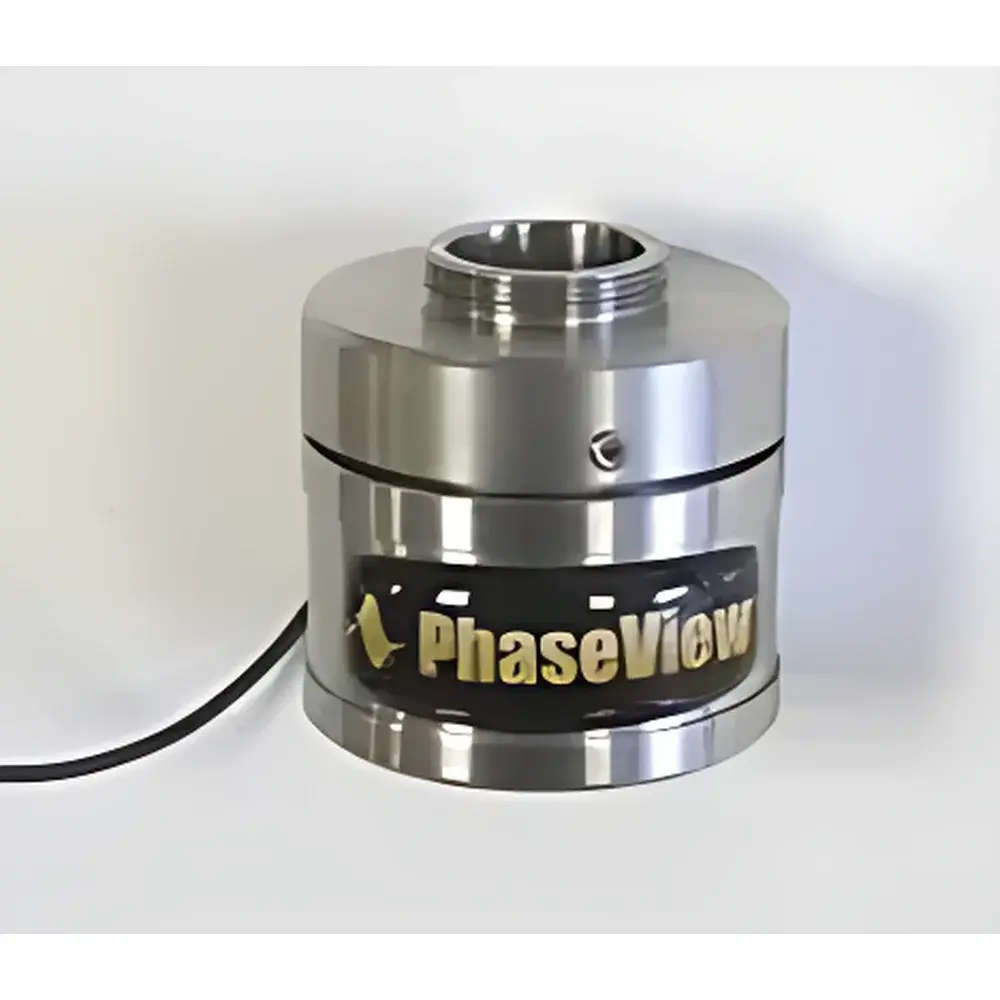
PhaseView SMARTSCAN Digital Remote Focus System for Microscopy
| Brand | PhaseView |
|---|---|
| Origin | France |
| Model | SMARTSCAN |
| Laser Source | Digital Focus Actuation System |
| Compatibility | Finite & Infinity-Corrected Objectives (including water-immersion and oil-immersion) |
| Focus Range | 100 mm / M² (e.g., 1 mm for 10× objective) |
| Optical Module Dimensions | Ø40 mm × 40 mm (H) |
| Control Unit Dimensions | 150 mm (L) × 160 mm (W) × 40 mm (H) |
| Input Power | 12 V DC / 1 A, via 110–220 V AC adapter |
| Standard Cable Length | 1 m |
| Mounting Thread Options | M27×0.75, M25×0.75, WJ4/5″×1/36″ |
| Included Components | Digital Remote Focus Lens, Control Unit, Software Suite |
Overview
The PhaseView SMARTSCAN Digital Remote Focus System is an engineered optical solution designed to enable high-speed, vibration-free axial scanning in transmitted and reflected-light microscopy configurations. Unlike conventional mechanical focusing—where the objective lens or stage moves physically—the SMARTSCAN system employs a patented digital wavefront modulation principle based on adaptive optics architecture. It dynamically adjusts the effective focal plane within the optical path without displacing any mechanical components, thereby preserving sample integrity and eliminating focus-induced drift, thermal perturbation, or mechanical hysteresis. This capability is especially critical in time-lapse imaging, live-cell observation, super-resolution modalities, and multi-layered tissue section analysis, where sub-micron stability and repeatability are non-negotiable. As a modular add-on compatible with both finite-conjugate and infinity-corrected microscope platforms, SMARTSCAN integrates seamlessly at the objective turret interface—requiring no modification to existing optical trains or alignment procedures.
Key Features
- Vibration-free axial scanning: No physical movement of objective or stage during focus adjustment—ideal for delicate biological specimens and microfluidic devices.
- Dynamic focus range scaling: Programmable depth-of-field traversal proportional to objective magnification (e.g., ±1 mm for 10×, ±0.01 mm for 100×), calculated as 100 mm / M².
- Universal mechanical compatibility: Supports standard objective thread mounts including M27×0.75, M25×0.75, and WJ4/5″×1/36″—enabling integration with water-immersion, oil-immersion, and dry objectives across major microscope brands.
- Compact optical module: Ø40 mm × 40 mm height; minimal footprint ensures unobstructed access to side ports and epi-illumination paths.
- Dual-mode control interface: Local ON/OFF toggle switch on control unit + software-driven remote command via USB 2.0; supports TTL synchronization for synchronized acquisition with cameras or light sources.
- Low-power operation: 12 V DC / 1 A input with universal AC adapter (110–220 V AC); optimized for continuous-duty laboratory environments.
Sample Compatibility & Compliance
The SMARTSCAN system maintains full optical fidelity across diverse specimen types—including fixed and live mammalian cells, zebrafish embryos, organoids, thin-sectioned histological slides, semiconductor wafers, and polymer films. Its non-contact focusing mechanism eliminates shear stress on soft or adhesion-sensitive samples, supporting long-term viability studies under physiological conditions. From a regulatory standpoint, the system’s deterministic focus positioning and audit-ready parameter logging (via included software) support GLP-compliant workflows. While not a medical device, its repeatable, traceable Z-axis control aligns with ISO 10993-5 cytotoxicity assay requirements for consistent focal plane registration and ASTM E2857-17 guidelines for quantitative microscopy validation.
Software & Data Management
SMARTSCAN ships with PhaseView’s proprietary FocusControl Studio—a cross-platform application (Windows/macOS) enabling real-time focus profiling, Z-stack automation, and scriptable focus sequencing via Python API. All focus positions are timestamped and logged with metadata (objective ID, magnification, ambient temperature, user ID), ensuring full traceability for QA/QC documentation. Export formats include CSV, TIFF stack, and HDF5—compatible with Fiji/ImageJ, Imaris, and MATLAB-based analysis pipelines. The software complies with FDA 21 CFR Part 11 requirements for electronic records when deployed with institutional authentication protocols and audit trail activation.
Applications
- Live-cell time-lapse imaging with millisecond-scale Z-plane switching, minimizing phototoxicity and motion artifacts.
- High-content screening (HCS) where rapid focal plane hopping across multi-well plates improves throughput without stage repositioning delays.
- Confocal and structured illumination microscopy (SIM), where precise Z-registration enhances optical sectioning fidelity and deconvolution accuracy.
- Industrial metrology of microstructures—e.g., MEMS devices or coated substrates—where thermal expansion or mechanical loading would compromise traditional autofocus routines.
- Correlative light-electron microscopy (CLEM) workflows requiring identical Z-coordinates across modalities.
FAQ
Does SMARTSCAN replace the microscope’s native focus mechanism?
No—it operates in parallel as an independent axial tuning element; the coarse/fine mechanical focus remains fully functional for initial setup and calibration.
Can SMARTSCAN be used with resonant scanners or spinning-disk confocals?
Yes—its low-latency digital actuation (<5 ms response time) synchronizes reliably with external trigger signals via TTL input.
Is firmware update supported in the field?
Yes—updates are delivered through FocusControl Studio and preserve all user-defined profiles and calibration data.
What is the maximum working distance extension achievable with a 60× water-immersion objective?
For a 60× objective, the theoretical focus range is 100 mm / 3600 ≈ 28 µm—sufficient to span the entire usable working distance of most high-NA water objectives while maintaining diffraction-limited resolution.
Does the system introduce chromatic aberration or transmission loss?
No—the optical module uses fused silica elements with broadband AR coatings (350–1100 nm); measured transmission exceeds 92% across visible and NIR bands.



