
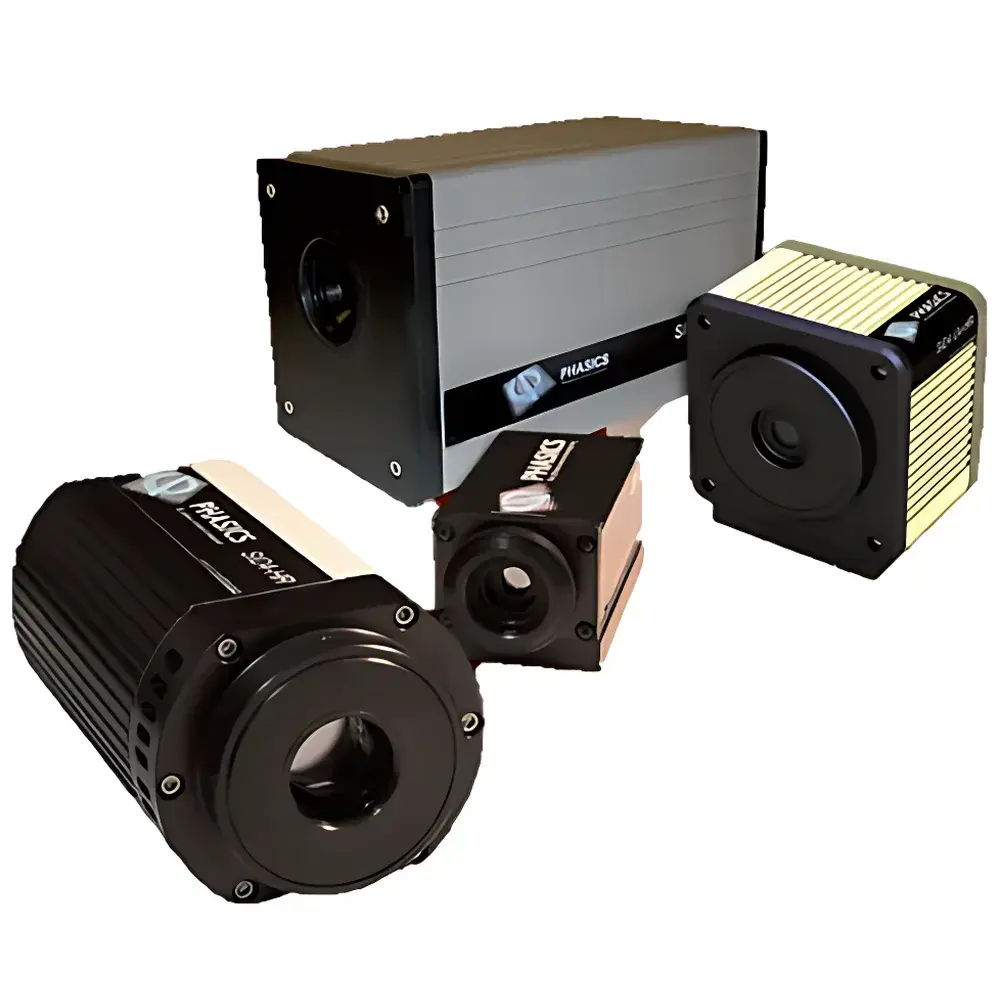
Phasics SID4 Wavefront Sensor
| Brand | Phasics |
|---|---|
| Origin | France |
| Model | SID4 |
| Spectral Range | 350–1100 nm |
| Spectral Resolution | 0.025 nm |
| Imaging Resolution | 1280 × 1024 pixels |
| Total Field of View (TFOV) | 5° |
| Instantaneous Field of View (IFOV) | 29.6 µm |
| Frame Rate | 60 fps |
| Phase Measurement Principle | Quadriwave Lateral Shearing Interferometry (QLSI) |
| Operating Mode | Real-time, Onboard (Embedded Processing) |
Overview
The Phasics SID4 Wavefront Sensor is a high-performance, compact interferometric instrument engineered for quantitative, real-time phase and wavefront characterization across the visible to near-infrared spectrum (350–1100 nm). Unlike conventional Shack–Hartmann or curvature sensors, the SID4 employs Quadriwave Lateral Shearing Interferometry (QLSI)—a patented, single-shot, self-referencing technique that reconstructs the optical phase map without moving parts or external reference beams. This principle enables direct, absolute wavefront measurement with sub-nanometer sensitivity and high spatial fidelity—even for highly divergent, low-coherence, or partially coherent beams. Designed for integration into demanding optical systems—including airborne platforms, laser diagnostics stations, and adaptive optics loops—the SID4 delivers robust, vibration-insensitive performance in laboratory, industrial, and field-deployable environments.
Key Features
- Single-shot, real-time wavefront acquisition at up to 60 frames per second—enabling dynamic analysis of transient optical phenomena.
- High-resolution phase mapping with up to 160 × 120 sampling points (400 × 300 optional in HR variants), delivering spatial resolution down to 29.6 µm.
- Achromatic design optimized across the full 350–1100 nm range; no wavelength-specific calibration required when switching between UV, visible, or NIR sources.
- Direct measurement capability for high-divergence beams (up to ±15°), eliminating the need for beam collimation or relay optics in many setups.
- Compact, lightweight form factor (54 × 46 × 75.3 mm; 250 g) with onboard FPGA-based processing—minimizing latency and enabling embedded control via USB 3.0 or GigE interface.
- RMS phase accuracy of ≤10 nm and sensitivity <2 nm RMS under standard illumination conditions—validated per ISO 10110-5 and ISO 21254 standards for wavefront metrology.
Sample Compatibility & Compliance
The SID4 supports a broad range of optical sources and configurations: continuous-wave and pulsed lasers (ns to fs), LED-based illumination, thermal emitters, and plasma sources. Its QLSI architecture inherently accommodates partial coherence and low signal-to-noise ratios—making it suitable for biological tissue imaging, combustion diagnostics, and EUV-compatible beamlines (with appropriate filtering). The sensor complies with CE marking requirements and meets electromagnetic compatibility (EMC) standards EN 61326-1 and safety standard EN 61010-1. For regulated environments—including GLP/GMP-compliant optical testing labs—the SID4 firmware supports audit-trail logging and user-access control when integrated with Phasics’ certified software suite (v5.2+), aligning with FDA 21 CFR Part 11 data integrity guidelines.
Software & Data Management
The SID4 is operated via Phasics’ proprietary WFSuite software—a cross-platform application (Windows/Linux/macOS) providing real-time visualization, batch analysis, and export of phase, intensity, Zernike coefficients, PV/RMS wavefront error, and reconstructed point-spread functions (PSF). Raw interferograms and processed datasets are saved in HDF5 format with embedded metadata (wavelength, exposure time, ROI, calibration ID), ensuring traceability and interoperability with Python (h5py), MATLAB, and LabVIEW environments. API support (C/C++, Python SDK) enables custom automation, closed-loop control integration (e.g., with deformable mirrors), and synchronization with external triggers (TTL, PTP). All software releases undergo internal verification per ISO/IEC 17025 Annex A.2 for measurement software validation.
Applications
- Laser beam quality assessment (M², BPP, Strehl ratio) in industrial laser manufacturing and ultrafast laser development.
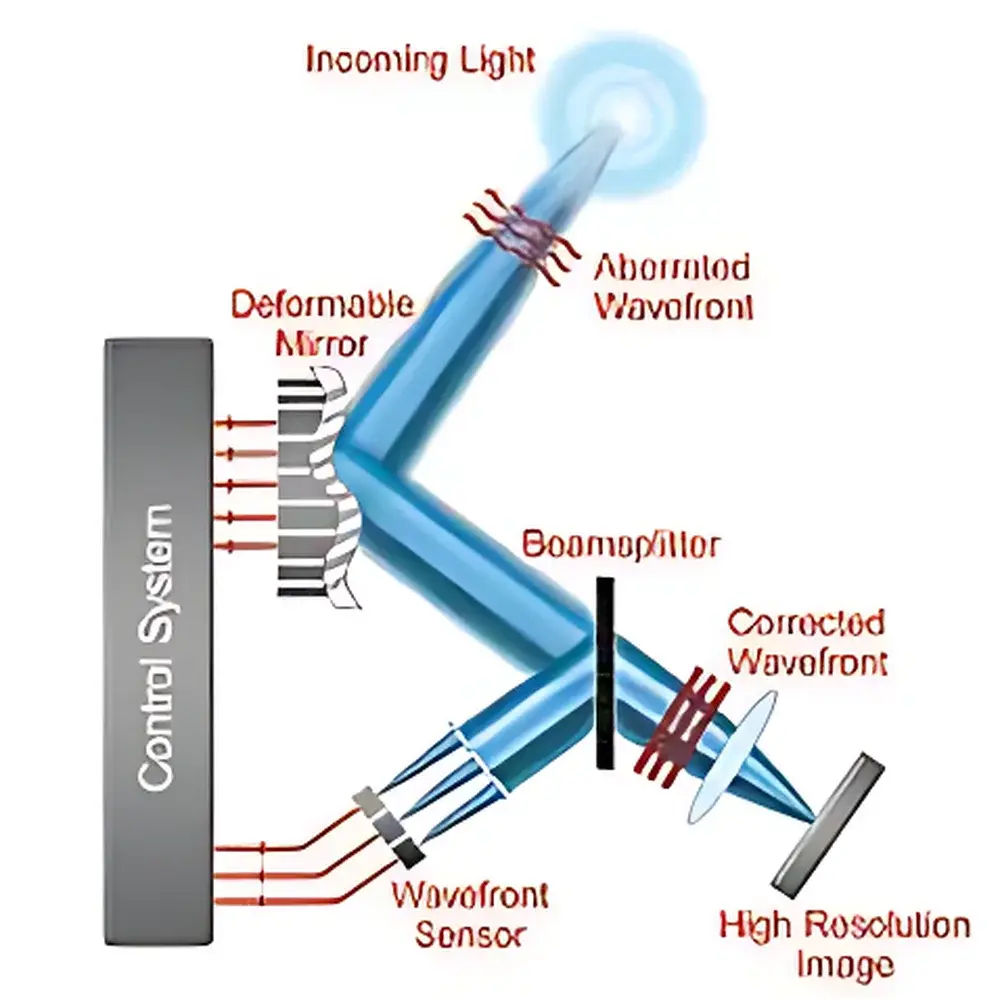
- Adaptive optics correction in astronomy (e.g., solar telescope AO systems) and ophthalmic imaging (AO-SLO, AO-OCT).
- Non-contact surface topography and defect inspection of precision optics, including aspheres, freeforms, and diffractive elements.
- Quantitative phase microscopy (QPM) for label-free live-cell imaging, refractive index tomography, and membrane dynamics studies.
- Plasma diagnostics and thermal emission profiling in fusion research and hypersonic boundary layer characterization.
- Beam alignment and stability monitoring in synchrotron beamlines and EUV lithography testbeds (with UV-grade variants).
FAQ
What measurement principle does the SID4 use, and how does it differ from Shack–Hartmann sensors?
The SID4 uses Quadriwave Lateral Shearing Interferometry (QLSI), a single-shot, common-path interferometric method that measures phase gradients directly without lenslet arrays or reference beams—offering higher sensitivity, no aliasing artifacts, and tolerance to beam divergence.
Is the SID4 compatible with pulsed laser sources?
Yes—provided pulse energy exceeds the sensor’s minimum fluence threshold (e.g., ≥2 µJ/cm² at 250 nm for UV-HR models) and repetition rate falls within the frame-rate limit (up to 60 Hz for SID4 standard). Synchronization via external trigger is supported.
Can the SID4 be calibrated for absolute wavefront metrology?
Yes—Phasics provides NIST-traceable factory calibration certificates (ISO/IEC 17025 accredited) for phase offset, pixel response uniformity, and spectral sensitivity. In-field recalibration tools are included in WFSuite.
Does the system support real-time feedback for adaptive optics?
Yes—via low-latency USB 3.0 streaming and optional real-time processing modules (WFSuite RT Edition), delivering Zernike mode updates at >10 Hz for closed-loop mirror control.
What environmental conditions are recommended for optimal operation?
Ambient temperature: 15–30 °C; relative humidity: <70% non-condensing; vibration isolation recommended for sub-5 nm RMS measurements. No active cooling required.




