
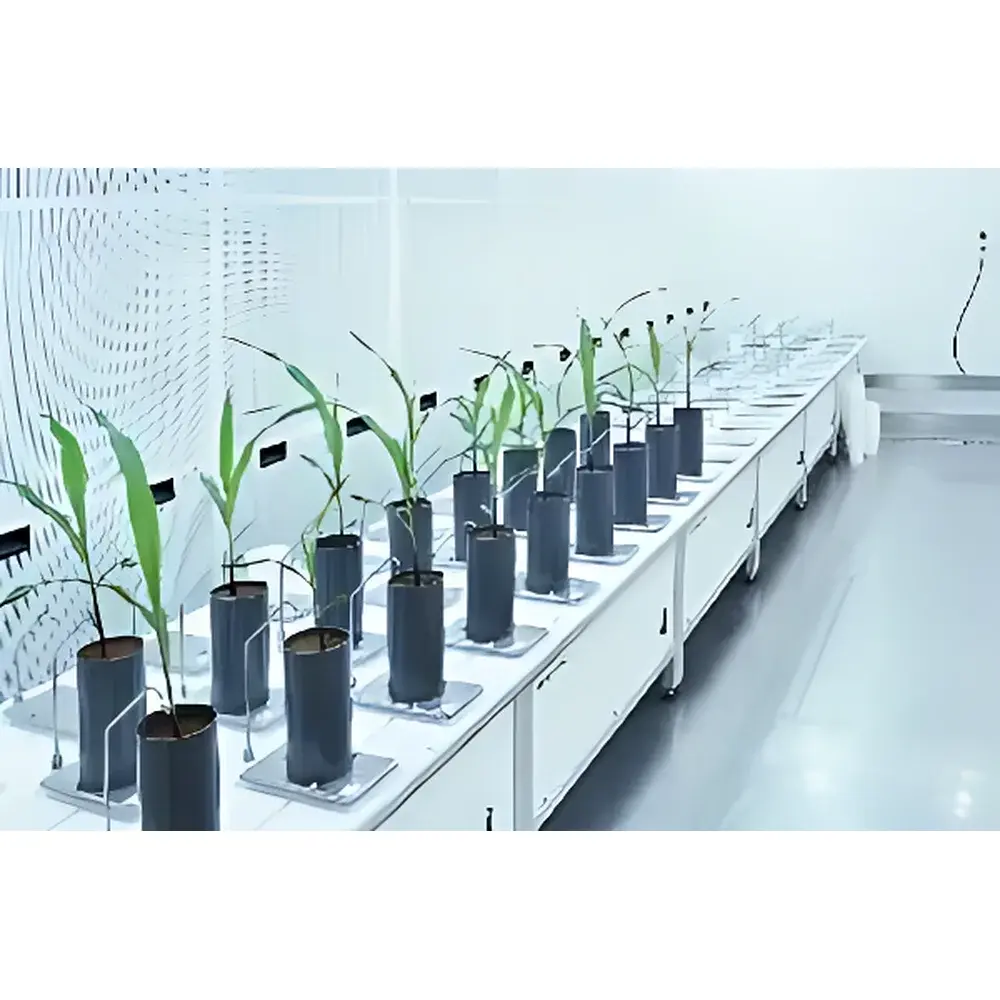
PhenoSpex DroughtSpotter Automated Drought Simulation and Precision Irrigation Platform
| Brand | PhenoSpex |
|---|---|
| Origin | Netherlands |
| Model | DroughtSpotter |
| Configuration Options | 12- or 24-unit modular system |
| Max Load per Unit | 7 kg (customizable) |
| Weighing Accuracy | ±0.02% of full scale |
| Irrigation Precision | ≤1 g per event |
| Pot Compatibility | Diameter up to 20 cm |
| Height options | 10–50 cm (customizable) |
| Environmental Sensors | PAR, air temperature, relative humidity, VPD |
| Data Output Format | CSV |
| Remote Access | Web-based interface + SSH protocol |
| Operating Temperature | 4–40 °C |
| Relative Humidity Range | 40–80% RH |
| IP Rating | IP65 |
| Data Storage Capacity | Up to 10,000 days of high-frequency measurements |
| Software Platform | Cross-platform (Windows, macOS, Linux-compatible web client) |
Overview
The PhenoSpex DroughtSpotter is an automated, high-precision drought simulation and irrigation control platform engineered for controlled-environment plant phenotyping research. It operates on the principle of gravimetric real-time transpiration monitoring: each plant container rests directly on a calibrated analytical balance integrated with a micro-dosing irrigation system. By continuously tracking mass changes at sub-gram resolution (≤1 g), the platform quantifies water loss due to transpiration with minute-level temporal resolution—enabling dynamic, non-invasive assessment of plant water use behavior under precisely defined drought stress regimes. Designed for integration into greenhouses, growth chambers, and climate-controlled phenotyping facilities, DroughtSpotter supports reproducible imposition of water deficit gradients across hundreds of individuals simultaneously—critical for quantitative genetic analysis, QTL mapping, and physiological screening of drought resilience traits.
Key Features
- Modular architecture: Configurable as 12- or 24-unit independent weighing–irrigation stations, scalable to multi-platform deployments.
- Gravimetric precision: High-stability load cells with ±0.02% full-scale accuracy (e.g., ±1.4 g at 7 kg capacity), enabling reliable detection of diurnal transpiration cycles.
- Smart irrigation logic: Adaptive dosing algorithm calculates required water volume in real time based on target weight setpoints, current mass drift, and flow dynamics—preventing overwatering and ensuring stepwise stress progression.
- Flexible pot compatibility: Accommodates cylindrical containers up to 20 cm diameter and 50 cm height; custom mounting fixtures available for irregular geometries or hydroponic trays.
- Synchronized environmental monitoring: Integrated sensors log photosynthetically active radiation (PAR), air temperature, relative humidity, and vapor pressure deficit (VPD) alongside plant mass data—essential for normalizing transpiration rates to atmospheric demand.
- Real-time visualization & remote operation: Web-based dashboard displays live weight trajectories, irrigation events, and derived transpiration kinetics; accessible globally via secure HTTPS and SSH protocols.
- Data integrity & compliance readiness: Timestamped raw measurements (mass, irrigation volume, environmental parameters) exported in open CSV format; audit-trail-capable logging aligns with GLP-aligned experimental workflows.
Sample Compatibility & Compliance
DroughtSpotter supports a broad spectrum of plant species—from model systems (Arabidopsis, rice, barley) to agronomic crops (wheat, maize, oilseed rape, tomato) and ornamentals (chrysanthemum). Its open mechanical design accommodates pots, rhizotrons, aeroponic modules, and soil-filled mesocosms. The system meets IP65 ingress protection standards for dust and water resistance, permitting stable operation in humid greenhouse environments. While not certified to ISO/IEC 17025, its traceable mass measurement chain (NIST-traceable calibration options available) and deterministic irrigation control support adherence to ASTM E3079-17 (Standard Guide for Plant Phenotyping Measurements) and FAO’s Crop Water Stress Index (CWSI) calculation frameworks. Data export structure facilitates alignment with MIAPPE (Minimum Information About a Plant Phenotyping Experiment) metadata standards.
Software & Data Management
The DroughtSpotter Control Suite is a browser-native application compatible with Windows, macOS, and Linux. Users define irrigation strategies—including “no irrigation”, “constant weight maintenance”, “fixed-volume addition”, and “weight-band regulation”—via intuitive graphical presets. All operations generate timestamped logs with millisecond resolution. Raw datasets include: absolute pot mass (g), cumulative irrigation volume (mL), calculated transpiration rate (g/h), VPD (kPa), PAR (µmol/m²/s), and ambient temperature/humidity. Data are stored locally on an industrial-grade embedded controller with expandable SD card support (up to 10,000 days at 1-min sampling). Exported CSV files integrate seamlessly with R, Python (Pandas), MATLAB, or commercial statistical platforms. Remote SSH access enables script-driven batch analysis and automated backup to institutional servers—supporting FAIR (Findable, Accessible, Interoperable, Reusable) data principles.
Applications
- High-throughput drought phenotyping for GWAS and genomic selection pipelines.
- Quantification of genotypic variation in water-use efficiency (WUE), stomatal conductance proxies, and drought recovery kinetics.
- Evaluation of soil moisture-retaining amendments (e.g., hydrogels, biochar) and antitranspirant compounds under controlled deficit irrigation.
- Calibration and validation of canopy-scale transpiration models using ground-truthed pot-level fluxes.
- Integration with 3D imaging platforms (e.g., PlantEye) to correlate real-time transpiration dynamics with structural biomass accumulation.
- Development of drought severity indices aligned with FAO-56 dual-crop coefficient methodology.
FAQ
How does DroughtSpotter ensure irrigation reproducibility across units?
Each station employs independently calibrated load cells and solenoid valves with closed-loop feedback; inter-unit coefficient of variation (CV) for identical irrigation events is <1.2% under standard operating conditions.
Can DroughtSpotter operate unattended for extended experiments?
Yes—designed for continuous 24/7 operation with battery-backed real-time clock, thermal management for 4–40 °C ambient range, and local data buffering during network outages.
Is third-party sensor integration supported?
Yes—RS-485 and analog (0–10 V / 4–20 mA) inputs allow connection of external weather stations, soil moisture probes, or CO₂ sensors; all streams synchronized to the master timestamp.
What level of technical support is provided post-installation?
PhenoSpex offers remote diagnostics, firmware updates, and application-specific protocol development support; on-site engineering assistance available under extended service agreements.
Does the system comply with FDA 21 CFR Part 11 requirements?
While not pre-certified, the audit-log architecture, electronic signature-ready user authentication, and immutable raw data export meet foundational requirements for Part 11–aligned workflows in regulated agricultural biotech R&D.
Related Products







