
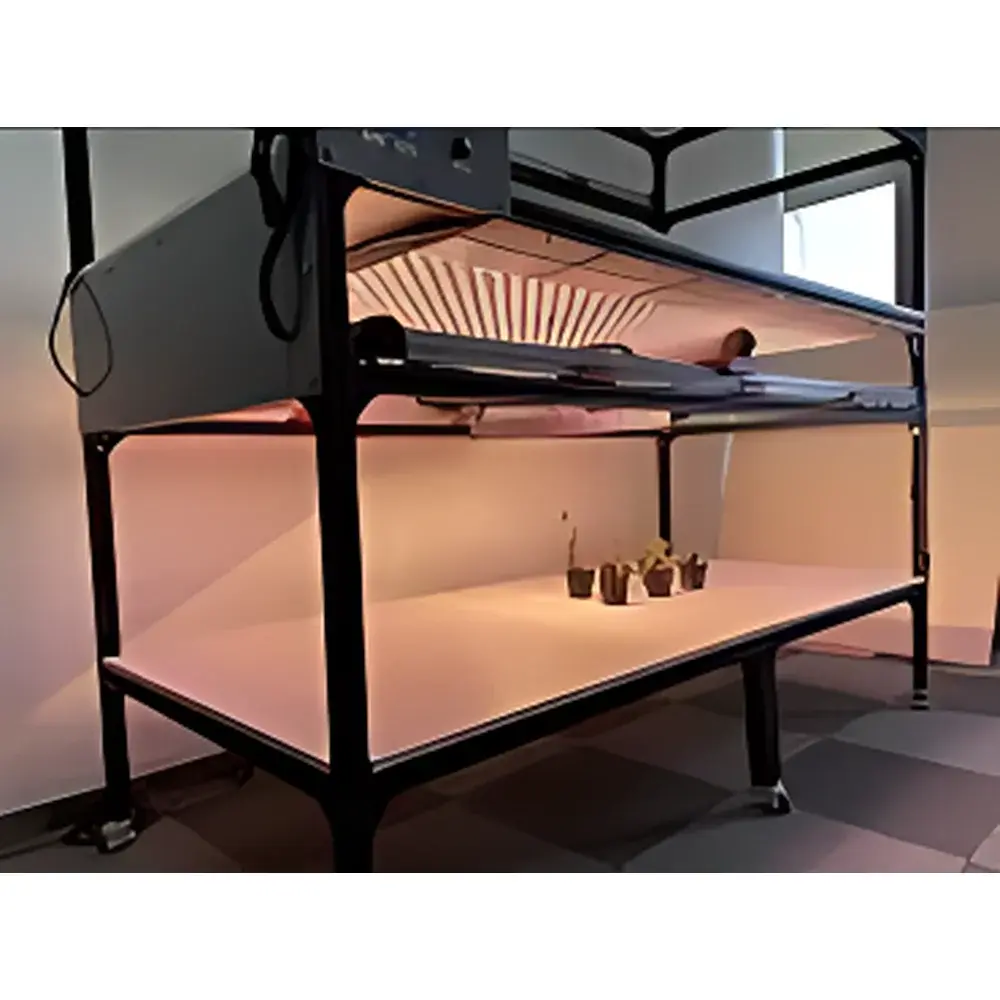
PhenoTron® Crop Germplasm Phenotyping & Viability Assessment Platform
| Brand | EcoTech |
|---|---|
| Origin | Beijing, China |
| Model | PhenoTron® |
| Key Features | Integrated LED cultivation, hyperspectral imaging (400–1000 nm), fiber-optic O₂/pH/temperature sensing, chlorophyll fluorescence imaging (FluorCam), thermal infrared (Thermo-RGB), high-throughput 96-well respirometry (REDFLASH), programmable circadian lighting (0–500 µmol·m⁻²·s⁻¹ PAR), morphometric seed & root phenotyping |
| Compliance | Designed for ISO/IEC 17025-aligned lab workflows, supports GLP-compliant data audit trails and FDA 21 CFR Part 11–ready software modules (optional) |
Overview
The PhenoTron® Crop Germplasm Phenotyping & Viability Assessment Platform is an integrated, non-destructive instrumentation system engineered for standardized, quantitative assessment of seed physiological quality and plant germplasm phenotypic traits. It operates on core biophysical measurement principles: oxygen consumption kinetics (via solid-state fluorescent optical sensors), chlorophyll a fluorescence transient analysis (OJIP kinetics, quenching parameters), reflectance-based hyperspectral profiling (400–1000 nm), thermal emission mapping (8–14 µm band), and morphometric image analysis of germinating seeds and early-stage root systems. Unlike conventional viability assays—such as the cold test (ASTM D5372) or accelerated aging (ISTA Standard 2023)—the PhenoTron® platform delivers dynamic, time-resolved metrics across multiple functional domains: metabolic activity (respiratory O₂ flux), photosynthetic competence (Fv/Fm, PIABS, Rfd), structural integrity (seed area, perimeter, aspect ratio, root architecture), water status (NIR spectral indices), and stress responsiveness (thermal dissipation patterns, fluorescence decline under abiotic challenge). Its modular architecture enables deployment in controlled-environment laboratories, growth chambers, or containerized climate simulation units—supporting reproducible, protocol-driven evaluation aligned with FAO’s Global Plan of Action for PGRFA and CGRFA guidelines.
Key Features
- Modular LED cultivation system with three-channel (cool white + red + far-red) or customizable RGB+FR spectral output; PAR intensity adjustable from 0 to 500 µmol·m⁻²·s⁻¹; programmable diurnal cycles and cloud/shade simulation protocols.
- Hyperspectral imaging module (PhenoTron®-HSI or PhenoTron®-XYZ variants): 400–1000 nm VNIR range (optional 900–1700 nm or 1000–2500 nm SWIR); calibrated reflectance and fluorescence excitation (UV-B/G/F, blue, red) for pigment quantification, moisture estimation, and biochemical index derivation (e.g., NDVI, PRI, ANTH).
- Fiber-optic multi-parameter sensor array: Real-time, label-free monitoring of dissolved O₂ (0–50% v/v, ±0.6% accuracy at 20% O₂), pH (±0.1 unit), and temperature (±0.2°C) in sealed 96-well plates using REDFLASH technology; response time <30 s, drift <0.5% O₂ per month.
- FluorCam chlorophyll fluorescence imaging system (optional): Full-suite parameter acquisition including Fv/Fm, ΦPSII, qP, NPQ, PIABS, Rfd, and light-response curves; compatible with multi-well plate masking and automated ROI segmentation.
- Thermo-RGB infrared thermography: High-resolution thermal mapping (≤0.05°C sensitivity) for seed metabolic heat signature detection and stomatal conductance inference during germination and early seedling development.
- Scalable integration pathways: Compatible with PlantScreen™ conveyor-based or XYZ gantry platforms for large-scale phenotyping; optional seed composition analyzers (handheld, benchtop, or flow-through NIR/FTIR configurations).
Sample Compatibility & Compliance
The platform accommodates intact seeds (cereal, legume, oilseed, vegetable), germinated embryos, seedlings (up to 14-day-old), and excised root systems. All imaging and sensing modules maintain sample integrity throughout measurement—no staining, sectioning, or destructive extraction required. Data acquisition adheres to ISO 20675:2020 (plant phenotyping terminology), ISTA Handbook Chapter 7 (seed vigor testing), and OECD Consensus Document on Compositional Considerations (2022). Optional software modules support 21 CFR Part 11 compliance (electronic signatures, audit trails, user access controls) and GLP-aligned reporting templates for regulatory submissions and germplasm bank documentation.
Software & Data Management
EcoTech’s Phenolyze™ software suite provides unified control, synchronized acquisition, and hierarchical data management. It features protocol libraries for standard assays (e.g., “Standard Germination Kinetics”, “Drought Stress Response Protocol”), batch processing pipelines for morphometrics (seed length/width/volume, root length/diameter/branching), spectral unmixing (PCA, PLSR), and fluorescence parameter extraction. Raw data (TIFF stacks, CSV time-series, HDF5 sensor logs) are stored with embedded metadata (instrument ID, calibration timestamp, environmental setpoints). Export formats include MIAPPE-compliant ISA-Tab, NetCDF, and FAIR-aligned JSON-LD for integration into national germplasm databases (e.g., EURISCO, GRIN).
Applications
- Seed bank quality assurance: Long-term viability monitoring of ex situ collections using O₂ consumption rate and Fv/Fm decay kinetics.
- Germplasm screening: High-throughput identification of drought-tolerant, salinity-resistant, or low-temperature-germinating accessions via combined thermal, spectral, and fluorescence phenotypes.
- Breeding program support: Early-generation selection based on seed vigor proxies (respiratory burst amplitude, chlorophyll reactivation speed) correlated with field emergence and yield stability.
- Physiological mechanism studies: Quantifying mitochondrial efficiency under stress via real-time O₂ dynamics, or dissecting photoprotective capacity through NPQ relaxation kinetics.
- Regulatory compliance testing: Generation of validated datasets for OECD, EFSA, or USDA APHIS dossiers on novel germplasm or gene-edited lines.
FAQ
What germplasm types are supported?
The platform is validated for dicot and monocot seeds (e.g., wheat, maize, soybean, tomato, Arabidopsis), dormant and non-dormant accessions, and cryopreserved samples post-thaw recovery assessment.
Can the system operate under GLP conditions?
Yes—when configured with audit-trail-enabled software, electronic signature modules, and instrument calibration logging, it meets GLP Annex 11 and ISO/IEC 17025 traceability requirements.
Is remote monitoring supported?
All sensor and imaging subsystems stream metadata and raw data over Ethernet; optional cloud-based dashboards enable secure off-site access to live metrics and scheduled report generation.
How is calibration maintained across modules?
Each optical module includes NIST-traceable reference standards (e.g., Spectralon® for reflectance, certified O₂ gas mixtures for fiber-optic sensors); automated daily self-check routines verify signal linearity and dark-current stability.
What training and application support is provided?
EcoTech offers on-site installation commissioning, SOP development workshops, and annual method validation support—including ISTA-certified assay protocol adaptation and inter-laboratory comparison coordination.




