
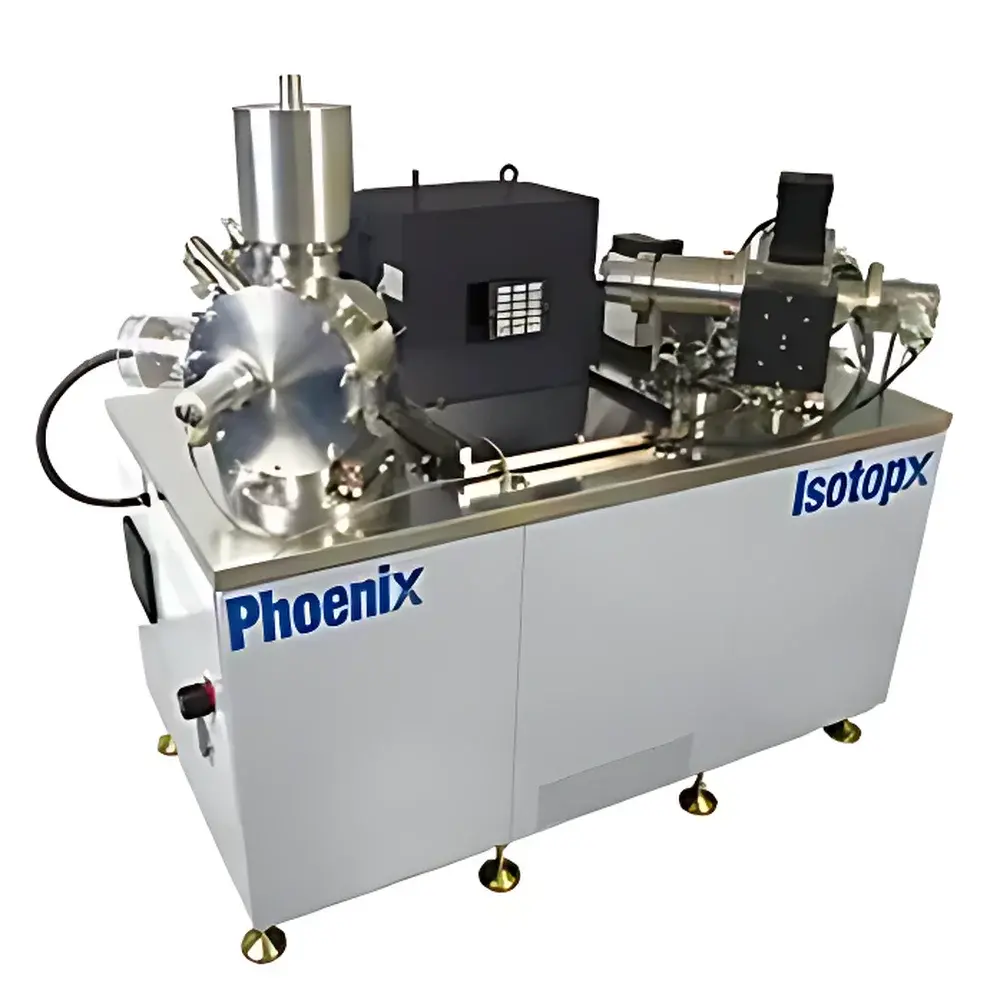
Phoenix ISOTOPX Phoenix Thermal Ionization Mass Spectrometer
| Brand | ISOTOPX |
|---|---|
| Origin | United Kingdom |
| Manufacturer Type | Authorized Distributor |
| Origin Category | Imported |
| Model | Phoenix |
| Instrument Type | Thermal Ionization Mass Spectrometer (TIMS) |
| Resolution | >450 |
| Dynamic Range (ATONA Amplifier) | 100 V |
| Mass Drift | <20 ppm over 40 min |
| Faraday Cup Lifetime | ≥10 years (Phoenix X62) |
| Vacuum Pumping Speed | Highest among commercial TIMS systems |
| Sample Capacity | 20-position rotatable carousel orthogonal to ion beam axis |
| Optional Detectors | Daly detector, Secondary Electron Multiplier (SEM), Multi-Collector Ion Counter with Conversion Dynode technology |
| Optional WARP Retarding Field Filter | Enables abundance sensitivity <1×10⁻⁸ for ²³⁷U/²³⁸U |
| Ion Extraction Slit | Enlarged for enhanced sensitivity |
| Focal Plane Rotation | Motorized, orthogonal to ion trajectory |
| Sample Chamber | Stainless steel with multiple auxiliary ports (pre-heating, cryo-trap, oxygen inlet) |
| Software | Fully integrated, GLP-compliant, remote operation enabled |
| Regulatory Compliance | Designed to support 21 CFR Part 11 audit trails, ISO/IEC 17025 data integrity requirements, and ASTM D7938 (TIMS-based isotope ratio analysis) |
Overview
The Phoenix Thermal Ionization Mass Spectrometer (TIMS), engineered by ISOTOPX in the United Kingdom, is a high-precision analytical platform designed for ultra-trace isotopic ratio measurements of non-volatile elements—including Sr, Nd, Hf, Pb, U, Th, Li, and Ca—in solid geological, nuclear, and planetary reference materials. Operating on the fundamental principle of thermal ionization—where analyte atoms are volatilized from a heated metal filament (typically Re or Ta) and ionized via surface ionization—the Phoenix achieves exceptional mass resolution (>450) and abundance sensitivity through a combination of optimized ion optics, ultra-stable electromagnetic field control, and extreme vacuum performance (<1×10⁻⁹ mbar in the source region). Its core architecture centers on minimizing ion losses, suppressing molecular interferences, and enabling quantitative detection of ion currents as low as 1.6×10⁻¹⁹ A (single-ion level), supported by the patented ATONA amplifier (GB2552233) delivering 100 V dynamic range. The instrument’s design prioritizes metrological traceability, long-term stability, and compliance with international standards for isotopic reference material certification.
Key Features
- Patented ATONA amplifier with 100 V dynamic range, enabling simultaneous measurement of major and ultra-trace isotopes without gain switching
- Largest magnet bore radius among commercial TIMS systems—enhancing ion transmission efficiency, mass resolving power, and long-term magnetic field stability
- Motorized rotating focal plane, dynamically aligned perpendicular to the ion trajectory to eliminate secondary ion artifacts from beam tilt
- High-voltage and magnetic field regulation achieving mass drift <20 ppm over 40 minutes—critical for multi-hour static multi-collection runs
- Phoenix X62 configuration with 10-year guaranteed lifetime Faraday cups (no replacement required under normal operation)
- Industry-leading vacuum system: dual-stage turbomolecular pumping optimized for rapid evacuation and sustained ultra-high vacuum (<5×10⁻¹⁰ mbar in collector array)
- 20-position sample carousel with orthogonal rotation relative to ion beam—eliminating cross-contamination between samples during sequential analysis
- Modular detector suite: independently addressable Faraday cups, Daly detector, SEM, and multi-collector ion counter with conversion dynode; all detectors operate without mechanical repositioning
- Optional WARP (Wien Accelerator Retarding Potential) filter—installed coaxially to suppress isobaric interferences and improve abundance sensitivity to <1×10⁻⁸ for ²³⁷U/²³⁸U
- Stainless-steel sample chamber with standardized ports for in-situ pre-heating, cryogenic trapping, and reactive gas (e.g., O₂) introduction to enhance oxide suppression
Sample Compatibility & Compliance
The Phoenix accommodates a wide range of solid sample forms—including purified element separates deposited on single or double filaments, pressed powder pellets, and micro-drilled mineral grains—without requiring derivatization or matrix removal beyond standard chemical purification protocols (e.g., ion exchange chromatography per ASTM D7938). Its dual-polarity capability supports both positive-ion (e.g., ⁸⁷Sr⁺, ¹⁴³Nd⁺) and negative-ion (e.g., ¹⁸O⁻, ¹⁰B⁻) analysis within the same instrument configuration. The system meets essential regulatory and quality framework requirements: software supports full 21 CFR Part 11 compliance with electronic signatures, audit trails, and user-access controls; raw data files are timestamped, immutable, and exportable in vendor-neutral formats (e.g., .csv, .mzML); hardware and firmware designs align with ISO/IEC 17025:2017 clauses on equipment verification, calibration traceability, and measurement uncertainty estimation.
Software & Data Management
PhoenixControl™—the native acquisition and processing software—is built on a deterministic real-time kernel to ensure sub-millisecond timing accuracy across multi-collector arrays. It supports fully automated sequence execution, including filament heating ramp profiles, peak jumping/static collection mode switching, and dynamic background subtraction. All detector configurations (Faraday, Daly, SEM) are managed within a unified interface with configurable integration times (1–60 s), baseline correction algorithms, and real-time dead-time correction. Data reduction employs robust statistical models (e.g., exponential law for mass fractionation, linear regression for internal normalization) and exports certified isotope ratios with expanded uncertainties (k=2) per GUM (JCGM 100:2008). Raw spectra and processed results are stored in hierarchical database structures compliant with FAIR principles (Findable, Accessible, Interoperable, Reusable).
Applications
- Geochronology & Isotope Geochemistry: High-precision ²⁰⁷Pb/²⁰⁶Pb, ¹⁴³Nd/¹⁴⁴Nd, and ¹⁷⁶Hf/¹⁷⁷Hf dating of zircon, apatite, and garnet; seawater Sr isotope stratigraphy; mantle-crust evolution studies
- Nuclear Forensics & Fuel Cycle Analysis: Quantification of ultra-low-level ²³⁶U and ²³⁹Pu impurities in enriched uranium; burnup determination via ¹⁴⁸Sm/¹⁴⁷Sm and ¹⁵¹Eu/¹⁵³Eu ratios; certification of IRMM and NIST isotopic reference materials
- Planetary Science: In-situ analysis of extraterrestrial samples (e.g., lunar regolith, meteoritic phosphates) for ⁸⁷Rb–⁸⁷Sr and ¹⁴⁷Sm–¹⁴³Nd chronometry; volatile element loss history via K/Ca and Rb/Sr systematics
- Environmental Tracing: Pb isotopic fingerprinting of anthropogenic contamination sources; Li isotope fractionation in weathering and hydrothermal systems
FAQ
What is the minimum detectable ion current for the Phoenix TIMS?
The system achieves single-ion detection capability, with a theoretical lower limit of ~1.6×10⁻¹⁹ A (equivalent to one elementary charge per second), routinely measurable using the Daly detector or SEM with conversion dynode.
Does the Phoenix support simultaneous multi-collector acquisition?
Yes—multi-collector configurations (up to 9 Faraday cups + 2 secondary detectors) allow true simultaneous isotope ratio measurement without scanning, eliminating time-dependent instrumental drift effects.
How is abundance sensitivity improved with the WARP filter?
The coaxial WARP retarding field filter selectively decelerates and filters scattered ions and hydride/molecular interferences, enabling abundance sensitivity better than 1×10⁻⁸ for critical isotope pairs such as ²³⁷U/²³⁸U.
Is remote operation supported for unattended overnight runs?
Yes—PhoenixControl™ includes secure HTTPS-based remote access, real-time status monitoring, email/SMS alerts for vacuum faults or filament burnout, and automated shutdown protocols.
What vacuum level is maintained in the collector region during analysis?
The dual-stage high-speed turbomolecular pump system sustains pressures below 5×10⁻¹⁰ mbar in the multi-collector array—essential for minimizing background noise and improving signal-to-noise ratio in ultra-low-abundance measurements.





