
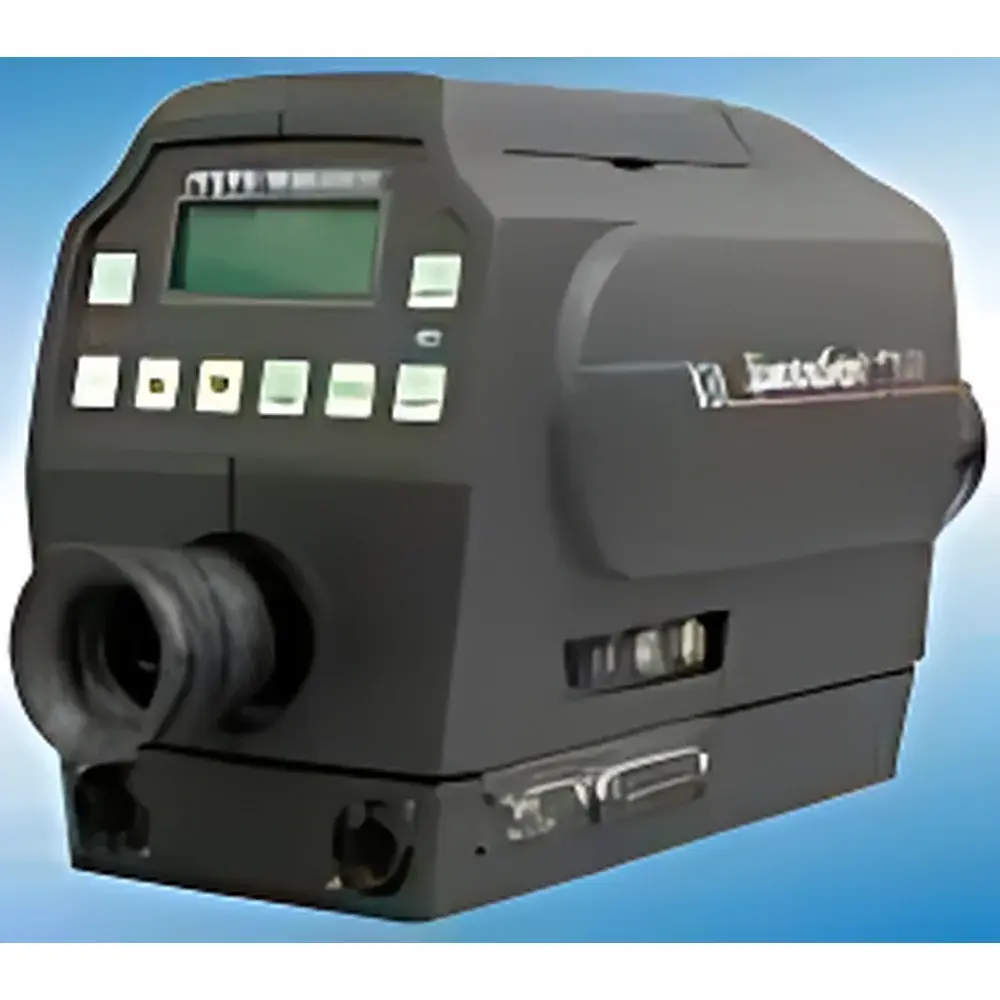
Photo Research PR-705 Spectroradiometer / Spectrophotometer / Colorimeter
| Brand | Photo Research |
|---|---|
| Origin | USA |
| Model | PR-705 |
| Type | Automated |
| Spectral Range | 380–1068 nm (PR-715 variant) |
| Minimum Measurable Spot Size | 0.02 mm |
| Field of View Options | Multiple selectable |
| Radiance Sensitivity | 0.003 cd/m² |
| Haze Measurement Range | 20% |
| Transmittance Measurement Range | 50% |
| Haze Repeatability | ±0.2% |
| Transmittance Repeatability | ±0.5% |
| Measurement Time | 50 ms per acquisition |
| Detector | Thermoelectrically Cooled Sealed InGaAs/Si CCD Array |
| Compliance | MIL-STD-461/810 (as configured for military night vision applications) |
Overview
The Photo Research PR-705 is a high-precision, automated spectroradiometer engineered for simultaneous spectral radiometric, photometric, and colorimetric characterization of light sources, displays, optical materials, and surface reflectance/transmittance properties. Operating on the principle of monochromator-based dispersive spectroscopy, the PR-705 employs a double-grating monochromator coupled with a thermoelectrically cooled InGaAs/Si hybrid detector array housed in a hermetically sealed, pressurized chamber. This architecture ensures exceptional long-term stability, low thermal drift (<0.01% per hour), and immunity to ambient humidity or condensation—critical for compliance with MIL-STD-461 and MIL-STD-810 environmental test protocols used in defense-grade night vision system validation. With a native spectral range of 380–1068 nm (extendable to 1068 nm via optional PR-715 configuration), the instrument delivers calibrated spectral power distribution (SPD) data at 1 nm resolution across visible and near-infrared bands. Its 50 ms measurement cycle enables real-time spectral capture under dynamic illumination conditions, while adaptive integration control dynamically optimizes signal-to-noise ratio (SNR) and dynamic range without user intervention.
Key Features
- Automated spectral acquisition with 50 ms measurement time, supporting high-throughput QA/QC workflows in display manufacturing and lighting R&D.
- Thermoelectrically cooled, sealed detector assembly ensuring radiometric stability ≤0.05% over 8 hours—validated per ISO/CIE TR 19557:2019 stability guidelines.
- Minimum measurable spot size of 0.02 mm (at 300 mm working distance), compatible with micro-LED, OLED subpixel, and thin-film optical coating analysis.
- Selectable field-of-view optics (1°, 2°, 5°, and fiber-coupled configurations) enabling precise spatial sampling per CIE 15:2018 and IEC 62368-1 Annex G requirements.
- Radiance sensitivity down to 0.003 cd/m², certified for low-light photometry in night vision device testing per MIL-L-85762A and STANAG 4363.
- Integrated haze and transmittance measurement capability with traceable NIST-calibrated reference standards; repeatability of ±0.2% for haze and ±0.5% for transmittance meets ASTM D1003 Category I specifications.
Sample Compatibility & Compliance
The PR-705 accommodates flat and curved transparent, translucent, and reflective samples—including glass substrates, polymer films, AR/HR coatings, LCD/OLED panels, and automotive headlamp lenses. Its non-contact optical design eliminates sample heating or mechanical stress. All radiometric calibrations are traceable to NIST Standard Reference Materials (SRMs) 2065, 2066, and 1930, with full uncertainty budgets documented per ISO/IEC 17025:2017. The system complies with key international standards including CIE S 014-2/E:2020 (spectroradiometry), ISO 13406-2 (display ergonomics), USP (analytical instrument qualification), and FDA 21 CFR Part 11 when deployed with validated software modules supporting electronic signatures and audit trails.
Software & Data Management
Controlled via Photo Research’s proprietary PR-705 Application Suite (v5.3+), the instrument supports fully automated measurement sequences, spectral database generation, and comparative analysis against user-defined tolerances. Raw spectral data is exported in ASCII, CSV, and CIE 15:2018-compliant XML formats. Software modules include GLP/GMP audit trail logging, calibration certificate generation with uncertainty reporting, and direct export to MATLAB, Python (via PR-SDK), and industry-standard color science platforms (e.g., Konica Minolta CMS). Firmware updates maintain alignment with evolving CIE technical reports and ASTM E308 revision cycles.
Applications
- Characterization of emissive microdisplays (AR/VR waveguides, micro-LED arrays) under pulsed and DC drive conditions.
- Quantitative evaluation of anti-glare, anti-fog, and anti-reflective coatings on medical device displays and cockpit instrumentation.
- Transmittance/haze profiling of optical diffusers and light-guide plates per ISO 14782 and JIS K 7136.
- Calibration and verification of luminance meters, colorimeters, and integrating sphere systems used in lighting laboratories.
- Supporting MIL-STD-3009 human-system integration testing for avionics and vehicle HUDs.
- Research in circadian lighting, photobiomodulation, and UV-A/visible/NIR spectral dosimetry.
FAQ
What spectral range does the standard PR-705 cover, and how does it differ from the PR-715?
The base PR-705 operates from 380 nm to 780 nm; the PR-715 variant extends coverage to 1068 nm using an optimized InGaAs detector array and recalibrated grating—enabling NIR reflectance analysis for semiconductor wafer inspection and agricultural sensor development.
Is the PR-705 suitable for measuring low-luminance OLED pixels?
Yes—the 0.003 cd/m² sensitivity, combined with 0.02 mm spot optics and adaptive integration, allows reliable measurement of individual subpixels in active-matrix OLEDs at typical viewing angles per IEC 61947-2.
How is calibration traceability maintained over time?
Each unit ships with dual NIST-traceable calibration certificates (radiance and irradiance), and optional annual recalibration services include full spectral responsivity mapping, linearity verification per CIE 127:2007, and dark current drift assessment.
Can the PR-705 be integrated into automated production test stands?
Yes—RS-232, USB 2.0, and Ethernet (TCP/IP) interfaces support SCPI command sets, enabling seamless integration with PLC-controlled stages, robotic arms, and MES platforms compliant with ISA-88/ISA-95 standards.





