
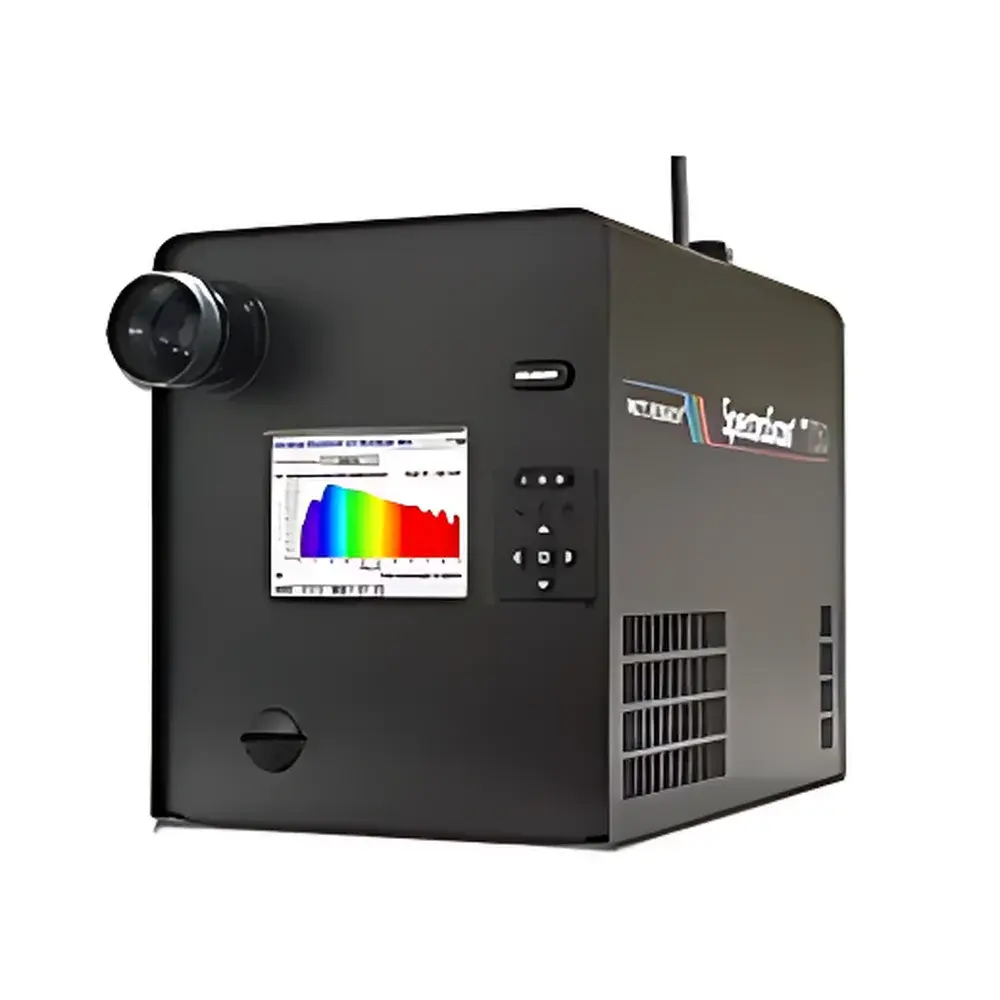
Photo Research PR-730/735 Cooled Spectroradiometer
| Brand | Photo Research |
|---|---|
| Origin | USA |
| Model | PR-730/735 |
| Detector Type | Cooled CCD (512 pixels) |
| Spectral Resolution | 0.781 nm/pixel |
| Minimum Luminance | 0.0003 cd/cm² |
| Spectral Bandwidth Options | 2 nm, 5 nm, 8 nm |
| Display | High-resolution full-color touchscreen |
| Communication Interfaces | USB, RS-232, Bluetooth (up to 100 m range) |
| Aperture Options | 8 interchangeable field-of-view apertures |
| Calibration Software | SpectraWin with user-accessible self-calibration module |
| Optical Compatibility | Fully compatible with PR LR-127 LED measurement accessory |
Overview
The Photo Research PR-730/735 is a high-precision cooled spectroradiometer engineered for absolute spectral radiance and luminance measurements across R&D, display calibration, lighting validation, and LED characterization workflows. Operating on the principle of diffraction-grating-based spectral dispersion coupled with thermoelectrically cooled 512-pixel CCD detection, the instrument delivers exceptional signal-to-noise ratio (SNR) and long-term photometric stability—critical for low-light applications such as OLED emissive pixel evaluation, automotive HUD verification, and dark-room display homogeneity mapping. Its spectral acquisition range spans 380–780 nm (standard), with optical throughput optimized for CIE 1931 colorimetric compliance. Unlike non-cooled spectrometers, the PR-730/735’s Peltier-cooled detector minimizes dark current drift, enabling repeatable sub-millicandela per square centimeter measurements over extended integration periods.
Key Features
- Cooled 512-pixel linear CCD array with thermoelectric stabilization to –10 °C, ensuring <0.05% dark current variation over 60-minute continuous operation
- Configurable spectral bandwidths (2 nm, 5 nm, 8 nm) achieved via motorized slit selection—no manual optical realignment required
- Eight precision-machined field-of-view apertures (ranging from 0.1° to 5°), all traceably calibrated against NIST-traceable standards
- Integrated full-color capacitive touchscreen interface with real-time spectral plot overlay, XYZ/CIE xyY/Lab conversion, and pass/fail threshold visualization
- Triple-mode digital connectivity: USB 2.0 (high-speed bulk transfer), RS-232 (legacy system integration), and Class 1 Bluetooth (100 m line-of-sight range for remote trigger and live data streaming)
- Onboard non-volatile memory stores >10,000 spectra with embedded metadata (timestamp, aperture ID, integration time, ambient temperature)
Sample Compatibility & Compliance
The PR-730/735 supports direct measurement of self-luminous sources—including microLED arrays, AMOLED panels, automotive interior lighting, and projection systems—without auxiliary optics in most configurations. When paired with the optional PR LR-127 lens adapter, it achieves standardized 2° and 10° CIE observer matching for LED package testing per IEC 62717 and LM-79-19 requirements. All factory calibrations are performed under ISO/IEC 17025-accredited conditions and include full uncertainty budgets per GUM (Guide to the Expression of Uncertainty in Measurement). The instrument complies with FDA 21 CFR Part 11 when used with SpectraWin v6.5+ in audit-trail-enabled mode, supporting GLP/GMP laboratory documentation workflows.
Software & Data Management
SpectraWin software (v6.5 or later) serves as the primary control and analysis platform, offering real-time spectral acquisition, multi-point spatial mapping, flicker analysis (IEEE 1789-compliant), and automated report generation in PDF/XLSX formats. The integrated self-calibration module allows users to perform end-to-end radiometric verification using PR-certified tungsten-halogen and LED reference standards—eliminating annual third-party recalibration downtime. Raw spectral data is stored in vendor-neutral .SPD format (ASCII-based, column-delimited), fully interoperable with MATLAB, Python (via NumPy/Pandas), and industry-standard color science tools including ColorThink Pro and LightTools. Audit logs record every calibration event, parameter change, and export action with operator ID and timestamp.
Applications
- Display manufacturing: Mura detection, white point uniformity mapping, and HDR tone curve validation on LCD, OLED, and QD-LED panels
- Automotive electronics: Instrument cluster readability under daylight/sunlight simulation, head-up display (HUD) virtual image luminance and chromaticity verification
- LED lighting R&D: Spatially resolved CCT and Duv mapping of COB modules, phosphor degradation tracking via spectral shift analysis
- AR/VR device testing: Near-eye display luminance linearity, angular color shift (goniochromism), and temporal response profiling
- Regulatory testing labs: Conformance assessment to ENERGY STAR Lamps V2.1, DLC Premium v5.1, and IES TM-30-20 Annex B protocols
FAQ
Does the PR-730/735 require annual factory recalibration?
No—its user-accessible self-calibration routine, validated against PR-supplied reference standards, satisfies ISO/IEC 17025 intermediate verification requirements. Full traceable recalibration is recommended every 24 months or after mechanical shock events.
Can the PR-730/735 measure pulsed or modulated light sources?
Yes—integrated hardware triggering supports external TTL sync inputs, enabling phase-locked spectral capture at frequencies up to 10 kHz. Integration time is adjustable from 1 ms to 60 s in 0.1-ms increments.
Is Bluetooth communication secure for lab network environments?
Bluetooth operates in dedicated 2.4 GHz ISM band with AES-128 encryption; SpectraWin enforces pairing authentication and disables ad-hoc discovery by default—meeting institutional IT security policies for peripheral devices.
How does the 2 nm bandwidth option impact measurement uncertainty?
At 2 nm FWHM, the instrument achieves optimal resolution for narrowband emitter characterization (e.g., quantum dot displays), with expanded uncertainty ±0.8% k=2 for Y (luminance) due to reduced photon flux—compensated by longer integration times and cooled detector SNR enhancement.
What spectral irradiance units are natively supported?
All radiometric units are convertible in real time: W/m²/sr/nm, µW/cm²/nm, and photon flux (µmol/m²/s/nm); photometric units include cd/m², fL, and nit—with CIE 1931 2° and 10° observer functions preloaded.



