
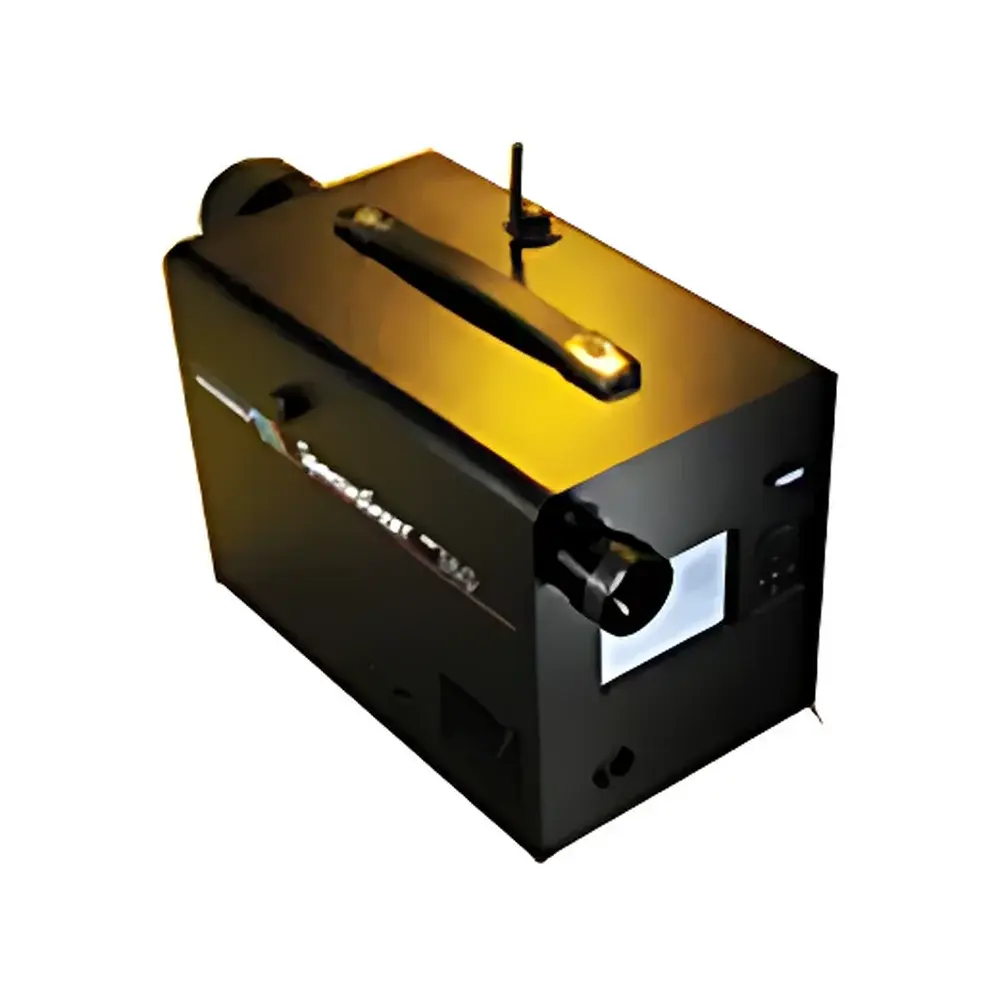
Photo Research PR-740/745 High-Sensitivity Cooled Spectroradiometer
| Brand | Photo Research |
|---|---|
| Origin | USA |
| Model | PR-740/745 |
| Detector Type | Cooled 512-pixel CCD |
| Spectral Resolution | Up to 0.781 nm/pixel |
| Minimum Luminance | 0.000017 cd/cm² |
| Spectral Bandwidth Options | 2 nm, 5 nm, 8 nm |
| Display | High-Resolution Full-Color Touchscreen |
| Interface Options | USB, RS-232, Bluetooth (up to 100 m range) |
| Calibration | User-performed via SpectraWin Remote Mode & Built-in Self-Calibration Software |
| Optical Accessories | Eight interchangeable apertures |
| Compliance | ASTM E308, CIE 15:2018, ISO/CIE 11664, USP <1058> (analytical instrument qualification framework) |
Overview
The Photo Research PR-740/745 is a high-sensitivity, thermoelectrically cooled spectroradiometer engineered for precision luminance, chromaticity, and spectral radiance measurements across R&D, display manufacturing, lighting validation, and LED characterization workflows. Unlike conventional photometers or uncooled spectrometers, the PR-740/745 employs a stabilized 512-pixel back-illuminated CCD detector operating at –10 °C, enabling sub-picomolar photon-level detection with exceptional signal-to-noise ratio (SNR) and long-term thermal stability. Its optical architecture follows CIE-standard f/1.5 imaging spectroradiometry principles, with diffraction-limited grating dispersion and calibrated NIST-traceable responsivity across 380–780 nm. The instrument delivers true spectral data—not interpolated or filtered approximations—making it suitable for compliance testing against ISO/CIE 11664 (colorimetry), ASTM E308 (computing tristimulus values), and IEC 62368-1 (display safety luminance thresholds). Designed as a direct evolution of the PR-730/735 platform, the PR-740/745 achieves 20× higher radiometric sensitivity and 250× faster spectral acquisition—critical for low-flux sources such as microLEDs, OLED pixels under pulse-width modulation, or ambient-light-dimmed automotive displays.
Key Features
- Cooled 512-pixel CCD detector with thermoelectric stabilization (–10 °C), minimizing dark current drift and enabling integration times up to 60 seconds without saturation
- Spectral resolution of 0.781 nm/pixel (at 512-pixel full frame), supporting accurate peak wavelength, FWHM, and dominant wavelength determination per CIE 177:2006
- Three selectable spectral bandwidths (2 nm, 5 nm, 8 nm) implemented via software-controlled slit mechanism—no mechanical aperture change required
- Eight standardized field-of-view apertures (0.1° to 5°), all mechanically indexed and automatically recognized by firmware for traceable solid-angle correction
- Integrated high-resolution capacitive touchscreen display with real-time spectral plot rendering, CIE 1931 xy and u’v’ chromaticity overlays, and luminance histogram visualization
- Triple-interface connectivity: USB 2.0 (mass storage + CDC), RS-232 (legacy automation), and Class 1 Bluetooth (100 m line-of-sight range) supporting remote trigger, live spectrum streaming, and firmware updates
Sample Compatibility & Compliance
The PR-740/745 accommodates planar emitters (OLED, LCD, microLED panels), point sources (LED chips, laser diodes), extended sources (backlights, signage), and reflective surfaces (via optional integrating sphere or reflectance probe). When paired with the LR-127 lens system, it meets the angular response requirements of CIE Publication 224 for near-field LED intensity distribution measurement. All factory calibrations are NIST-traceable and documented per ISO/IEC 17025 guidelines. Instrument qualification supports IQ/OQ/PQ protocols aligned with USP and FDA 21 CFR Part 11 when used in regulated environments—audit trails, electronic signatures, and calibration lockout are enforced through SpectraWin’s GLP-compliant mode. Measurement uncertainty budgets comply with GUM (JCGM 100:2008) and are provided in the Certificate of Calibration.
Software & Data Management
SpectraWin v7.x serves as the native control, analysis, and reporting platform. It provides dual operational modes: Local GUI (touchscreen or PC-connected) and Remote Mode for automated integration into CI/CD test benches or MES systems. Remote Mode enables script-driven acquisition (Python, LabVIEW, MATLAB APIs), batch processing of spectral time-series, and export to CSV, XML, or CIE 15:2018-compliant .cie files. The embedded self-calibration module allows users to perform full spectral responsivity verification using supplied PR-certified calibration lamps—eliminating reliance on third-party recalibration cycles. Data integrity safeguards include write-once logging, SHA-256 hash verification of raw spectra, and configurable retention policies compliant with 21 CFR Part 11 Annex 11 requirements.
Applications
- Display metrology: Mura assessment, grayscale tracking, viewing angle uniformity, and HDR tone-mapping validation per VESA DisplayHDR and SMPTE ST 2084
- LED & VCSEL characterization: Radiant flux, efficacy (lm/W), color rendering index (CRI), TM-30 metrics, and binning consistency at wafer and package levels
- Automotive lighting: ADB headlamp beam pattern certification, DRL chromaticity tolerance verification, and interior ambient light sensor calibration
- Medical device displays: Luminance uniformity verification per IEC 62304 and usability validation under low-illumination clinical settings
- AR/VR waveguide evaluation: Exit pupil luminance mapping, speckle contrast quantification, and eyebox spectral fidelity analysis
FAQ
What is the minimum measurable luminance level, and under what conditions is it achieved?
The specified 0.000017 cd/cm² is achievable using the 5° aperture, 2 nm bandwidth, 60-second integration time, and cooled detector mode—validated per CIE S 023/E:2020 Annex B.
Can the PR-740/745 be used for flicker measurement per IEEE 1789 or IEC TR 61000-3-3?
Yes—when configured with 1 ms minimum integration time and synchronized external trigger input, it captures temporal spectral transients at up to 1 kHz sampling rate; flicker percentage and frequency are computed in SpectraWin using CIE TN 006:2020 methodology.
Is user calibration traceable to national standards?
User-performed calibration uses PR-supplied NIST-traceable tungsten-halogen and deuterium reference lamps; certificates include uncertainty budgets referenced to NIST SRM 2032 and 2034.
Does the instrument support automated pass/fail testing against custom specification limits?
Yes—SpectraWin’s Test Sequence Editor allows defining multi-parameter limits (e.g., x,y chromaticity box, luminance min/max, CCT tolerance) with configurable alarm outputs via TTL or TCP/IP.
How is thermal drift compensated during extended measurements?
Real-time dark frame subtraction, periodic internal reference lamp checks (every 30 minutes), and temperature-compensated pixel gain mapping ensure <±0.1% luminance drift over 8-hour continuous operation.




