
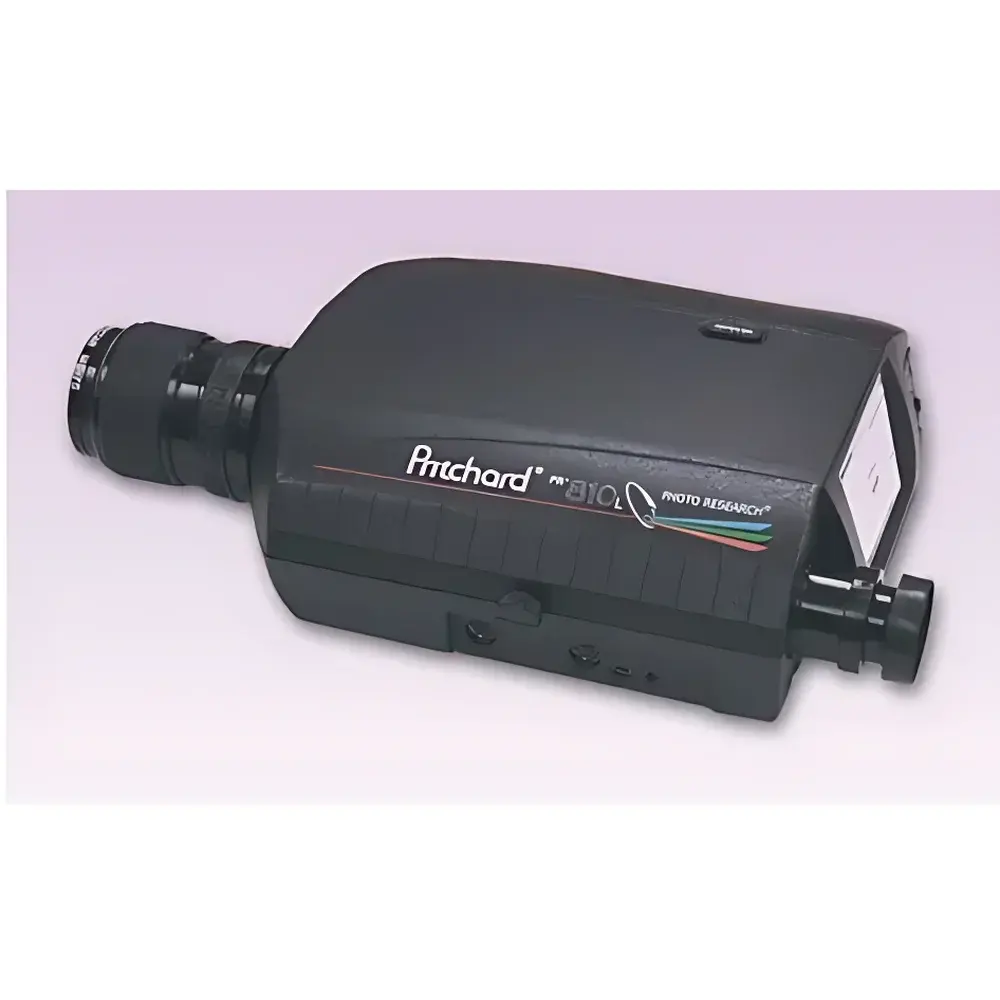
Photo Research PR805/810 Photometer and Colorimeter
| Brand | Photo Research |
|---|---|
| Origin | USA |
| Model | PR805/810 |
| Power Supply | Rechargeable Li-ion battery (≥12 h continuous operation) |
| Display | Full-color capacitive touchscreen |
| Lens | Standard 75 mm focal length (measurement distance: 355 mm to infinity) |
| Minimum Luminance | PR810 — 0.0001 fL (0.00034 cd/m²) |
| Apertures | PR805 — 10 fixed apertures |
| Neutral Density Filter Turret | 3-decade attenuation (10×, 100×, 1000×) |
| Dynamic Range | >9,000,000:1 |
| Interface | USB Virtual COM port (RS-232 emulation), optional Class 1 Bluetooth (100 m range) |
| Data Storage | Internal memory + SD card slot |
| Compliance | Designed for ASTM E308, CIE 15:2018, ISO/CIE 11664, USP <1033>, FDA 21 CFR Part 11–ready software integration |
Overview
The Photo Research PR805/810 is a high-precision, portable photometer and colorimeter engineered for absolute luminance, chromaticity, and contrast ratio measurement in demanding R&D, manufacturing QA/QC, and field validation environments. Built upon the legacy of the Pritchard optical system—a collimated viewing architecture where the alignment axis of the eyepiece coincides precisely with the measurement optical path—the PR805/810 ensures traceable geometric accuracy and minimal cosine error across all measurement distances (355 mm to infinity). Unlike conventional PMT-based photometers requiring AC power and external cooling, the PR805/810 integrates a thermally stabilized silicon photodiode array with spectral correction filters calibrated against NIST-traceable standards. Its dual-model architecture—PR805 optimized for broad-aperture, high-sensitivity applications; PR810 configured for automated aperture selection and ultra-low-light performance—enables consistent CIE 1931 XYZ tristimulus and CIELAB color space computation under variable ambient and low-luminance conditions (down to 0.0001 fL).
Key Features
- Pritchard optical design with 75 mm focal length lens, ensuring collimated viewing geometry and minimized angular response deviation per CIE Publication 127.
- Rechargeable lithium-ion battery supporting ≥12 hours of continuous operation—enabling true handheld deployment in cockpit, avionics bay, or outdoor display validation without tethering.
- Full-color capacitive touchscreen interface with intuitive menu navigation, real-time spectral preview, and on-device pass/fail threshold evaluation.
- Motorized neutral density filter turret providing 10×, 100×, and 1000× attenuation—combined with aperture selection, delivering a total dynamic range exceeding 9,000,000:1 for high-contrast emissive and transmissive measurements.
- USB Virtual COM port enabling seamless integration into automated test equipment (ATE) via ASCII command protocol; fully compatible with LabVIEW, Python pySerial, and MATLAB instrument control toolboxes.
- Optional Class 1 Bluetooth module (order code: BT-PR8xx) supporting secure, low-latency remote control and data streaming up to 100 meters—ideal for hazardous or inaccessible measurement zones.
Sample Compatibility & Compliance
The PR805/810 accommodates flat-panel displays (OLED, microLED, LCD), automotive instrument clusters, HUDs, aircraft MFDs, medical device interfaces, and reflective signage. It supports both self-luminous (emissive) and backlit/transmissive samples, with configurable measurement area definition via aperture selection. Calibration is maintained through factory-applied spectral responsivity corrections aligned to CIE 1931 V(λ) and x(λ), y(λ), z(λ) functions. The instrument meets requirements for photometric traceability per ISO/IEC 17025-accredited calibration labs and supports audit-ready data logging compliant with GLP and GMP frameworks when paired with validated software (e.g., PR-655 Control Suite v4.2+). Firmware and driver packages include built-in support for ASTM E308 spectral data interpolation, CIE 15:2018 chromatic adaptation transforms, and USP photometric validation protocols.
Software & Data Management
The PR805/810 operates natively with Photo Research’s PR-655 Control Suite (Windows), offering full remote configuration, real-time data visualization, batch export (CSV, XML, SDF), and customizable report generation. All measurements store timestamp, GPS metadata (when enabled via Bluetooth-connected mobile device), aperture/ND state, and raw analog-to-digital counts for post-hoc uncertainty analysis. SD card storage retains ≥10,000 full-spectrum measurements with embedded calibration checksums. For enterprise integration, the ASCII command set enables direct embedding into Python-based CI/CD pipelines or PLC-controlled test sequences. When deployed in regulated environments, optional 21 CFR Part 11 compliance modules provide electronic signature enforcement, audit trail logging, and role-based access control—validated per IQ/OQ protocols.
Applications
- Aerospace & Defense: Instrument panel brightness uniformity mapping, HUD luminance verification per MIL-STD-3009, night-vision compatibility testing.
- Automotive: Cluster and infotainment display photometry per UNECE R118, glare assessment, ambient light sensor characterization.
- Consumer Electronics: OLED burn-in monitoring, HDR tone-mapping validation, display aging studies under accelerated luminance stress.
- Medical Devices: Surgical monitor luminance stability per IEC 62304, diagnostic display grayscale tracking, DICOM GSDF conformance checks.
- Lighting & Signage: LED billboard uniformity analysis, emergency exit sign photometric certification per NFPA 101, photobiological safety screening (IEC 62471).
FAQ
What is the difference between PR805 and PR810?
The PR810 features four motorized, auto-selected apertures and a higher-sensitivity detector configuration, enabling measurements down to 0.0001 fL. The PR805 offers ten fixed apertures and is optimized for general-purpose field photometry with enhanced ruggedness and simplified operation.
Does the PR805/810 support CIEDE2000 or other advanced color difference metrics?
Yes—colorimetric data is output in CIE XYZ, CIELAB, and CIELUV; delta-E calculations including CIEDE2000, CMC(l:c), and BFD are performed externally via PR-655 Control Suite or third-party color science libraries.
Can the instrument be calibrated onsite by the user?
Field calibration requires a NIST-traceable reference source and PR-655 Calibration Utility; however, routine verification using a stable LED reference is supported via the built-in “Check Standard” function.
Is firmware upgrade capability available over USB?
Yes—firmware updates are delivered as signed .bin files and installed via the PR-655 Control Suite with automatic version rollback and integrity verification.
How is measurement uncertainty quantified for low-luminance readings?
Uncertainty budgets follow JCGM 100:2008 guidelines and incorporate contributions from detector noise, ND filter tolerance (±0.5%), aperture edge diffraction, and spectral mismatch—documented in the instrument’s Certificate of Calibration.




