
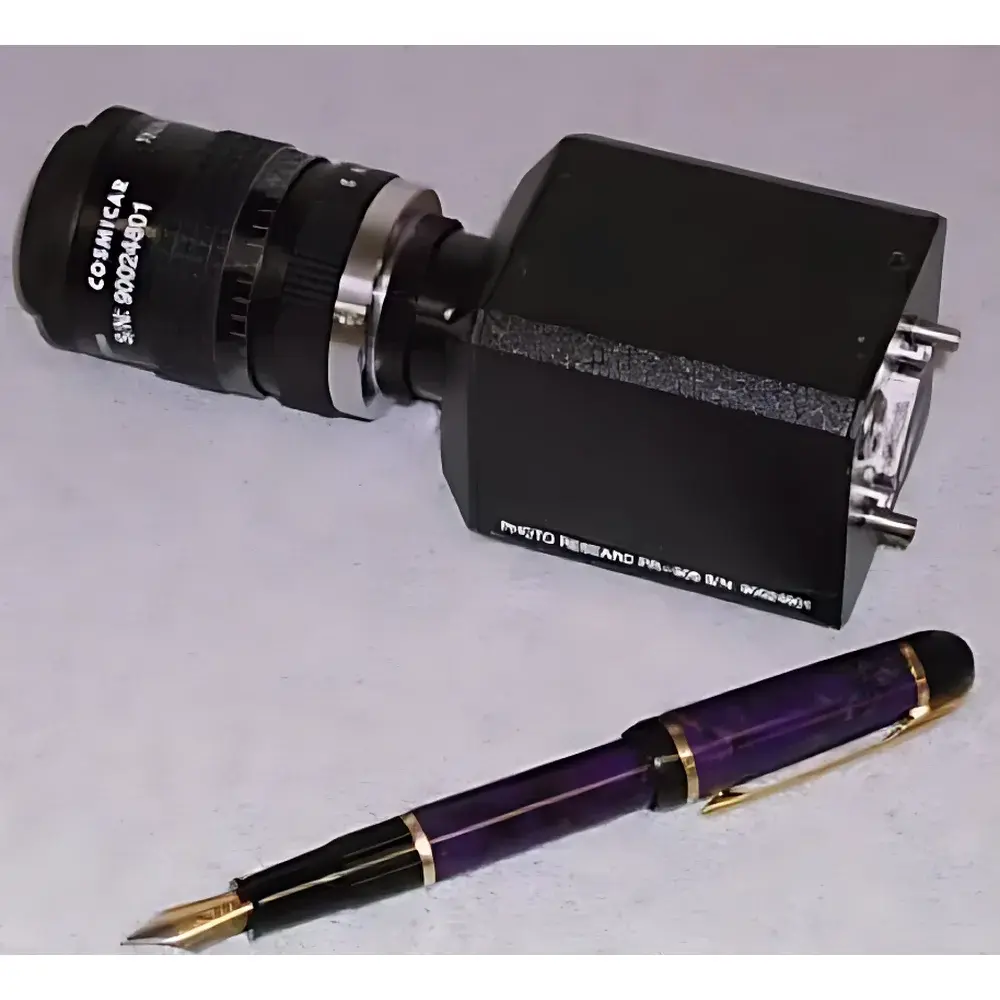
Photo Research PR905 Video Photometer
| Brand | Photo Research |
|---|---|
| Origin | USA |
| Model | PR905 |
| Sensor Resolution | 1024 × 1024 pixels |
| Photopic V(λ) Filter Compliance | CIE 1931 Standard Observer |
| Standard Lens | 50 mm focal length |
| Optional Lenses | High-resolution telecentric and wide-angle optics |
| Optional ND Filters | OD 0.3 to OD 3.0 (logarithmic attenuation) |
| Software | VideoWin v5.x with real-time exposure optimization, ROI-based analysis, and Excel export capability |
| Compliance | Meets CIE Publication No. 15, ISO/CIE 11664-1:2016 (colorimetry), and ASTM E308-22 (computing tristimulus values) |
| Data Output | Luminance (cd/m²), Chromaticity (CIE x,y or u′,v′), Uniformity (% deviation), Contrast Ratio (luminance ratio), Defect localization map |
Overview
The Photo Research PR905 Video Photometer is a high-precision, CCD-based imaging photometric system engineered for quantitative spatial measurement of luminance, chromaticity, and uniformity across self-luminous and reflective display surfaces. Unlike traditional scanning photometers, the PR905 employs a single-shot 1024 × 1024 pixel scientific-grade CCD sensor coupled with a rigorously calibrated CIE 1931 photopic V(λ) spectral response filter — ensuring traceable, standards-compliant luminance data in cd/m² without mechanical scanning artifacts. Its optical architecture integrates a factory-aligned 50 mm f/2.8 lens optimized for flat-field imaging at working distances from 300 mm to ∞, enabling rapid full-field acquisition of emissive devices such as OLED, LCD, PDP, microLED, and CRT panels. The system operates on fundamental principles of digital radiometry: incident photons are converted to charge via the CCD’s silicon photodiode array, then digitized and weighted by the V(λ) filter’s spectral transmittance curve to yield photometrically accurate luminance values per pixel — all within a single exposure cycle.
Key Features
- 1024 × 1024 resolution monochrome CCD sensor with 12-bit dynamic range and low read-noise architecture for high signal-to-noise ratio (SNR) performance
- CIE 1931 V(λ)-matched interference filter certified to ISO/CIE 11664-1:2016, providing photometric accuracy traceable to NIST standards
- Integrated real-time exposure optimization algorithm in VideoWin software that dynamically adjusts integration time based on local scene luminance — eliminating saturation and underexposure in heterogeneous displays
- Modular optical design supporting interchangeable lenses: standard 50 mm, telecentric 100 mm (for high MTF resolution), and 24 mm wide-angle (for large-area coverage)
- Stackable neutral density (ND) filter wheel (OD 0.3–3.0) enabling measurement of luminance ranges from 0.01 cd/m² to over 100,000 cd/m² without hardware reconfiguration
- PCI interface with deterministic frame timing and hardware-level trigger synchronization for repeatable inter-system integration in automated test environments
Sample Compatibility & Compliance
The PR905 is validated for use across flat panel display (FPD) manufacturing, R&D, and quality assurance workflows. It supports measurement of emissive technologies including AMOLED, LTPS-LCD, QD-OLED, and legacy CRTs, as well as reflective and semi-transmissive samples when used with calibrated backlighting. All photometric outputs comply with ASTM E308-22 for colorimetric computation, ISO 9241-307:2008 for display uniformity assessment, and IEC 62341-6-3:2021 for OLED luminance characterization. System calibration certificates include uncertainty budgets per ISO/IEC 17025 requirements, and optional factory recalibration services maintain metrological continuity for GLP/GMP-regulated environments.
Software & Data Management
VideoWin v5.x serves as the embedded control and analysis platform, featuring a dual-mode operation: live preview with histogram-guided exposure setup, and post-acquisition batch analysis with customizable regions of interest (ROIs). The software computes spatially resolved luminance (Y), chromaticity coordinates (CIE 1931 x,y and CIE 1976 u′,v′), delta-E₂₀₀₀ maps, contrast ratios (peak-to-black, center-to-corner), and uniformity indices (min/max deviation, RMS variation). All numerical results export directly to CSV or Microsoft Excel formats with metadata headers (timestamp, exposure time, lens ID, ND filter state). Audit trails, user access logs, and electronic signatures are available in VideoWin Enterprise Edition to satisfy FDA 21 CFR Part 11 compliance requirements for regulated laboratories.
Applications
- Full-panel luminance and chromaticity mapping for FPD production line pass/fail screening
- Hotspot and mura defect localization and quantification using gradient-based thresholding algorithms
- Viewing angle characterization via goniometric image capture (when mounted on motorized rotation stages)
- Lifetime testing of emissive pixels through longitudinal luminance decay tracking
- Backlight unit (BLU) uniformity validation in edge-lit and direct-lit LCD assemblies
- Human vision modeling support via integration with perceptual models (e.g., CIECAM02) for visual quality prediction
FAQ
What is the minimum measurable luminance level with the PR905?
With the OD 3.0 neutral density filter and maximum integration time, the system achieves a lower detection limit of 0.01 cd/m² under controlled darkroom conditions.
Can the PR905 measure angular luminance distribution?
Yes — when integrated with a precision goniometer stage (e.g., Zolix GTS series), VideoWin supports automated multi-angle image capture and Lambertian/non-Lambertian BRDF reconstruction.
Is V(λ) filter calibration traceable to national standards?
Each PR905 ships with a NIST-traceable spectral transmittance certificate for its V(λ) filter, verified using a double-monochromator spectroradiometer per CIE Technical Report 225:2017.
Does VideoWin support automated pass/fail reporting per customer-defined tolerances?
Yes — users define spatial and photometric tolerance zones (e.g., ±5% luminance deviation within central 80% area), and VideoWin generates annotated PDF reports with color-coded pass/fail overlays.
How frequently should the system be recalibrated?
Photo Research recommends annual recalibration; however, in high-utilization production environments, quarterly verification using a reference luminance standard (e.g., PR-740) is advised to ensure ongoing measurement integrity.



