
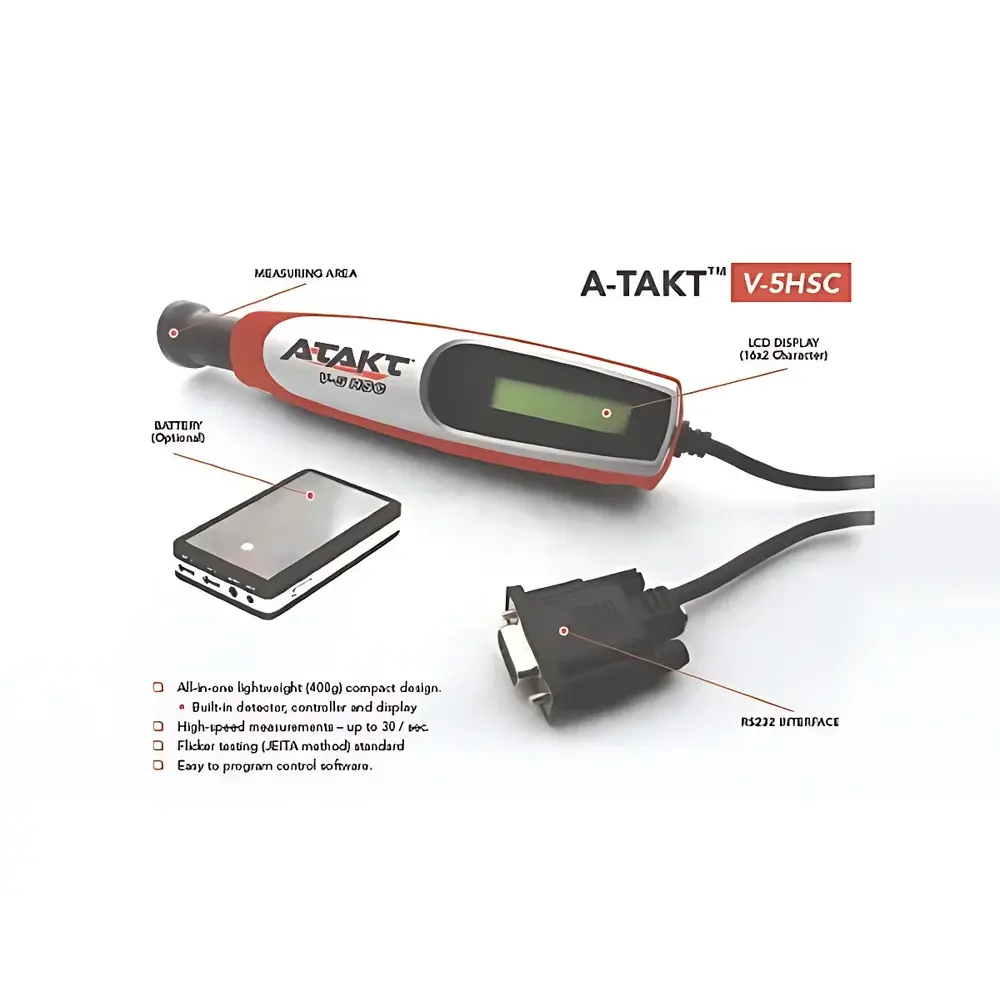
Photo Research A-TAKT V-5HSC Handheld Tristimulus Colorimeter
| Brand | Photo Research |
|---|---|
| Origin | USA |
| Model | V-5HSC |
| Detection Principle | Filter-based tristimulus photometry conforming to CIE 1931 2° standard observer |
| Luminance Range | 0.01 to 6,000 cd/m² |
| Dynamic Range | 60,000:1 |
| Measurement Speed | Up to 30 readings per second |
| Spectral Matching f₁′ (CIE X/Y/Z) | 3.4% / 3.2% / 3.4% |
| Interface | RS232 with ASCII command protocol |
| Flicker Measurement | JEITA-compliant (built-in, no add-on required) |
| Display | Integrated high-contrast OLED screen |
| Power | Rechargeable Li-ion battery (≥8 hrs continuous operation) |
Overview
The Photo Research A-TAKT V-5HSC Handheld Tristimulus Colorimeter is an engineered solution for high-accuracy, contact-mode luminance and chromaticity measurement in flat panel display (FPD) manufacturing, R&D laboratories, and quality control environments. Unlike spectroradiometric systems, the V-5HSC employs precision optical filter technology calibrated to the CIE 1931 2° standard observer spectral sensitivity functions (x̄(λ), ȳ(λ), z̄(λ)). Its core architecture integrates the photodetector array, signal processing electronics, and OLED display into a single ergonomic probe—eliminating external controllers and minimizing cable-induced noise or latency. This monolithic design ensures mechanical stability and thermal consistency critical for repeatable low-light measurements down to 0.01 cd/m², while maintaining a 60,000:1 dynamic range suitable for evaluating both sub-threshold OLED pixels and high-brightness microLED arrays. The instrument complies with industry-relevant photometric definitions per CIE Publication 127 and ISO/CIE 11664 series standards, and supports JEITA TR-001 flicker evaluation without auxiliary hardware—a capability validated against reference-grade spectroradiometers such as the PR-740.
Key Features
- Monolithic probe architecture: All functional subsystems—including silicon photodiodes, temperature-compensated analog front-end, FPGA-based real-time signal processing, and high-resolution OLED display—are housed within the handheld unit.
- CIE-matched tristimulus filters: Achieves f₁′ values of 3.4% (X), 3.2% (Y), and 3.4% (Z), representing best-in-class spectral fidelity among filter-based colorimeters at this form factor and price point.
- High-speed acquisition: Capable of up to 30 sequential luminance/chromaticity readings per second with full CIE XYZ, xyY, u’v’, and ΔE₀₀ computation delivered in real time.
- JEITA TR-001 flicker analysis: Built-in temporal sampling engine (≥1 kHz effective bandwidth) enables direct calculation of flicker percentage (FP), flicker index (FI), and frequency-domain metrics per JEITA standards—no firmware upgrade or accessory required.
- RS232 ASCII command interface: Supports programmable control of single or daisy-chained units using a documented, human-readable protocol compatible with LabVIEW, Python (pySerial), and legacy factory automation PLCs.
- Battery-powered operation: Integrated rechargeable lithium-ion pack delivers ≥8 hours of continuous measurement under typical FPD test conditions (25°C ambient, 100 cd/m² average luminance).
Sample Compatibility & Compliance
The V-5HSC is optimized for emissive display technologies including LCD (CCFL and LED-backlit), OLED (RGB, WOLED, QD-OLED), microLED, and PDP panels. Its contact-mode aperture geometry (standard 5 mm diameter, optional 2 mm and 10 mm adapters available) ensures consistent field-of-view registration across pixel-level and macro-scale measurements. The device meets traceability requirements under ISO/IEC 17025 when used with NIST-traceable calibration sources. It supports GLP/GMP-aligned workflows through configurable data logging (timestamped CSV export via RS232) and optional audit-trail-enabled firmware (compliant with FDA 21 CFR Part 11 when deployed with validated host software). All optical components are RoHS-compliant and manufactured under AS9100-certified processes.
Software & Data Management
No proprietary PC software is required for basic operation—the V-5HSC operates autonomously with on-device menu navigation and result visualization. For integration into automated test stations, the ASCII command set enables full remote control: trigger measurement, configure averaging mode (1–100 samples), select color space output, initiate JEITA flicker capture, and retrieve results in comma-delimited format. Command syntax follows ANSI X3.4 conventions and is backward-compatible with legacy Photo Research instruments (e.g., PR-655, PR-705), minimizing code migration effort during system upgrades. Third-party drivers are available for National Instruments TestStand and Keysight PathWave, supporting automated pass/fail reporting aligned with AEC-Q200 or IEC 62341-6-2 display qualification protocols.
Applications
- FPD production line verification: Contact-mode uniformity mapping of luminance and chromaticity across active matrix panels (AMOLED, LTPS-LCD) with sub-second per-point throughput.
- R&D characterization: Correlated color temperature (CCT) stability testing under varying drive currents and thermal loads; gamut coverage validation against DCI-P3 and Rec. 2020 targets.
- Quality assurance auditing: Cross-instrument correlation studies between handheld units and benchtop spectroradiometers (e.g., PR-740, Konica Minolta CS-2000) using standardized white and grayscale patches.
- Flicker compliance screening: Pre-certification assessment of display modules against JEITA TR-001 thresholds prior to formal EMC or IEC/EN 61000-3-2 testing.
- Repair and field service: On-site verification of backlight replacement consistency and OLED burn-in compensation algorithms in service centers.
FAQ
Does the V-5HSC require annual recalibration?
Yes—Photo Research recommends traceable recalibration every 12 months using NIST-traceable standards, particularly when used in regulated environments (e.g., ISO 13485 medical display manufacturing). Calibration certificates include uncertainty budgets per GUM (JCGM 100:2008).
Can the V-5HSC measure pulsed or PWM-driven displays?
Yes—its high-speed sampling engine synchronizes internally to emission transients, enabling accurate time-integrated photometry for displays operating under variable-frequency PWM dimming schemes.
Is the f₁′ value certified per CIE Publication 177?
The reported f₁′ values are measured per CIE 177:2007 Annex B methodology using a tunable monochromator and reference photodiode system; full spectral responsivity data is supplied with each instrument’s calibration report.
What accessories are needed for automated integration?
Only a standard DB9 RS232 cable and 5 VDC power supply (included); no additional interface cards, dongles, or SDK licenses are required for basic ASCII command functionality.
How does the V-5HSC handle temperature drift during extended measurements?
Internal thermistor network continuously monitors detector and filter substrate temperatures; real-time correction coefficients are applied to raw ADC counts using factory-characterized thermal response models stored in non-volatile memory.





