
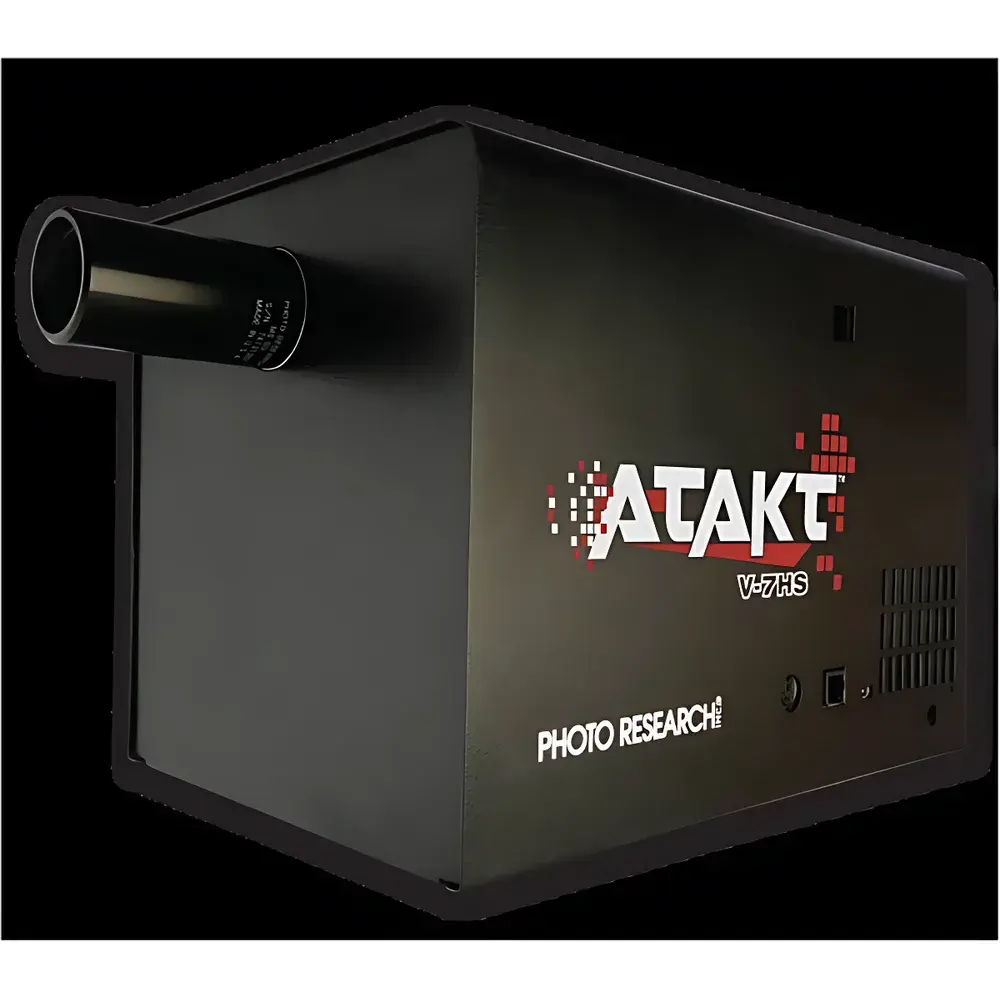
Photo Research A-TAKT Spectroradiometer for FPD Production Line Testing
| Brand | Photo Research |
|---|---|
| Origin | USA |
| Model | A-TAKT |
| Type | CCD-based spectroradiometer |
| Spectral Bandwidth Options | 2 nm, 5 nm, 8 nm |
| Field-of-View Apertures | 0.50°, 1.0°, 1.25°, 1.50° |
| Lens Options | Fixed-focus 50 mm or zoom 75 mm |
| Stray-light Suppression | Optional shielded brightness accessory |
| Mounting Interface | 1/4"-20 SAE threaded port |
| Communication Interfaces | USB 2.0, RS-232 |
| OS Compatibility | Windows Vista (32/64-bit) and later, macOS 10.7+ |
| SDK Available | Yes, C/C++, .NET, LabVIEW compatible |
| Compliance Support | ASTM E308, CIE 15:2018, ISO/CIE 11664, IEC 62369-1, FDA 21 CFR Part 11 (audit trail via software logging) |
Overview
The Photo Research A-TAKT Spectroradiometer is an industrial-grade, CCD-based spectroradiometric measurement system engineered specifically for real-time photometric and colorimetric verification on flat panel display (FPD) production lines. Unlike traditional filter-based photometers or slower scanning monochromator systems, the A-TAKT employs a fixed-grating spectrometer architecture coupled with a thermoelectrically stabilized linear CCD array to deliver full spectral acquisition (typically 380–780 nm) in sub-second integration times. This enables true spectral fidelity—without interpolation or filter-matching approximations—while maintaining throughput required for 100% inline inspection of CCFL, LED-backlit LCD, and OLED panels. Its optical design follows CIE-standard observer functions (CIE 1931 2° and CIE 1964 10°), ensuring traceable luminance (cd/m²), chromaticity (x, y or u’, v’), correlated color temperature (CCT), and dominant wavelength measurements compliant with display manufacturing specifications such as VESA FPDM2, JEITA CP-3405, and ISO 13406-2.
Key Features
- Real-time spectral acquisition: Full 380–780 nm spectrum captured in ≤300 ms per measurement, enabling dynamic process monitoring without sacrificing metrological rigor.
- Modular optical configuration: Interchangeable apertures (0.50° to 1.50°), lens options (50 mm fixed-focus or 75 mm zoom), and spectral bandwidths (2 nm, 5 nm, 8 nm) allow optimization for varying working distances, spot sizes, and luminance ranges—from ultra-low-brightness micro-OLEDs (10,000 cd/m²).
- Stray-light robustness: Optional shielded brightness accessory with integrated baffle system minimizes ambient light contamination, critical for open-floor factory environments where uncontrolled illumination may otherwise compromise measurement repeatability.
- Image-assisted targeting: Integrated CMOS preview imager enables precise spatial registration of measurement spots relative to display subpixels or active area boundaries—eliminating manual alignment errors and supporting automated ROI definition.
- Industrial interface readiness: Dual communication channels (USB 2.0 and RS-232) support deterministic command-response timing; ruggedized cabling and optional IP54-rated enclosures enhance reliability in vibration-prone or dust-laden production settings.
- Software-agnostic control: Comprehensive SDK supports native integration into ATE platforms using C/C++, .NET, Python (via DLL wrappers), and LabVIEW, with full support for asynchronous triggering, batch sequencing, and metadata tagging (e.g., panel ID, timestamp, recipe name).
Sample Compatibility & Compliance
The A-TAKT series accommodates diverse FPD geometries—including rigid glass substrates, flexible OLED foils, and curved automotive displays—through adjustable focus, telecentric lens variants, and motorized aperture selection. It meets calibration traceability requirements per NIST SP 250-86 and is validated against reference standards including PR-670 SpectraScan and Konica Minolta CS-2000. Measurement protocols align with international standards: luminance accuracy conforms to ASTM E1335-22 (Class L1), chromaticity uncertainty adheres to CIE 15:2018 Annex D, and spectral irradiance response satisfies IEC 62369-1 for display safety evaluation. When deployed with audit-trail-enabled software, data logs comply with FDA 21 CFR Part 11 electronic record requirements for regulated manufacturing environments.
Software & Data Management
The A-TAKT operates with Photo Research’s PR-700 Series Software Suite (v5.2+), offering both standalone GUI operation and headless API-driven execution. All raw spectral data are stored in vendor-neutral IEEE 1159-compliant .spc format, preserving wavelength-resolved intensity values at native pixel resolution. Batch processing modules support statistical analysis (Cpk, Δu’v’, Yxy deviation maps), pass/fail thresholding per zone, and export to CSV, XML, or SQL databases. Audit trails record operator ID, parameter changes, calibration events, and firmware revisions—enabling GLP/GMP-aligned review cycles. Custom report templates can be generated programmatically via XSLT or integrated directly into MES/SCADA dashboards using RESTful webhooks.
Applications
- Inline luminance uniformity mapping across TFT-LCD and AMOLED active areas
- White point drift tracking during thermal aging tests
- Subpixel-level chromaticity verification for RGB stripe and delta arrangements
- Dynamic contrast ratio validation under pulse-width-modulated (PWM) dimming
- Color gamut assessment against DCI-P3, Rec. 2020, and sRGB targets
- Automated yield analysis by correlating spectral outliers with defect clusters from AOI systems
FAQ
Does the A-TAKT require annual recalibration?
Yes—Photo Research recommends traceable recalibration every 12 months against NIST-traceable standards, or after any mechanical shock, lens replacement, or firmware update affecting spectral response.
Can the A-TAKT measure pulsed or PWM-driven displays?
Yes—the instrument supports external trigger synchronization with jitter < ±1 µs, enabling gated spectral capture aligned to frame sync or backlight enable signals.
Is remote firmware update supported over USB?
Yes—firmware updates are delivered via signed .hex packages and applied through the PR-700 software suite with rollback capability and version checksum verification.
What is the minimum measurable luminance with the V-7HS variant?
Under optimal conditions (2 nm bandwidth, 1.5° aperture, 50 mm lens, 10 s integration), the V-7HS achieves a noise floor of 0.003 cd/m² (k = 2, 95% confidence).
How does “EasyProfile” technology improve measurement speed?
EasyProfile dynamically selects optimal integration time, gain setting, and aperture based on initial preview image histogram analysis—reducing manual setup iterations and eliminating saturation or underexposure in first-pass measurements.





