
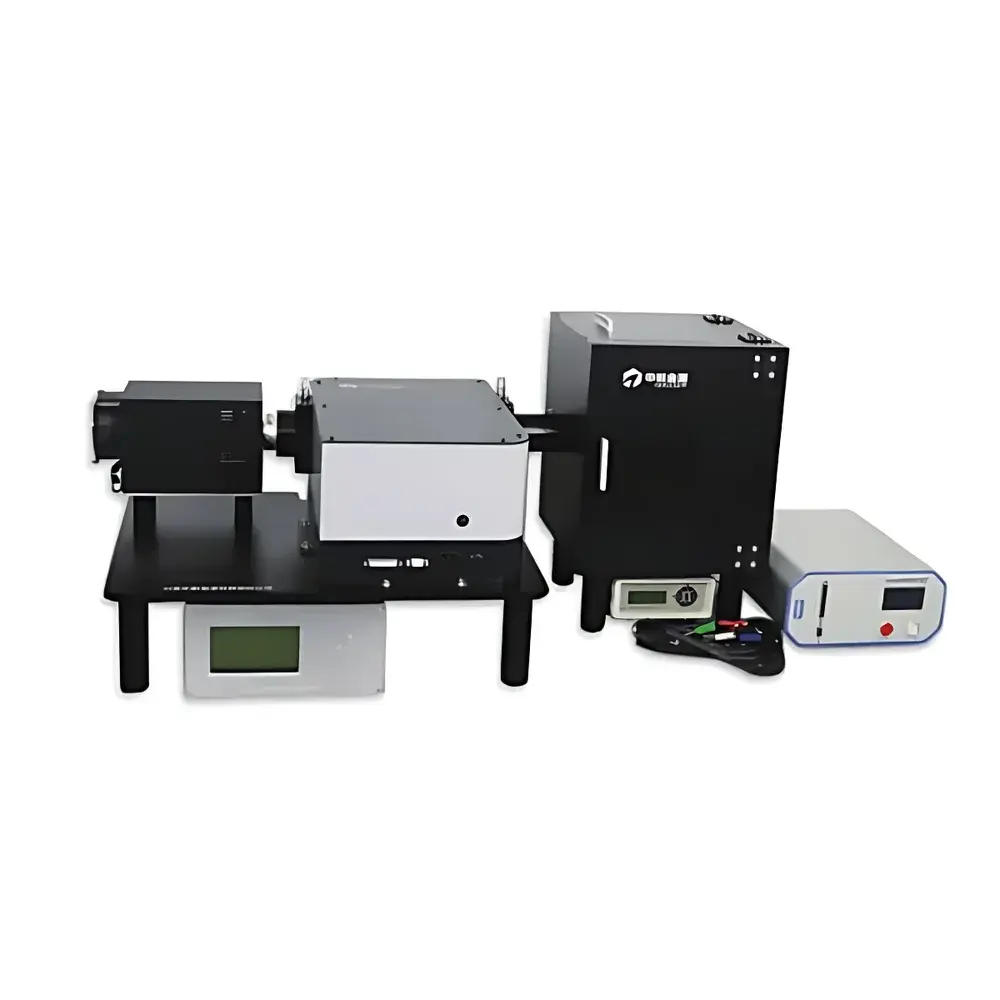
Photoelectrochemical Testing Solution by CEAULIGHT
| Brand | CEAULIGHT |
|---|---|
| Origin | Beijing, China |
| Manufacturer Type | OEM Manufacturer |
| Product Category | Domestic |
| Model | Photoelectrochemical Testing Solution |
| Pricing | Available Upon Request |
| Light Source Type | Tunable Monochromatic Xenon-Based Light Source |
| Illumination Mode | External Irradiation |
| Key Configurations | CEL-SLA (2.00 mW/cm²), CEL-SLF (10.00 mW/cm²), CEL-SLB (200.00 mW/cm²) |
| Spectral Range | 200–1600 nm |
| Bandwidth (FWHM) | 1–20 nm (adjustable) |
| Compatible Lamps | Xenon (CEL-HX, CEL-S500, CEL-S150), Deuterium, Tungsten-Halogen, Mercury |
| Primary Applications | Photoelectrochemistry, IPCE/ABPE Quantum Yield Analysis, Electrochemical Impedance Spectroscopy (EIS) under Illumination, Transient Photocurrent/Photovoltage Measurement |
Overview
The CEAULIGHT Photoelectrochemical Testing Solution is an integrated optical-electrochemical instrumentation platform engineered for quantitative, wavelength-resolved characterization of photoactive materials and devices. It operates on the principle of controlled monochromatic irradiation coupled with synchronized electrochemical measurement—enabling precise determination of incident photon-to-current efficiency (IPCE), absorbed photon-to-current efficiency (ABPE), action spectra, and wavelength-dependent charge transfer kinetics. The system leverages high-stability xenon arc lamps as broadband excitation sources, combined with precision grating monochromators or interference filter-based spectral selection modules to deliver tunable, narrowband illumination across the deep ultraviolet (200 nm) to near-infrared (1600 nm) spectrum. Unlike fixed-wavelength LED arrays or broadband-filtered setups, this solution provides continuous spectral scanning capability with defined full-width-at-half-maximum (FWHM) bandwidths (1–20 nm), ensuring rigorous compliance with ASTM E2583 (Standard Test Method for Spectral Responsivity Measurements of Photovoltaic Devices) and ISO 17025 traceability requirements for spectral irradiance calibration.
Key Features
- Modular architecture supporting interchangeable light engines: CEL-S500 solar-simulating xenon lamp, CEL-HXF300 high-intensity xenon lamp, and filter-based CEL-SLB configuration for high-flux static-wavelength applications.
- Real-time spectral stability monitoring via integrated reference photodiode and NIST-traceable radiometric calibration certificates for each lamp–monochromator combination.
- External irradiation geometry optimized for compatibility with standard three-electrode electrochemical cells (e.g., quartz cuvettes, optically transparent electrode cells, gas-tight PEC reactors), minimizing thermal load and enabling simultaneous in situ spectroelectrochemical measurements.
- Motorized wavelength scanning with programmable step resolution (0.1 nm minimum), dwell time control (10 ms–60 s), and automated shutter synchronization to eliminate dark-current artifacts during electrochemical acquisition.
- Rugged mechanical design with air-cooled lamp housings, vibration-damped optical mounts, and EMI-shielded power supplies to ensure long-term operational reproducibility in shared laboratory environments.
Sample Compatibility & Compliance
The system accommodates a broad range of photoelectrode configurations including FTO-, ITO-, or Au-coated conductive substrates; powder slurries deposited on conductive glass; thin-film metal oxides (e.g., TiO₂, BiVO₄, Fe₂O₃); perovskite heterostructures; and molecular catalyst-modified electrodes. All optical components comply with ISO 9022-3 (Environmental testing — Optics and optical instruments) for humidity and temperature resilience. Electrical interfaces meet IEC 61010-1 safety standards for laboratory measurement equipment. Data acquisition protocols support 21 CFR Part 11-compliant audit trails when used with validated third-party potentiostats (e.g., BioLogic SP-300, Metrohm Autolab PGSTAT302N) and optional electronic signature modules.
Software & Data Management
CEAULIGHT’s proprietary LightControl Suite (v4.2+) provides native integration with common electrochemical workstations via TCP/IP or USB-VCP protocols. It enables synchronized triggering of light wavelength sweeps and potentiostat data capture, automatic background subtraction using dark-reference scans, and real-time IPCE calculation using the formula: IPCE(λ) = (1240 × Jph(λ)) / (λ × Pin(λ)), where Jph is photocurrent density (A/cm²), λ is wavelength (nm), and Pin is incident monochromatic irradiance (W/cm²). Export formats include CSV, HDF5, and MATLAB .mat for downstream analysis in Origin, Python (SciPy/Pandas), or MATLAB. Raw spectral irradiance datasets are archived with embedded metadata (lamp hours, grating position, slit width, calibration date) to satisfy GLP documentation requirements.
Applications
- Quantitative action spectrum mapping of photoanodes and photocathodes for solar fuel generation.
- Wavelength-dependent electrochemical impedance spectroscopy (EIS) to deconvolute bulk, interface, and catalytic charge-transfer resistances.
- Time-resolved photocurrent transient analysis under chopped monochromatic illumination to extract carrier lifetime and recombination order.
- Calibration of quantum efficiency standards for UV–Vis–NIR spectroradiometers and reference solar cells.
- Development and validation of multi-junction photoelectrochemical devices requiring spectral mismatch correction.
FAQ
What spectral calibration standards are provided with the system?
Each configured light engine includes a NIST-traceable spectral irradiance calibration report (±3% uncertainty, 200–1600 nm), measured using a calibrated CCD spectroradiometer and corrected for monochromator throughput and lamp aging.
Can the system be integrated with rotating disk electrode (RDE) or scanning electrochemical microscopy (SECM) setups?
Yes—external TTL trigger inputs and analog voltage outputs allow hardware-level synchronization with RDE motor controllers and SECM positioning systems for spatially resolved photoelectrochemical mapping.
Is ozone generation a concern when operating below 220 nm?
The CEL-SLA and CEL-SLF configurations include optional ozone-scrubbing quartz envelopes and active ventilation ports compatible with standard lab fume hood exhaust systems.
How is spectral bandwidth (FWHM) verified and maintained over time?
Bandwidth verification is performed quarterly using a mercury-argon emission line source (e.g., Hg-Ar pen lamp), with automated reporting in LightControl Suite; grating alignment drift is compensated via factory-calibrated encoder feedback.
Does the system support automated IPCE mapping across multiple bias potentials?
Yes—LightControl Suite supports nested experimental protocols: wavelength sweep at user-defined DC bias steps (e.g., from –0.5 V to +1.2 V vs. RHE), with automatic normalization to reference cell response and export of 3D (λ, V, IPCE) datasets.




