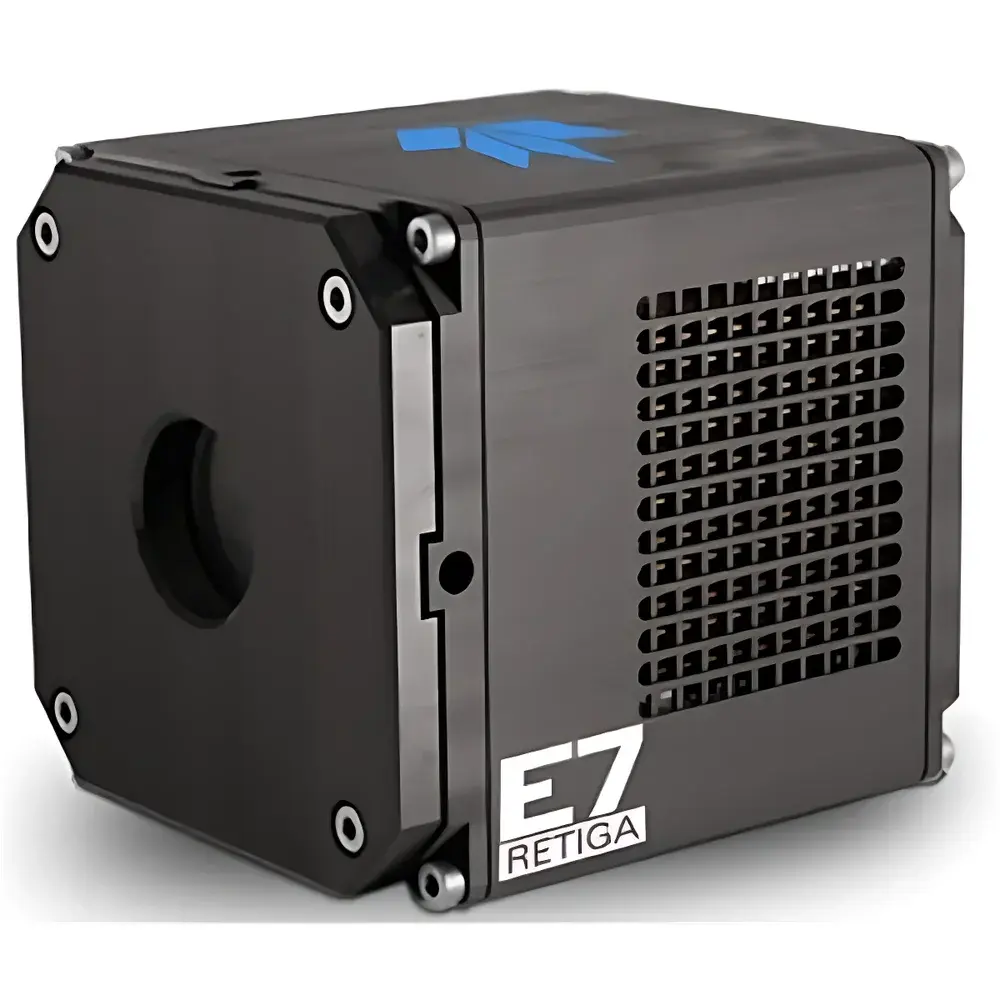
Photometrics RETIGA E Series Cooled Low-Noise CMOS Camera
| Brand | Teledyne Photometrics |
|---|---|
| Origin | USA |
| Model | RETIGA E7 / RETIGA E20 |
| Sensor Resolution | 7.1 MP (RETIGA E7) / 20.4 MP (RETIGA E20) |
| Read Noise | <2.1 e⁻ (typ.) |
| Dark Current | ≤0.001 e⁻/pix/s (E7) / ≤0.003 e⁻/pix/s (E20) |
| Cooling Temperature | −25 °C |
| Interface | USB 3.2 Gen 1 |
| Software Support | PVCam™ API, SDK for Python/C++/LabVIEW/MATLAB |
| Compliance | CE, FCC, RoHS |
Overview
The Photometrics RETIGA E Series represents a foundational advancement in scientific CMOS imaging—engineered specifically for applications demanding high-fidelity signal capture under extended integration times. Unlike conventional CMOS sensors limited by thermal noise accumulation, the RETIGA E Series leverages proprietary vacuum-sealed thermoelectric cooling and deep-pixel architecture to achieve dark current levels as low as 0.001 e⁻/pix/s at −25 °C. This performance bridges the historical gap between CCD-based long-exposure systems and modern CMOS speed, enabling quantitative imaging across exposure durations from seconds to 60 minutes without significant thermal signal degradation. The platform operates on the principle of photon-limited detection, where signal-to-noise ratio (SNR) is governed primarily by photon shot noise, read noise, and dark current—parameters rigorously optimized in both the RETIGA E7 (7.1 MP) and RETIGA E20 (20.4 MP) variants. Designed for OEM integration and core laboratory instrumentation, the series serves as a drop-in replacement for legacy CCD-based platforms in fluorescence microscopy, chemiluminescence detection, DNA gel documentation, and low-light Western blot analysis.
Key Features
- Vacuum-sealed cold chamber with active thermoelectric cooling to −25 °C, eliminating condensation and ensuring long-term sensor stability
- Ultra-low dark current: ≤0.001 e⁻/pix/s (RETIGA E7) and ≤0.003 e⁻/pix/s (RETIGA E20) — validated per ISO 15739:2013 methodology
- Read noise <2.1 e⁻ RMS (typ.) at full well capacity, maintained across all gain modes and frame rates
- High quantum efficiency (>80% peak QE) with back-illuminated sensor architecture
- Compact, fanless mechanical design (110 × 110 × 75 mm) compliant with standard optical breadboard and microscope mounting interfaces
- USB 3.2 Gen 1 interface with deterministic latency and hardware-triggered acquisition support (TTL input/output)
Sample Compatibility & Compliance
The RETIGA E Series supports monochrome and color variants (E20-C) for both transmission and emission-based modalities, including widefield epifluorescence, trans-illumination chemiluminescence, and UV-excited nucleic acid visualization. Its dynamic range exceeds 85 dB (E7) and 82 dB (E20), enabling linear response across intensities typical of stained gels, immunoblots, and low-expression fluorescent reporters. All models are certified to IEC 61000-6-3 (EMI) and IEC 61000-6-2 (immunity), with CE marking confirming conformity to EU Medical Device Regulation (MDR) Annex I essential requirements for ancillary imaging components. While not classified as an in vitro diagnostic device, the camera meets key elements of ISO 13485-aligned manufacturing controls and supports audit-ready metadata logging required for GLP-compliant workflows.
Software & Data Management
Control and integration are enabled through the PVCam™ Application Programming Interface—a vendor-supported, cross-platform driver stack compliant with NIH ImageJ/Fiji, Micro-Manager, and commercial OEM software frameworks. The SDK includes native bindings for Python (via PyPVCam), C++, LabVIEW (NI-DAQmx compatible), and MATLAB (Image Acquisition Toolbox). All acquisitions embed EXIF-compliant metadata: timestamp (UTC), exposure time, temperature, gain, binning, and sensor ROI coordinates. Audit trail functionality—including user ID, parameter change history, and firmware version—is available via optional logging modules, supporting alignment with FDA 21 CFR Part 11 electronic record requirements when deployed in regulated environments.
Applications
- Long-integration chemiluminescent detection in Western blotting and ELISA validation
- Low-light fluorescence imaging of live-cell reporters with minimal phototoxicity
- DNA/RNA gel documentation under UV or blue-light excitation
- OEM integration into automated electrophoresis stations and microplate readers
- Time-lapse cytology requiring stable SNR over multi-hour acquisitions
- Quantitative protein expression analysis using near-infrared dyes (e.g., IRDye®)
FAQ
What is the maximum recommended exposure time for quantitative linearity?
For optimal photometric accuracy, exposures up to 3600 seconds (60 min) are supported; however, linearity deviation remains <1% up to 1800 s under −25 °C operation.
Does the RETIGA E Series support hardware synchronization with external light sources?
Yes—dual TTL inputs (exposure trigger, frame sync) and outputs (exposure active, frame valid) enable precise coordination with LED shutters, laser pulsers, and motorized stages.
Is sensor calibration data provided with each unit?
Each camera ships with factory-measured flat-field, dark-frame, and pixel-response non-uniformity (PRNU) correction maps, accessible via PVCam™ API for real-time correction.
Can the camera be operated in triggered rolling-shutter mode?
No—RETIGA E models use global shutter architecture exclusively, eliminating motion artifacts and ensuring spatial fidelity across all exposure durations.
How is firmware updated, and is version rollback supported?
Firmware updates are performed via PVCam™ Utility; full version history and signed rollback packages are retained for GxP traceability.