
Photon Systems Instruments FluorPen FP 100 Fixed Transparent Leaf Clip Handheld Chlorophyll Fluorometer
| Origin | Czech Republic |
|---|---|
| Manufacturer Type | Authorized Distributor |
| Origin Category | Imported Instrument |
| Model | FluorPen FP 100 Fixed Transparent Leaf Clip |
| Price | Upon Request |
| Measurement Principle | Modulated Chlorophyll Fluorescence (PAM-based) |
| Time Resolution | 10 µs (100,000 measurements/sec) |
| Fluorescence Detection Range | 697–750 nm |
| Excitation Wavelength | 470 nm (blue LED), optional multi-wavelength LED modules available |
| PAR Sensor Range | 400–700 nm, resolution 1 µmol(photon)·m⁻²·s⁻¹ |
| Data Storage | 4 MB internal memory (≥100,000 data points) |
| Dimensions | 120 × 57 × 30 mm |
| Weight | 180 g |
| Power Supply | 4 × AAA batteries (70 h continuous operation) |
| Operating Temperature | 0–55 °C |
| Relative Humidity | 0–95% RH (non-condensing) |
| Communication | USB or Bluetooth (optional) |
| GPS Module | Optional, time-stamped and georeferenced output |
Overview
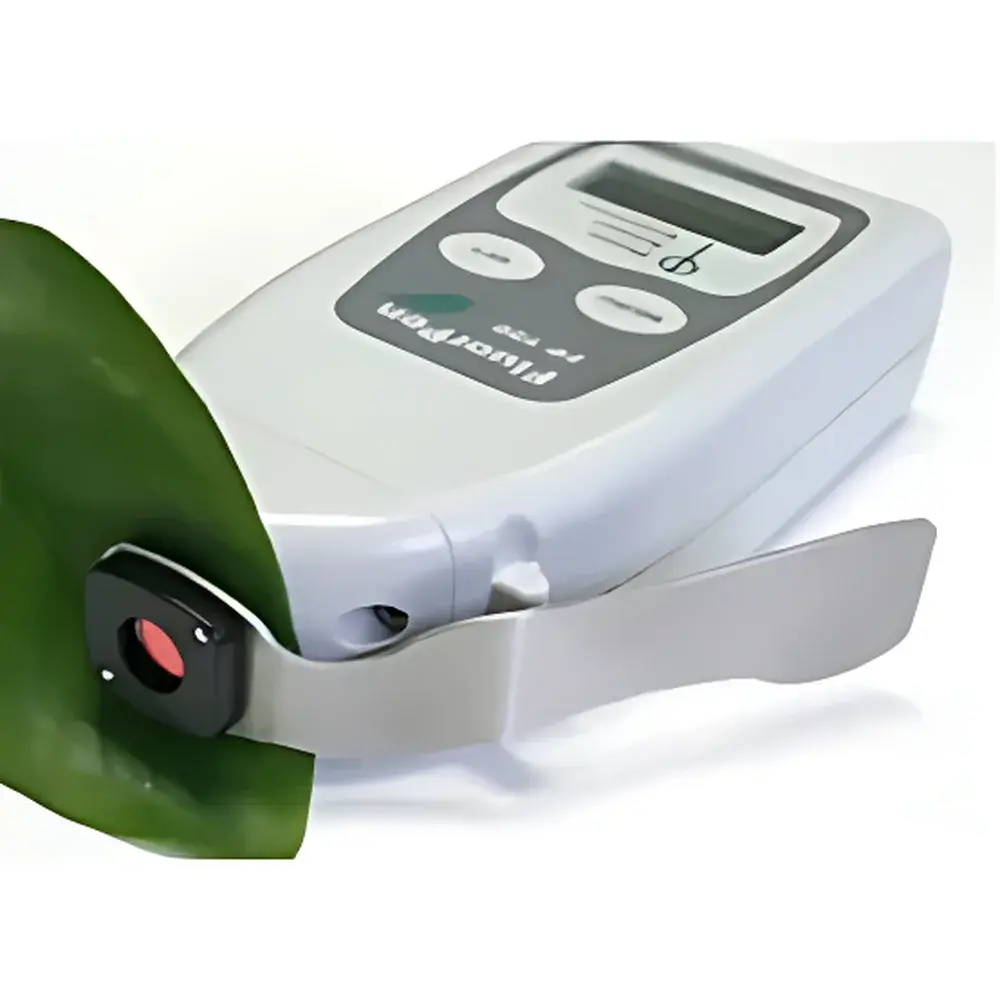
The Photon Systems Instruments FluorPen FP 100 Fixed Transparent Leaf Clip is a field-deployable, high-resolution chlorophyll fluorometer engineered for quantitative, non-invasive assessment of photosynthetic performance in vivo. It operates on the principle of pulse-amplitude modulated (PAM) chlorophyll fluorescence, enabling precise discrimination between photochemical and non-photochemical quenching processes within Photosystem II (PSII). Unlike conventional chlorophyll meters that estimate pigment concentration via absorbance, the FluorPen FP 100 measures dynamic fluorescence kinetics—including transient OJIP curves, light-response curves, and fluorescence quenching parameters—providing direct physiological insight into electron transport efficiency, photoinhibitory status, and stress-induced metabolic perturbations. Its fixed transparent leaf clip design allows real-time measurement under ambient illumination without prior dark adaptation, making it uniquely suited for diurnal monitoring, rapid screening, and longitudinal field studies where experimental throughput and ecological relevance are critical.
Key Features
- Integrated optical architecture: Compact, palm-sized housing (120 × 57 × 30 mm) houses blue LED excitation source (470 nm), PIN photodiode detector with 697–750 nm bandpass filter, PAR sensor, and embedded microcontroller—all calibrated to ISO/IEC 17025 traceable standards.
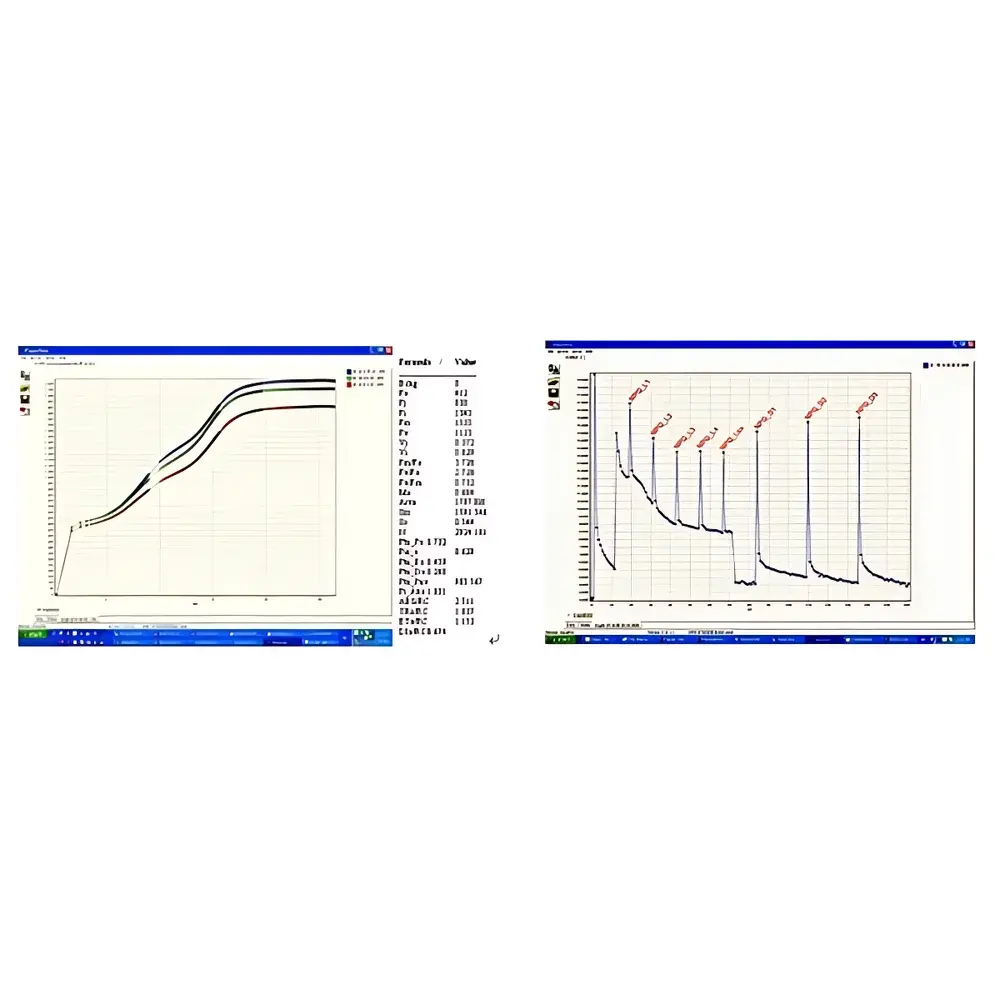
- Ultra-high temporal resolution: 10 µs sampling interval enables reconstruction of the full OJIP transient (0.05 ms to 1 s), yielding 26 biophysically validated parameters including F0, Fj, Fi, Fm, Vj, Mo, Area, Sm, PIAbs, ABS/RC, TR0/RC, and ETR0/RC.
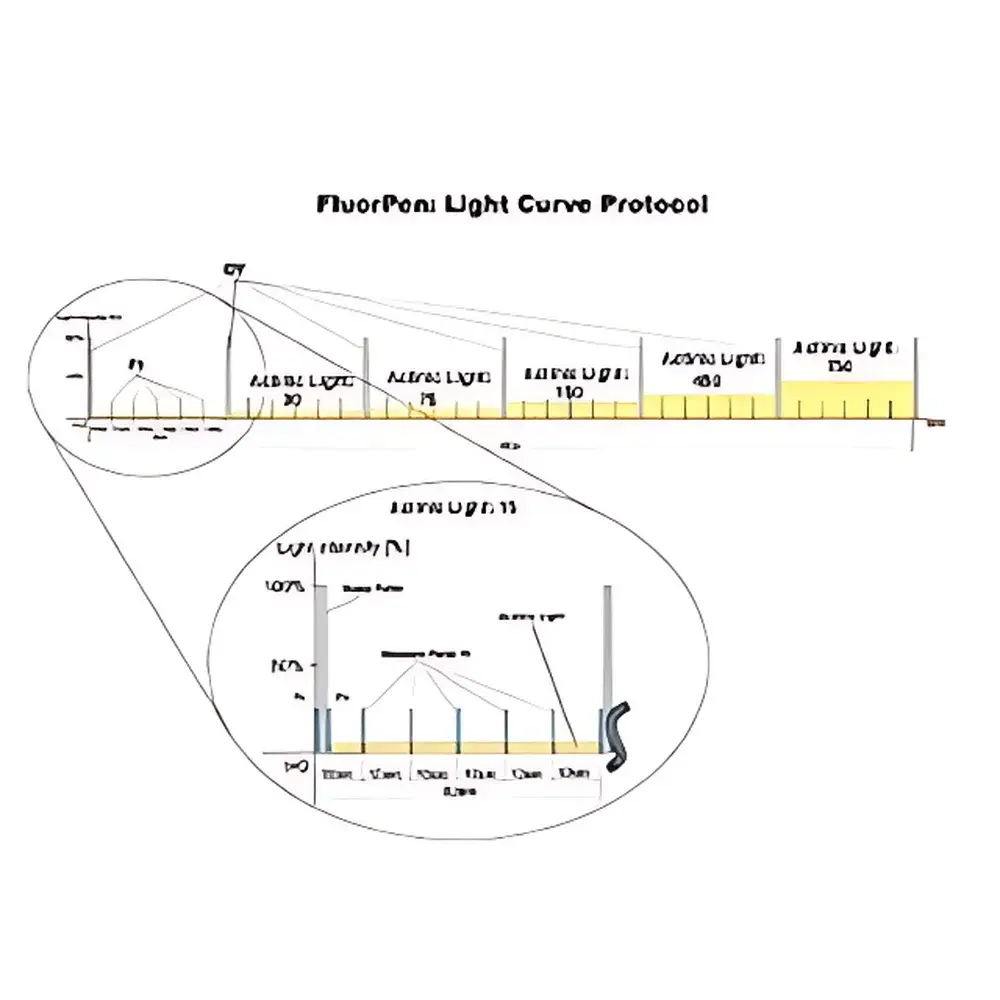
- Preloaded standardized protocols: Three programmable light-response curve routines (including rapid light curves and steady-state acclimation), two fluorescence quenching analysis modes (NPQ and qP), and full OJIP-test implementation compliant with the JIP-test formalism (Strasser et al., 2004).
- On-device data management: 4 MB flash memory stores >100,000 timestamped parameter sets; dual-button interface with 2×8 character LCD supports field navigation, real-time parameter display (e.g., QYII, NPQ, Rfd), and automatic PAR averaging over 20 sequential readings.
- Modular connectivity: Optional Bluetooth 4.2 or USB 2.0 interface enables wireless or wired synchronization with FluorPen Professional Software v5.x for remote triggering, batch download, statistical export (CSV, Excel), and GLP-compliant audit trail generation.
Sample Compatibility & Compliance
The fixed transparent leaf clip (standard configuration) accommodates leaves up to 3 mm thick with minimal compression, preserving natural stomatal conductance and mesophyll gas exchange during measurement. Its quartz-transmissive design ensures uniform photon delivery across the measured area while permitting concurrent incident PAR monitoring—critical for calculating light-use efficiency (ΦPSII) under variable irradiance. The instrument meets IEC 61326-1:2013 for electromagnetic compatibility and is validated per ASTM E2912-21 (Standard Practice for Chlorophyll Fluorescence-Based Plant Stress Assessment). All firmware and software comply with FDA 21 CFR Part 11 requirements for electronic records and signatures when used in regulated agricultural research or environmental biomonitoring contexts.
Software & Data Management
FluorPen Professional Software provides a validated platform for post-acquisition analysis, supporting multi-sample comparative visualization of OJIP kinetics, NPQ relaxation kinetics, and light-saturation responses. It generates GLP-compliant reports with embedded metadata (operator ID, location, calibration date, instrument serial number), supports user-defined calculation templates (e.g., stress indices ΔF/Fm, ΦNPQ), and exports raw fluorescence traces in ASCII format for third-party modeling (e.g., MATLAB, R, Python). When paired with the optional GPS module, all datasets include WGS84 coordinates and UTC timestamps, enabling GIS-integrated spatial mapping of photosynthetic heterogeneity across field plots or forest canopies.
Applications
- Photosynthetic phenotyping: High-throughput screening of crop germplasm for drought, heat, or salinity tolerance via early detection of PSII damage (e.g., decreased Fv/Fm, increased Mo, reduced PIAbs).
- Agrochemical efficacy testing: Quantification of herbicide mode-of-action (e.g., DCMU-induced inhibition of electron transport) through time-resolved NPQ suppression and QYII collapse.
- Ecotoxicology and biomonitoring: Identification of bioindicator species responsive to soil heavy metals or aquatic pollutants using dose-dependent fluorescence signature shifts (e.g., altered OJIP shape, elevated F0).
- Molecular plant physiology: Validation of gene-editing outcomes (e.g., CRISPR knockouts of photoprotective proteins) via functional characterization of non-photochemical quenching capacity.
- Forestry and conservation biology: In situ assessment of canopy-level photoinhibition gradients in response to canopy thinning, air pollution exposure, or climate-driven phenological mismatches.
FAQ
What distinguishes the fixed transparent leaf clip from other clip types?
The fixed transparent clip eliminates the need for dark adaptation by allowing simultaneous measurement of fluorescence yield and incident PAR under natural light, enabling true diurnal tracking of PSII operating efficiency (ΦPSII) without interrupting plant physiology.
Can the FluorPen FP 100 be used for long-term unattended monitoring?
Yes—when configured with the optional weatherproof FluorPen Field Station variant (IP67-rated enclosure, solar-rechargeable battery, SD card logging), it supports autonomous deployment for up to 30 days with programmable measurement intervals.
How is calibration maintained across field deployments?
Each unit ships with NIST-traceable reference standards for both fluorescence intensity and PAR irradiance; users perform daily zero-point checks using the built-in dark reference shutter and validate spectral response annually via certified calibration service.
Is the OJIP analysis compliant with peer-reviewed methodology?
Yes—the instrument implements the Strasser–Tsimilli–Srivastava (JIP-test) formalism as published in *Photosynthesis Research* (2004, Vol. 79, pp. 209–223) and is cited in >120 ISI-indexed publications validating its use in stress physiology and systems biology.
Does the software support regulatory submission workflows?
FluorPen Professional Software v5.x includes 21 CFR Part 11-compliant user access controls, electronic signature capture, immutable audit logs, and version-controlled protocol templates—fully auditable for submissions to EPA, EFSA, or OECD guideline studies.




